Public services
An ambulance waits outside the Lady Sybil Free Hospital with its patient still inside, because there is no trolley free in the hall to put her on. The crew have been waiting for two hours. They know the hall well by now, and have opinions about the paintwork.
A call comes in from the Shades that this ambulance would have answered. Another ambulance answers it, from the far side of the river, by way of Misbegot Bridge.
Hours at the door
In June 2026 the NHS in England began counting corridor care, meaning patients who spent at least 45 minutes somewhere in a hospital that was never meant for patients. On an average day the first count found more than 2,200 of them in emergency departments alone. That September the ambulances of the West Midlands spent some 32,800 hours parked outside hospitals with patients in the back, and one handover at Royal Stoke took seventeen hours and forty-one minutes.
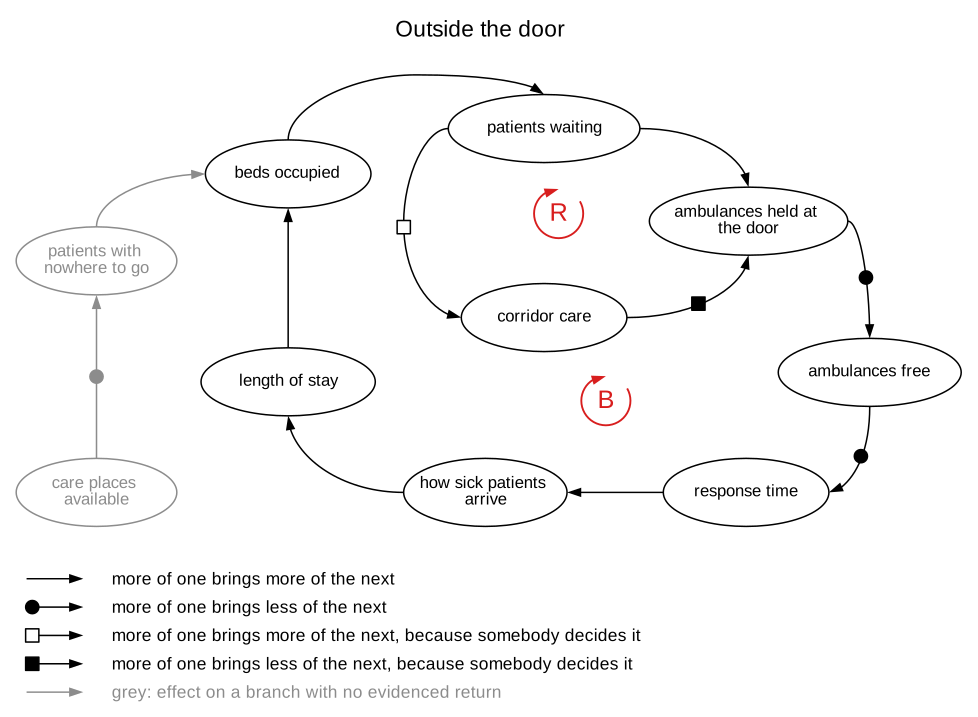
An ambulance at the door is an ambulance not on the road, so the next patient waits longer for it. A patient who waits longer usually arrives sicker, stays longer, and takes a bed for longer, which leaves the hall fuller for the ambulance behind. The hall fills because the wards are full, and the wards are full partly because patients well enough to leave have nowhere to be cared for when they do.
Corridor care is the hospital’s answer. It moves the patients from the ambulance into the corridor, which frees the ambulance and keeps the patient exactly where she was, only indoors. Dr Lawn calls it ward 0, and has asked the board twice to give it a nurse.
At the Lady Sybil, Igor has a spare of everything, including, it is rumoured, a spare corridor. Nobody has asked where he keeps it. Staffing it is another matter.
Click to enlarge.
The two loops
Reinforcing (R):
more patients waiting -> more ambulances held at the door -> fewer ambulances free -> a slower response -> sicker patients on arrival -> longer stays -> more beds occupied -> more patients waiting
Balancing (B):
more patients waiting -> more corridor care -> fewer ambulances held at the door -> more ambulances free -> a faster response -> patients arrive less sick -> shorter stays -> fewer beds occupied -> fewer patients waiting
The remedy
corridor care, decided by the hospital: fewer ambulances held at the door, and patients waiting indoors instead of outside. It needs nurses the hospital does not have. The Palace can press the board for a nurse on ward 0, and pay for her.
The note was for the university
In September 2020 attackers encrypted some thirty servers at the university hospital in Duesseldorf. Their ransom note was addressed to the university. When the police told them they had hit a hospital, they withdrew the demand and handed over the key, and were never heard from again.
The hospital had already withdrawn from emergency care. A critically ill woman who would have been brought to it was taken to Wuppertal instead, where her treatment began an hour later, and she died. Prosecutors opened an investigation into negligent homicide, and later dropped it.
In London in June 2024 ransomware hit Synnovis, the company that ran the pathology for several hospitals in the south-east of the city. The hospitals went back to doing blood tests by hand. Unable to match blood types quickly, they used the universal type, and the national blood service appealed for O-type donors across England. More than 10,000 outpatient appointments and some 1,700 operations were put off. A patient who died during the attack had waited a long time for a blood result, one of the factors in the death.
Ireland’s health service had already learned the full version in May 2021, when the Conti gang encrypted most of its computers and the service switched everything off. The attackers had been inside for eight weeks. They too handed over the key, after a public outcry, and the recovery still took months and cost the service about €100 million.
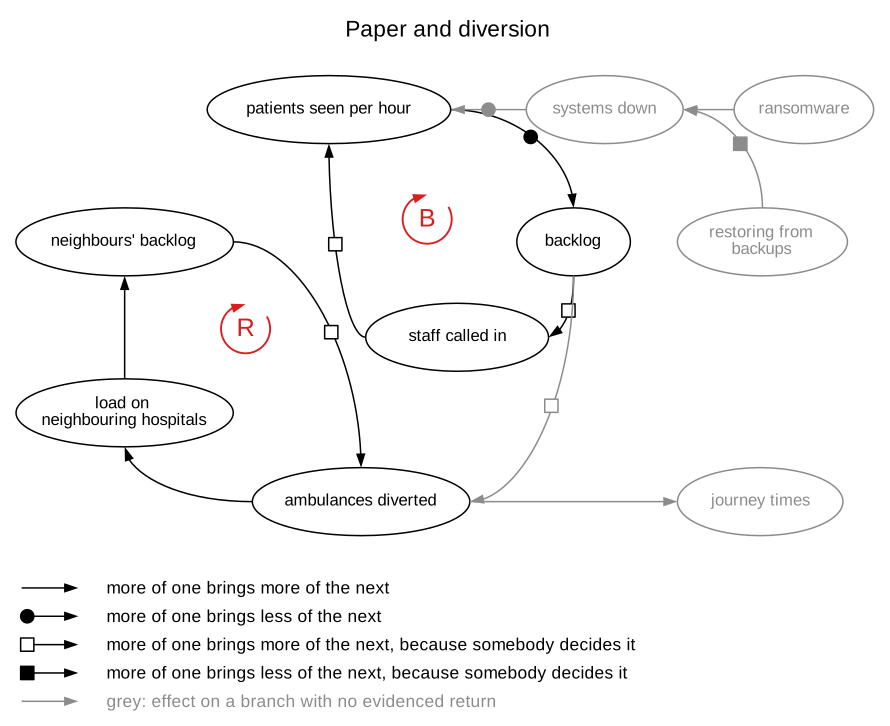
A hospital that cannot see its records sees fewer patients an hour, and a hospital with a backlog diverts its ambulances to the neighbours. The neighbours had their own queue before the diverted ambulances arrived, and before long they are diverting too. The diverted patients spend the difference on the road, as the woman from Duesseldorf did.
Click to enlarge.
The two loops
Reinforcing (R):
more ambulances diverted -> more load on neighbouring hospitals -> a bigger neighbours’ backlog -> more ambulances diverted
Balancing (B):
a bigger backlog -> more staff called in -> more patients seen per hour -> a smaller backlog
The three remedies
restoring from backups, done by the hospital: systems back up, if the backups were kept somewhere the attackers did not reach. It takes days at best.
staff called in, decided by the hospital: more patients seen per hour, from staff who were resting for the next shift.
ambulances diverted, decided by the hospital: a shorter queue at its own door and a longer one at the neighbours’. The Palace can ask the neighbours to take them, and the neighbours can ask the Palace who will take theirs.
Nobody calls the Watch
In the Shades, a burglary reported to the Watch is a burglary investigated eventually, by which time the burglar has retired. People in the Shades have stopped reporting burglaries. The figures for the Shades accordingly show very little crime, and the city’s treasurers, who fund the Watch by the figures, have moved the watchmen to districts with more crime to fight.
Funding the Watch by the figures is the Palace’s own rule, and the Palace can break it. Watchmen sent to the Shades whatever the figures say cost the treasury money it can see, to prevent crime it cannot, which is the kind of spending treasurers like least and Vimes likes best.
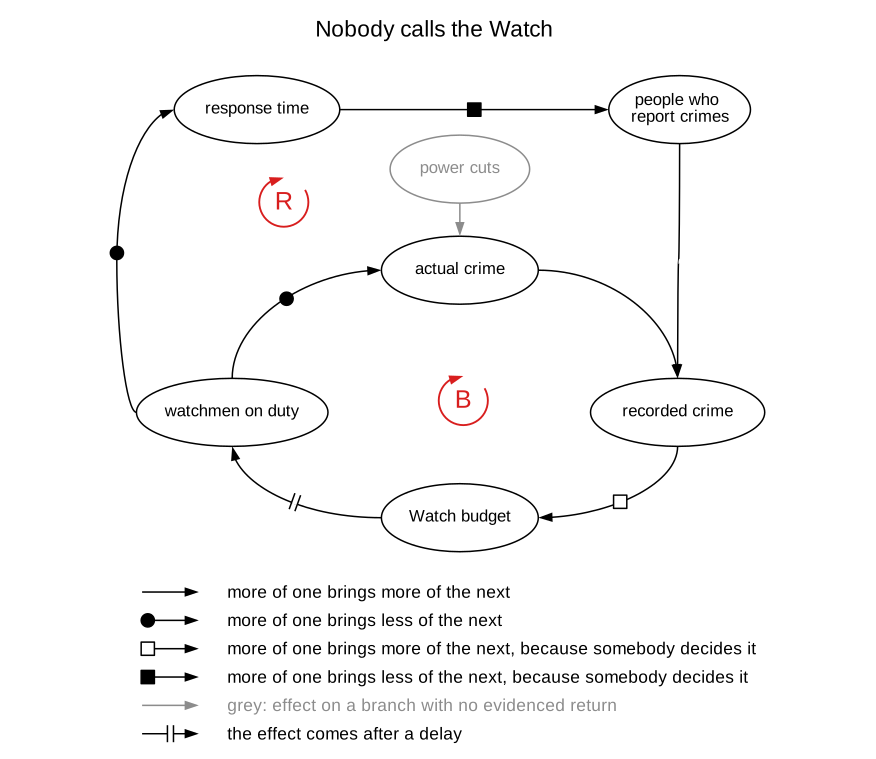
A slower Watch hears about less, a Watch that hears about less is given less, and a Watch that is given less is slower. Commander Vimes regards the arrangement as a perfect machine for producing quiet streets on paper.
There is one way out, and it is unpleasant. Fewer watchmen leave more actual crime, and eventually there is so much of it that even the Shades start reporting, the figures rise, and the money comes back. A blackout speeds this up, since dark streets are good for business in some trades.
Click to enlarge.
The two loops
Reinforcing (R):
a slower response -> fewer people who report crimes -> less recorded crime -> a smaller Watch budget -> fewer watchmen on duty, after a delay -> a slower response
Balancing (B):
fewer watchmen on duty -> more actual crime -> more recorded crime -> a bigger Watch budget -> more watchmen on duty, after a delay
The remedy
the Watch budget, set by the Palace’s treasurers: more watchmen on duty, after a delay. Set by the figures, it follows the quiet streets down. Set by Vimes, it costs money and saves crime nobody counts.
After the inquiry
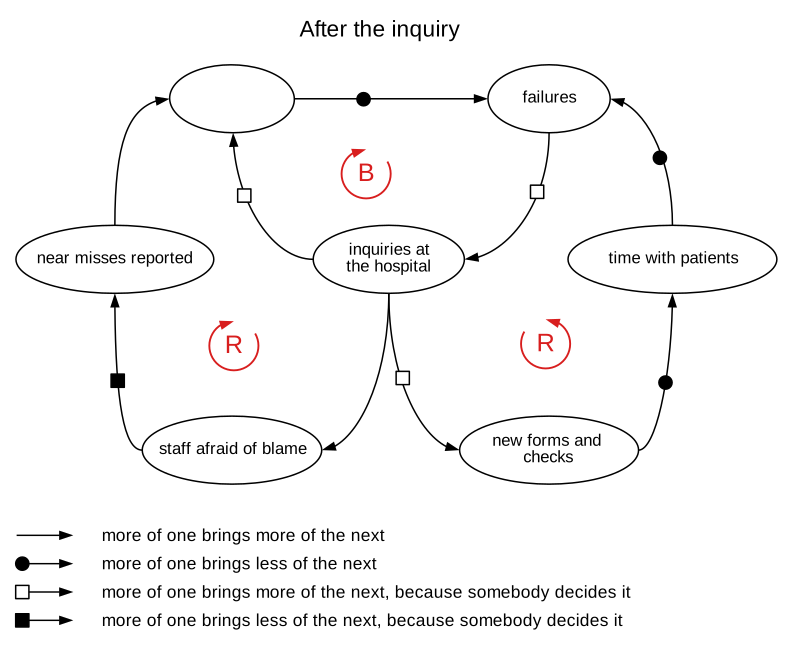
When something goes badly wrong at the Lady Sybil, there is an inquiry, and Mr Slant of the Guild of Lawyers attends it, as he has attended every inquiry in the city for the last three hundred years. The inquiry finds that procedures were not followed and recommends more of them. Every recommendation becomes a form, and every form takes a few minutes of a nurse away from a patient. The next failure happens in those minutes.
Inquiries also teach. A failure that is understood is less likely to happen twice, and the best teacher is the near miss, the mistake caught just in time and written down by the person who nearly made it. People write those down when they feel safe doing so. After an inquiry that ends with somebody’s name in the newspaper, fewer people feel safe, the near misses go unreported, and the hospital learns less from the mistakes it nearly made than from the ones it made.
The forms are the one thing every inquiry can be sure of producing. Drumknott files them, in triplicate, and has never once been asked to produce one.
Click to enlarge.
The three loops
Reinforcing (R):
more failures -> more inquiries at the hospital -> more new forms and checks -> less time with patients -> more failures
more failures -> more inquiries at the hospital -> more staff afraid of blame -> fewer near misses reported -> fewer lessons learned -> more failures
Balancing (B):
more failures -> more inquiries at the hospital -> more lessons learned -> fewer failures
The remedy
an inquiry at the hospital, called by the hospital board: lessons learned and new forms, in proportions decided mostly by whether anybody’s name reaches the Times. Calling one costs nothing at once and buys time. Not calling one costs political capital the next morning.
Everyone else’s emergency
Every other system in the city fails into the public services. A boil notice brings the sick to the hospital, a blackout brings the cold and the frightened, a closed bridge keeps the nurses on the wrong bank, and a silent clacks leaves the Watch guessing. None of those failures has to wait for a bed. All of them arrive at the same door.
The city is getting older, more of its patients have several things wrong with them at once, and each year’s budget is set by last year’s demand. A service that can refuse nobody will always look, on paper, like the most expensive thing in the city, right up to the day it has to refuse somebody.
Last year’s figures
Imagined conversation with Lord Vetinari.
Lord Vetinari: “The hospital is funded for last year’s emergencies, Drumknott, which were very well behaved. This year’s have not read the budget.”