Water and sanitation
A pump fails in the Shades, and nobody reports it for three days. The Shades notice at once. Reporting it is another matter, since the people who would report it have learned what usually happens next. Nothing happens, and then somebody comes round to ask who complained.
Nap Hill notices nothing. Nap Hill is uphill, on a different main, and has never in its history carried water up a staircase.
Real towns can fail just as quietly. In Brixham, in Devon, in May 2024, the parasite Cryptosporidium got into the drinking water through an air valve in a farmer’s field, a valve that was faulty, exposed and covered in mud. The town boiled its kettles for eight weeks and hundreds of people reported being ill. The fine, two years later, was a record. The valve had been in the field the whole time.
The river provides
Ankh-Morpork takes its water from the Ankh, a river that has usually been drunk at least once before it reaches the city, and which the city then improves by adding to it. Turning it into something that can go in a kettle takes treatment, and treatment takes chemicals that arrive on carts from somebody else’s factory. Pushing it up to the taps takes pumps, and the pumps take power. Somebody has to watch the dials at night. Nobody has ever written a ballad about any of these people.
Out of the other end goes everything the city has finished with. Harry King made his fortune from what the city throws away, and he would point out, if asked, that he relies on the river doing its share. Sewers need water to move anything, so a city without water becomes, within a day or two, a city with a sewer problem.
The Lady Sybil Free Hospital wants water for every dialysis machine, every boiled instrument and every cup of tea drunk between operations, and it wants it now. The university hospital in Heidelberg learned in 2019 what now means, when blue-tinted water came out of its taps and it spent about six hours without drinking water. Dialysis, sterilisation and the kitchens waited for tankers lent by other water companies.
The fire brigade needs pressure in the mains, and so does every brewery in the city. Ankh-Morpork has always been clear about which of the two it would miss first. The sewers, meanwhile, often know about an outbreak a few days before the doctors do, because everybody contributes. The European Urban Wastewater Treatment Directive now has countries sample them when a public health emergency is declared.
A pipe a century
Pipes last a long time. That is the trouble. The ones under the Shades were laid by people whose grandchildren are dead, and on current form they will be replaced by people whose grandparents are not yet born.
France renews about 0.6 per cent of its drinking water network a year, enough to get round the whole of it in some 165 years, and loses about one litre in five on the way to the tap. Europe’s water services, through their federation, call the average renewal rates “far too low to avoid degradation over time”.
A pipe left in the ground costs nothing this year. It costs later, when it bursts, and the burst is paid for out of the money that would have replaced it. A city that patches in a hurry has less to renew at leisure, so next year it patches in a hurry again.
The money is short because the price is low. Water bills in the EU cover about 70 per cent of what the service costs, the rest coming from public budgets, and the OECD found that more than 95 per cent of people in 24 member states could pay more without hardship. Keeping tariffs artificially low for everyone, it wrote, “leads to the vicious cycle of decaying infrastructure and deteriorating services”.
A low price also pays low wages. The people who know which valve is under which cobble grow old in the job, because younger people with the same skills can earn more elsewhere, and in most European countries with figures the water workforce is older than the average across sectors. When they retire, the map of the valves retires with them.
Nobody pays for rain
The Patrician once proposed a water rate. The Shades replied that water falls out of the sky for free. The Patrician agreed, and observed that it is worth exactly that until somebody pipes it. Neither side has moved since.
Ireland tried it for real. Domestic water charges arrived in 2014 with a new national utility, Irish Water, and met mass protest and a refusal to pay. They were suspended in 2016 and abolished in 2017, and the state has paid for the network ever since. Leakage, close to half of all treated water in 2014, still came to about a third in 2025.
The failures kept coming, and each one made the protesters’ case for them. In October 2019 a dosing line blocked at the Leixlip treatment plant near Dublin, four turbidity alarms went unanswered one evening, and some 600,000 people were told to boil their water. The regulator had raised the plant in an audit that March. Later the utility, by then renamed Uisce Eireann, paid its staff bonuses while residents in Cork were out protesting about the colour of what came out of their taps.
A company that people do not trust cannot charge them, and a company that cannot charge them gives them fresh reasons not to trust it. Both sides are right, and that keeps it going.
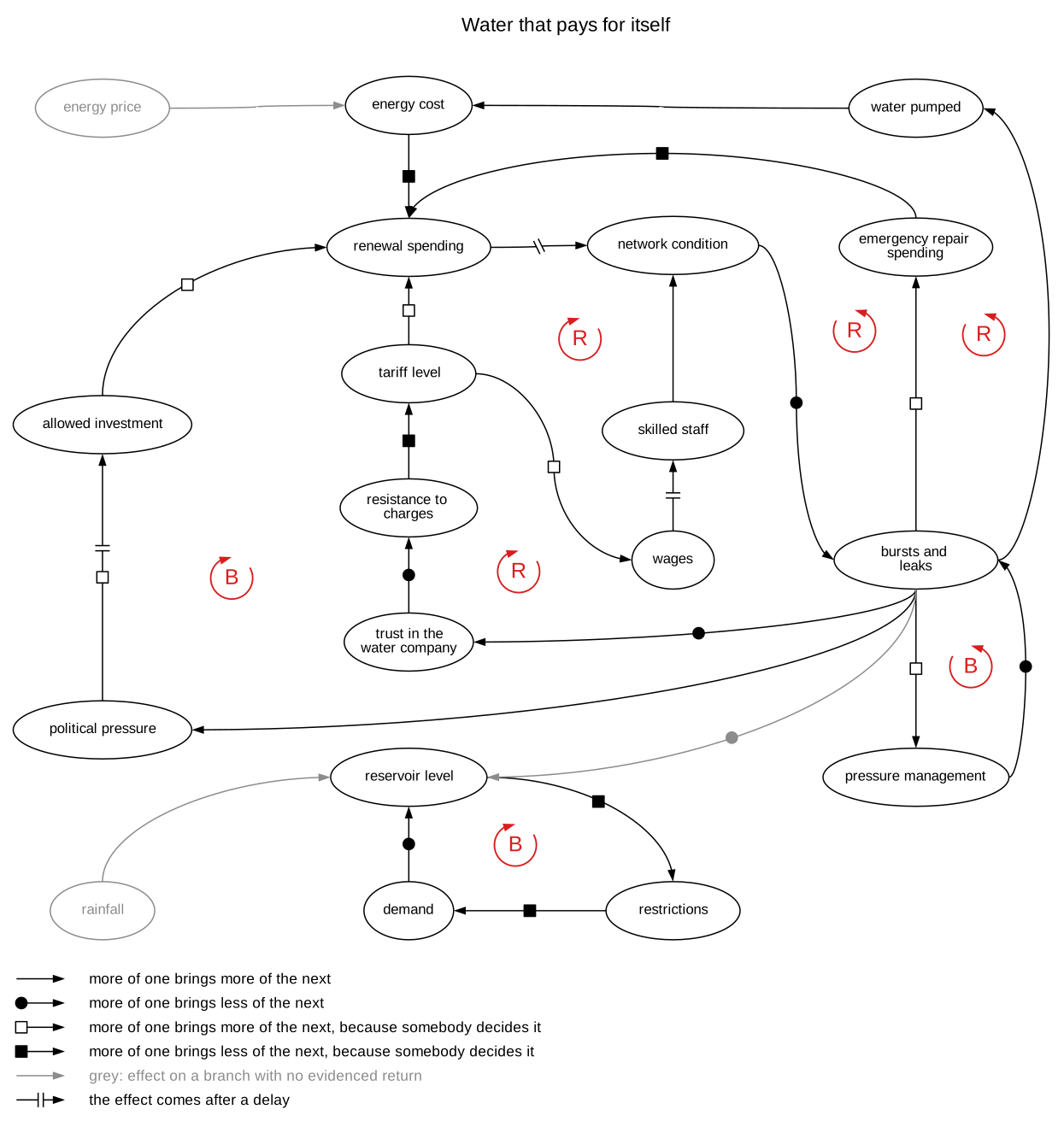
Click to enlarge.
The seven loops
Reinforcing (R):
less renewal spending -> worse network condition, after a delay -> more bursts and leaks -> more emergency repair spending -> less renewal spending
more bursts and leaks -> less trust in the water company -> more resistance to charges -> lower tariff level -> less renewal spending -> worse network condition, after a delay -> more bursts and leaks
more bursts and leaks -> more water pumped -> higher energy cost -> less renewal spending -> worse network condition, after a delay -> more bursts and leaks
more bursts and leaks -> less trust in the water company -> more resistance to charges -> lower tariff level -> lower wages -> fewer skilled staff, after a delay -> worse network condition -> more bursts and leaks
Balancing (B):
more bursts and leaks -> more political pressure -> more allowed investment, after a delay -> more renewal spending -> better network condition, after a delay -> fewer bursts and leaks
more bursts and leaks -> more pressure management -> fewer bursts and leaks
lower reservoir level -> more restrictions -> less water demand -> higher reservoir level
The four remedies
a higher tariff, asked for by the water company and allowed or refused by the Palace: more renewal spending and better wages. Every burst makes it harder to ask for, and the Shades refuse to pay it first.
allowed investment, decided by the Palace when political pressure is high: more renewal spending, after a delay, and fewer bursts years after that. Somebody pays, through the bills or through the treasury.
pressure management, decided by the water company: fewer bursts and leaks, at the price of a weaker shower and a top floor that waits its turn. It costs nothing but patience.
restrictions, decided by the water company when the reservoir runs low: less water demand. They run on goodwill that the bursts have been spending. The Palace can back them, or be blamed for them.
Paid for twice
Every litre that leaks has already been cleaned and pumped, so a leaking network buys its electricity and its chemicals for water that ends up in the ground under the street. When the price of energy jumps, the leaks get dearer overnight, and the money comes out of the same budget as the pipes that would stop them.
In 2022 the chemicals ran short as well. In November the president of the German chemical industry association, the Verband der Chemischen Industrie (VCI), warned that high energy prices and broken supply chains had left wastewater plants short of hydrochloric acid, that some authorities had allowed plants to put more phosphate into rivers, and that the problem could spill over into drinking water.
The lights go out
In January 2026 an arson attack on the power grid left more than 40,000 households in south-west Berlin without electricity for days. The waterworks at Beelitzhof switched to its own generator without a flicker. Two of the eleven sewage pumping stations in the area had generators of their own; the other nine needed mobile ones brought in, while the water company’s lorries pumped the sewage out.
When the whole Iberian Peninsula lost power in April 2025, the taps mostly kept running, on generators and fuel brought by road. A year later Catalonia, where only some treatment plants have generators that can run for long, was drawing up a plan to lower tap pressure in a blackout and keep the critical plants on diesel. A generator is a promise to keep the water flowing for as long as the diesel lasts, and the diesel lasts for as long as the roads do.
A pipe under pressure leaks outwards and wastes the water. A pipe without pressure leaks inwards. Every crack that let water out lets the ground in once the pumps stop, along with whatever the ground has been keeping. Flushing a main clean means isolating it and draining it, which lowers its pressure for as long as the cleaning takes.
Boil before drinking
The first boil notice in the Shades is obeyed. The third is read. By the fifth, people use it to light the fire they were supposed to boil the water on. Mr Dibbler sells bottled water from a barrel, sourced from a spring whose location he declines to disclose, and this is considered by his customers to be one of the more reassuring things about it.
A notice is a request, and a fair share of people decline it even the first time. The longer it runs, the more of them decline, and the more of them fall ill, and the illness is the reason the notice has to stay. A notice from a company nobody trusts is advice from a company nobody trusts, and is followed accordingly.
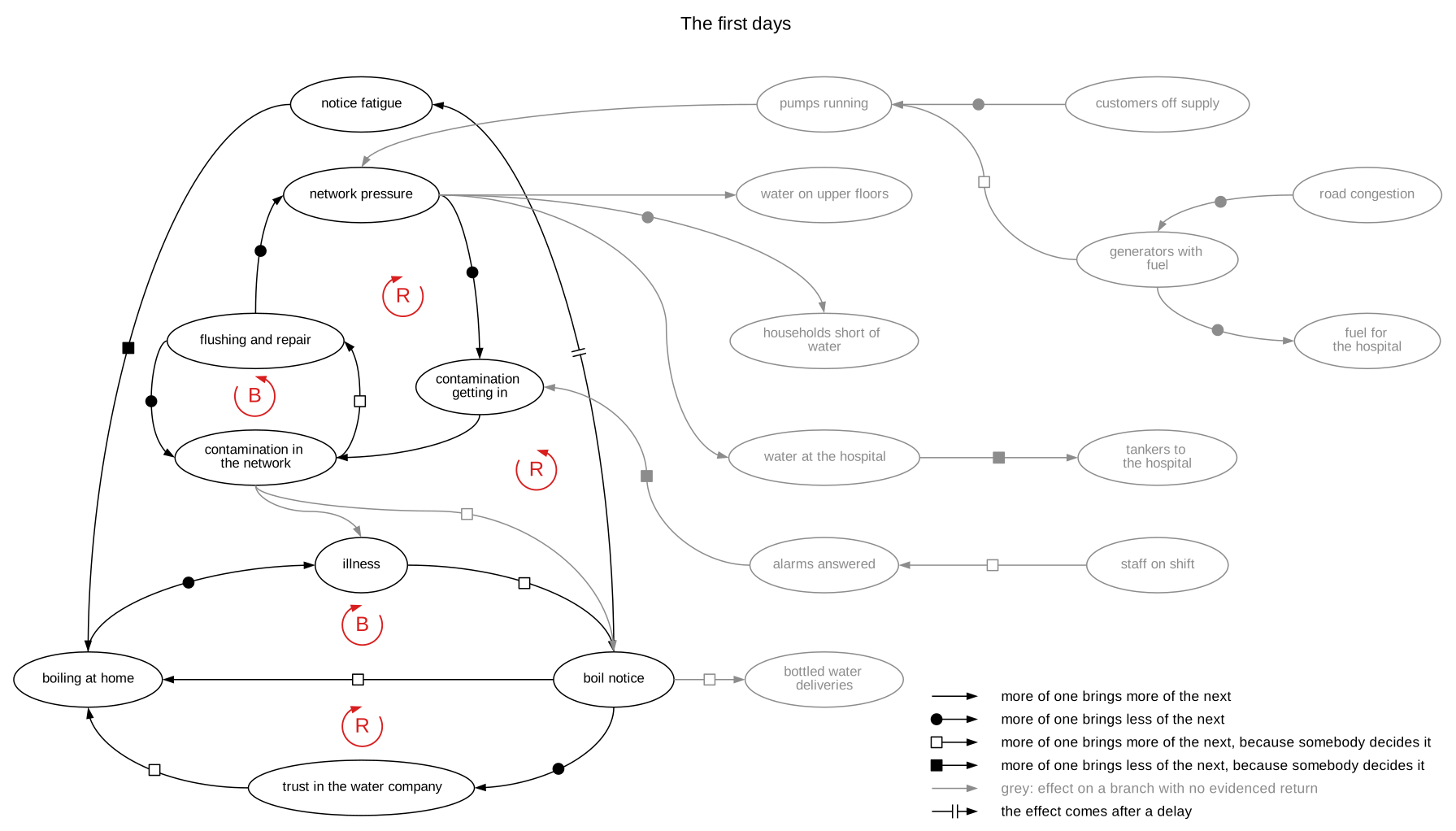
Click to enlarge.
The five loops
Reinforcing (R):
lower network pressure -> more contamination getting in -> more contamination in the network -> more flushing and repair -> lower network pressure
a boil notice -> more notice fatigue, after a delay -> less boiling at home -> more illness -> the boil notice stays
a boil notice -> less trust in the water company -> less boiling at home -> more illness -> the boil notice stays
Balancing (B):
more contamination in the network -> more flushing and repair -> less contamination in the network
a boil notice -> more boiling at home -> less illness -> the boil notice is lifted
The five remedies
generators with fuel, kept by the water company: pumps running through a power cut, for as long as the diesel lasts and the roads stay open. The hospital wants the same diesel, and the Palace decides who gets it.
staff on shift, paid for by the water company: alarms answered, and less contamination getting in. Night shifts cost wages that a low tariff does not pay, so the alarms go unanswered on the cheapest evenings.
flushing and repair, done by the water company: less contamination in the network, at the price of lower pressure while it runs.
a boil notice, issued by the water company with the health authority: more boiling at home and less illness, and a little less trust each time. The Palace can press for an early lift, which costs nothing until the next outbreak.
tankers to the hospital, sent by the water company or borrowed from its neighbours: water at the hospital when the pressure falls.
Somebody opened a valve
In April 2025 somebody opened a valve at a dam in Bremanger, in western Norway, from a computer elsewhere. The water ran for about four hours before anyone at the dam noticed. Norwegian police later attributed it to pro-Russian hackers, and the head of the security service described it as less an attempt to cause damage than a demonstration of what they could do.
In Poland that year several small water plants were broken into the same way. According to the prosecutors, the intruders logged in through control panels that sat on the open internet behind passwords such as 123456. The European cybersecurity agency, ENISA, counts drinking water and wastewater among the least prepared sectors it assesses: many small sites with nobody on them, old equipment, and contractors who need to log in from outside.
The Thieves’ Guild regards this sort of thing as unlicensed and therefore deplorable. The Assassins’ Guild regards it as vulgar, since nobody was even invited.
A dry August
In August 2022 more than a hundred French communes had no drinking water and were supplied by tanker, and most of the country was under restrictions on use. Restrictions work. People water the garden less, wash the car less and fill the bath less, and the reservoir lasts longer. They are also the one part of the arrangement that runs on public goodwill, and the rest of the arrangement has been spending that for years.
A water company can also lower the pressure in its mains, which cuts leaks and bursts at the price of a weaker shower and a top floor that waits its turn. It is one of the few repairs that cost nothing but patience, and Nap Hill has never had much of that to spare.
Anger is fast
England spilled sewage from its storm overflows for millions of hours in 2024, and the anger, when it came, came quickly. In 2025 an independent commission recommended abolishing the water regulator for England and Wales, Ofwat, and the government agreed almost before the ink was dry. The companies were allowed some £104 billion of investment for the five years to 2030, paid for by higher bills. South West Water got its record fine for Brixham.
Anger is fast. Concrete is slow. The investment that an angry summer buys arrives years later, in a different budget, under a different minister, in pipes nobody will see. By then the next scandal has usually found somebody else.
In Ankh-Morpork the allowing is the Patrician’s. An angry summer makes the decision easy and the bill large, and a quiet one makes it easy to put off. The pipes do not mind either way, which is the problem.
The next hundred years
In July 2021 a flood went down the Ahr valley in Germany and damaged every treatment plant in it. Sewage ran into the river untreated for weeks, and one village had its sewage treated by a mobile plant from the German Red Cross. The main that carries drinking water down the valley had to be relaid along some 27 kilometres, and the treatment plant at Sinzig is being rebuilt somewhere higher.
The rain is getting heavier and the dry spells longer, and the pipes are being renewed at a pace measured in centuries against budgets set every year. Much of what the next century of weather will test was laid in the last one, by people who expected a different climate and a larger budget. They were wrong about both.
The same afternoon
Imagined conversation with Lord Vetinari.
Lord Vetinari: “Water, Drumknott, is the one thing this city will riot for and refuse to pay for, frequently on the same afternoon.”