Communications
A clacks tower on the road to Sto Lat stops blinking at a quarter past four. Nobody in the city notices for an hour. Messages simply stop arriving, and the one message the clacks has never been able to send is that nothing is coming.
By six the merchants have noticed, because the prices from Sto Lat are late. By seven the Watch has noticed, because the merchants have come round to complain. The Patrician noticed at half past four, and said nothing, in case it turned out to be interesting.
Three hours of battery
A tower runs on power like everything else, and keeps a battery for when the power goes. The battery is sized for an ordinary cut. Ordinary cuts are short, and they are not the kind that tests it.
When the Iberian Peninsula lost its electricity on April 28th, 2025, the mobile networks kept going on batteries that, by most accounts, last somewhere between one and three hours. Then the masts went out one by one as the batteries ran flat, and the masts still working filled up with everybody else’s calls.
Spain’s answer was a decree requiring operators to keep at least four hours of power at the antennas serving three quarters of the population, by about 2030. The first draft had said 85 per cent of the population. The operators explained why that was too many, and the population, being in the dark at the time of the original problem, was not asked.
Storm Eowyn did the same to Ireland in January 2025, the worst damage to telephone service the Irish regulator had ever recorded. At the peak about a third of mobile users had a poorer signal or none, and one operator alone had some 900 mobile sites down. The operators put much of it down to lost power rather than wind. The masts were standing. They had simply run out.
A mast that goes dark sends its callers to the next mast, which was busy already. Calls fail, and people whose calls fail call again, because the alternative is to sit and wonder, and the network fills with people asking whether the network is working.
Operators can give emergency traffic priority, which helps the emergency and thins everyone else. The masts that matter most can be kept alive with a generator, if somebody can drive the diesel to them, and the diesel is the same diesel that the hospital has been counting.
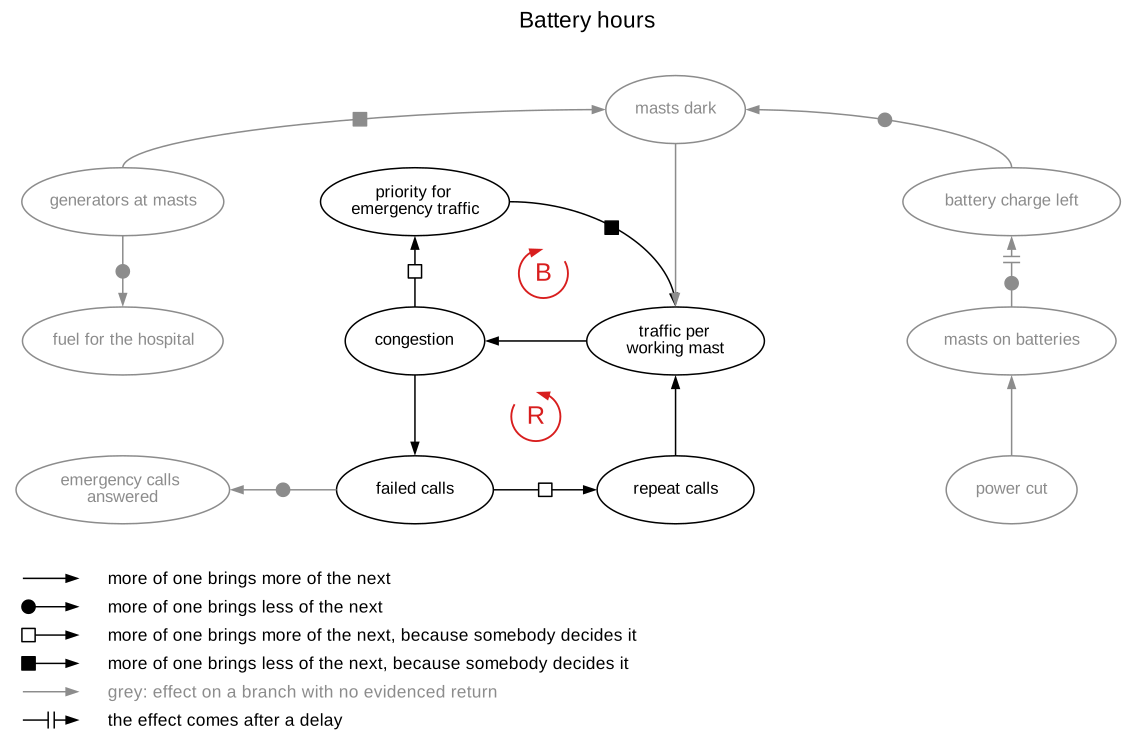
Click to enlarge.
The two loops
Reinforcing (R):
more traffic per working mast -> more network congestion -> more failed calls -> more repeat calls -> more traffic per working mast
Balancing (B):
more traffic per working mast -> more network congestion -> more priority for emergency traffic -> less traffic per working mast
The two remedies
generators at masts, kept by the operators: fewer masts dark, for as long as somebody drives the diesel out. The hospital is counting on the same diesel, and the Palace decides who gets it.
priority for emergency traffic, decided by the operators: less traffic per working mast, so emergency calls get through and everyone else waits longer.
Nobody answers
On June 2nd, 2021 the French emergency numbers stopped working for about seven hours. Calls to the ambulance, the police, the fire brigade and 112 went through Orange’s network, and from a quarter to five in the afternoon until midnight some 11,800 of them never arrived. At least five deaths were investigated. Orange traced it to a software fault in the equipment joining its modern network to the old one, following an upgrade meant to add capacity.
An emergency number is the one call that nobody makes twice in a calm voice. In Ankh-Morpork the Watch takes its emergencies by clacks, and Commander Vimes has a standing order that any tower going quiet near a watch house is treated as an emergency in itself. The order was written after the evening the tower went quiet and nobody thought to treat it as one.
Rumour needs no towers
Where news stops, rumour starts, and rumour has never needed a tower. Within an hour of the Sto Lat tower going dark the Shades know that Sto Lat has burned down, that it has declared war, and that the price of flour will double by Tuesday. Two of these are untrue. The third becomes true by Thursday, because enough people have bought flour.
Worried people call their families, the calls fill what network is left, and less news gets through, so the rumour has the field to itself a little longer. An official warning can cut through all of it, a message sent to every telephone in an area at once, as several European countries now do. It needs a network to arrive on, and a network is what the city is short of at the time.
Leaders help by being seen. During the Berlin blackout of January 2026 the city’s mayor was criticised for how little he appeared in the dark districts, and a city that cannot see its government will usually invent one. The Patrician has always understood this, and has a habit, in a crisis, of walking through the Shades at a moderate pace with nobody hurrying him.
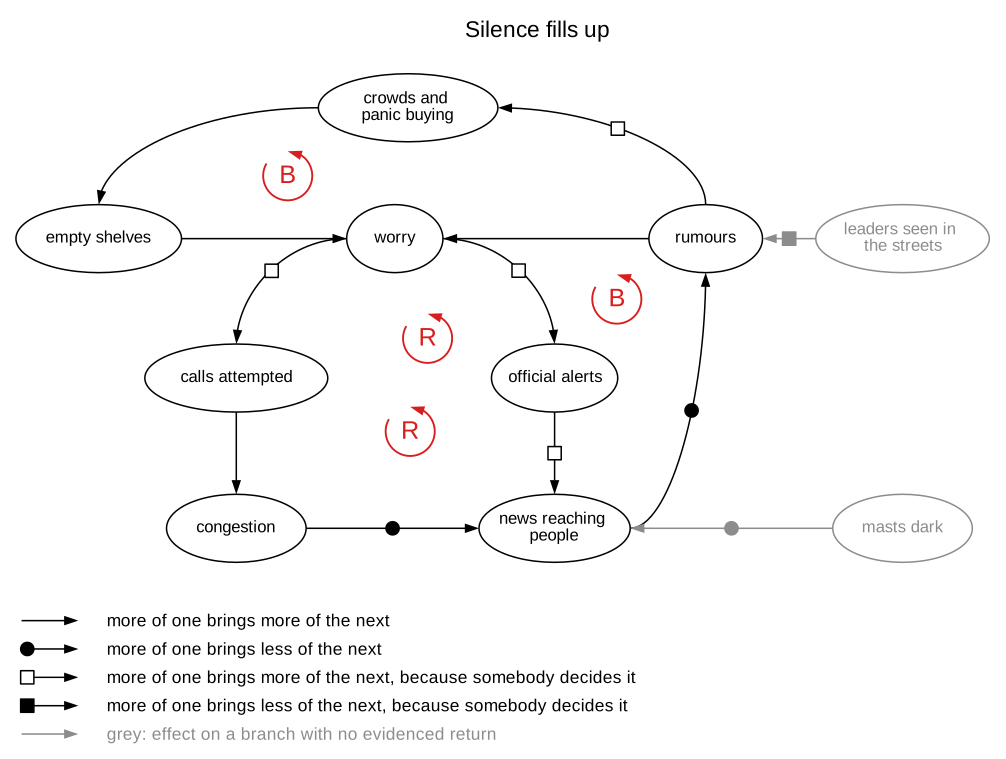
Click to enlarge.
The four loops
Reinforcing (R):
less news reaching people -> more rumours -> more public worry -> more calls attempted -> more network congestion -> less news reaching people
less news reaching people -> more rumours -> more panic buying -> less stock on shelves -> more public worry -> more calls attempted -> more network congestion -> less news reaching people
Balancing (B):
more public worry -> more official alerts -> more news reaching people -> fewer rumours -> less public worry
more public worry -> more official alerts -> more news reaching people -> fewer rumours -> less panic buying -> more stock on shelves -> less public worry
The two remedies
official alerts, sent by the Palace: more news reaching people and fewer rumours, if there is a network left to carry them. An alert that turns out wrong costs more than the rumour it replaced.
leaders seen in the streets, which means the Patrician on foot in the Shades: fewer rumours. It costs an evening and a certain amount of nerve, and it works only if he is seen.
The Grand Trunk
The Grand Trunk clacks company was bought, in Ankh-Morpork’s living memory, by gentlemen who had borrowed the money to buy it. The debt had to be paid, so the maintenance was cut, and cutting maintenance made the profits look splendid, which raised the share price, which allowed the gentlemen to borrow more. The towers kept working for a while out of habit. Then they started to break down, and the company explained each breakdown as an unforeseeable act of the weather.
Customers had nowhere to go. A company with no rival can let its towers decay for a long time, because every customer it annoys is still a customer the next morning.
A rival changes that, and in the city’s case it was the Post Office, run by Moist von Lipwig, who had been a confidence trickster and therefore understood the Grand Trunk better than its owners did. Customers who leave take their money with them, and the money was what paid for the towers that were left. The fear of losing more is the only thing that has ever persuaded the owners to send a man up a tower with a spanner.
The rival was the Palace’s doing. Pressing the owners had produced explanations about the weather. Giving them a competitor produced spanners, and needed nothing from the owners at all.
The clacks keeps one custom from that time. Some names are sent up and down the line forever, with a code that tells every tower to pass them on and never log them, because a man is not dead while his name is still being spoken. The company’s accountants have never found a way to charge for it.
One network can carry far more than anyone thinks of. On the morning Russia invaded Ukraine, February 24th, 2022, an attack on the Viasat satellite network wiped thousands of its modems, and some 5,800 wind turbines in Germany lost the link that let their owner monitor and control them from afar. The turbines kept turning on their own. Few lists of what the German grid depended on had included a satellite company, and it had not occurred to the satellite company to ask.
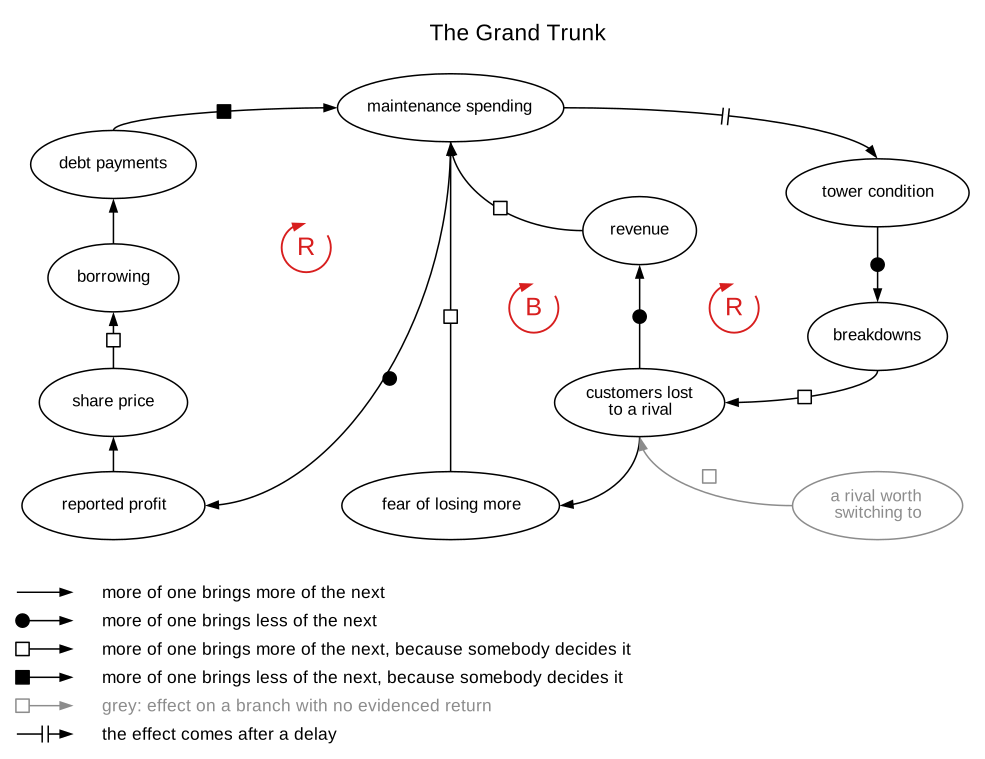
Click to enlarge.
The three loops
Reinforcing (R):
less maintenance spending -> higher reported profit -> higher share price -> more borrowing -> more debt payments -> less maintenance spending
less maintenance spending -> worse tower condition, after a delay -> more breakdowns -> more customers lost to a rival -> less revenue -> less maintenance spending
Balancing (B):
less maintenance spending -> worse tower condition, after a delay -> more breakdowns -> more customers lost to a rival -> more fear of losing more -> more maintenance spending
The two remedies
maintenance spending, decided by the owners: better tower condition, after a delay. They spend when they fear losing customers and not before. The Palace can press them, which they treat as weather.
a rival worth switching to, which the Palace can license or revive: more customers lost to it, and more fear of losing more. It takes years and a suitable rogue.
An anchor in December
Much of what Europe says to itself runs through cables on the seabed. On Christmas Day 2024 the C-Lion1 cable between Finland and Germany failed in the Gulf of Finland, along with several others, and Finnish authorities boarded a tanker suspected of dragging its anchor across the seabed for some ninety kilometres. The repair ship came from France, and some of the equipment from outside the Baltic altogether. The cable was back on January 6th. A Helsinki court later decided it had no jurisdiction over the ship.
There are not many cable ships, and every cut joins the same short queue. A single cut is an inconvenience with several routes round it. Several cuts at once, in a sea with few ships to mend them, are a question of who waits longest, and the answer is decided by somebody else’s priorities in a port a long way away. How the traffic finds its way round a cut belongs to the internet.
Everything on the line
The clacks used to carry messages. It now carries the city’s payments, the power company’s control of its own substations, the alarms in the old people’s homes, and the heating timers. At the same time the old copper lines and the radios that worked without it are being switched off, because nobody wants to pay for two of everything.
Each year a little more of the city has only one way to say that something is wrong, and that way runs on a battery sized for an ordinary cut.
No news
Imagined conversation with Lord Vetinari.
Lord Vetinari: “In my experience, Drumknott, nothing travels faster than the absence of news. It arrives everywhere at once, and the people fill it with whatever they were afraid of already.”