Dependencies
Each system page draws its own loops, and the arrows that leave a page are drawn in grey, heading for somebody else’s problem. Put together, they show which failures turn into which, and in which direction. Most of them start at the power station.
What fails into what
A power cut reaches every other system in the city. The pumps stop, the clacks masts go dark, the card terminals and the trains stop, and the hospital’s diesel starts to go. Two of the systems it reaches push back. Dark masts slow the reconnection that would end the cut, because the power company runs its substations over the clacks. And worry feeds on itself through the clacks and the shops: a card outage sends people to the cash machines, empty machines spread worry, worried people call and buy, and the calls jam the network the card terminals need.
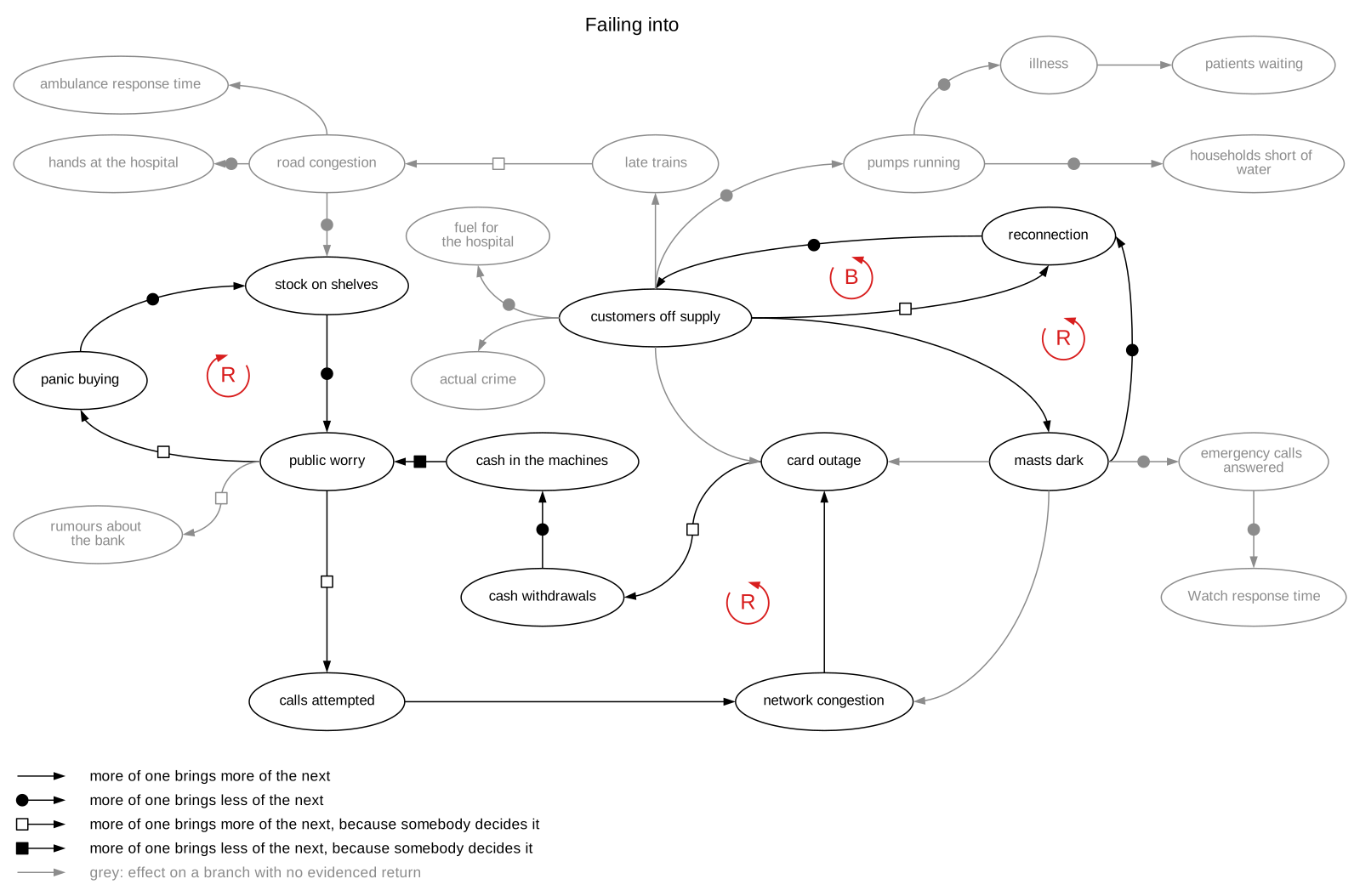
Click to enlarge.
The four loops
Reinforcing (R):
more customers off supply -> more masts dark -> less reconnection -> more customers off supply
more public worry -> more panic buying -> less stock on shelves -> more public worry
more public worry -> more calls attempted -> more network congestion -> more card outages -> more cash withdrawals -> less cash in the machines -> more public worry
Balancing (B):
more customers off supply -> more reconnection -> fewer customers off supply
One blackout
A blackout runs to a timetable nobody wrote. Within hours the mast batteries run flat, the masts go dark one by one, and calls for help stop arriving. The pumps keep going on generators for as long as the diesel lasts, and the diesel comes by road, on roads that the stopped trains have filled. Within days the pressure in the mains drops, dirt gets in, and a boil notice goes out after the first people are ill. Each system holds out as long as the thing it leans on.
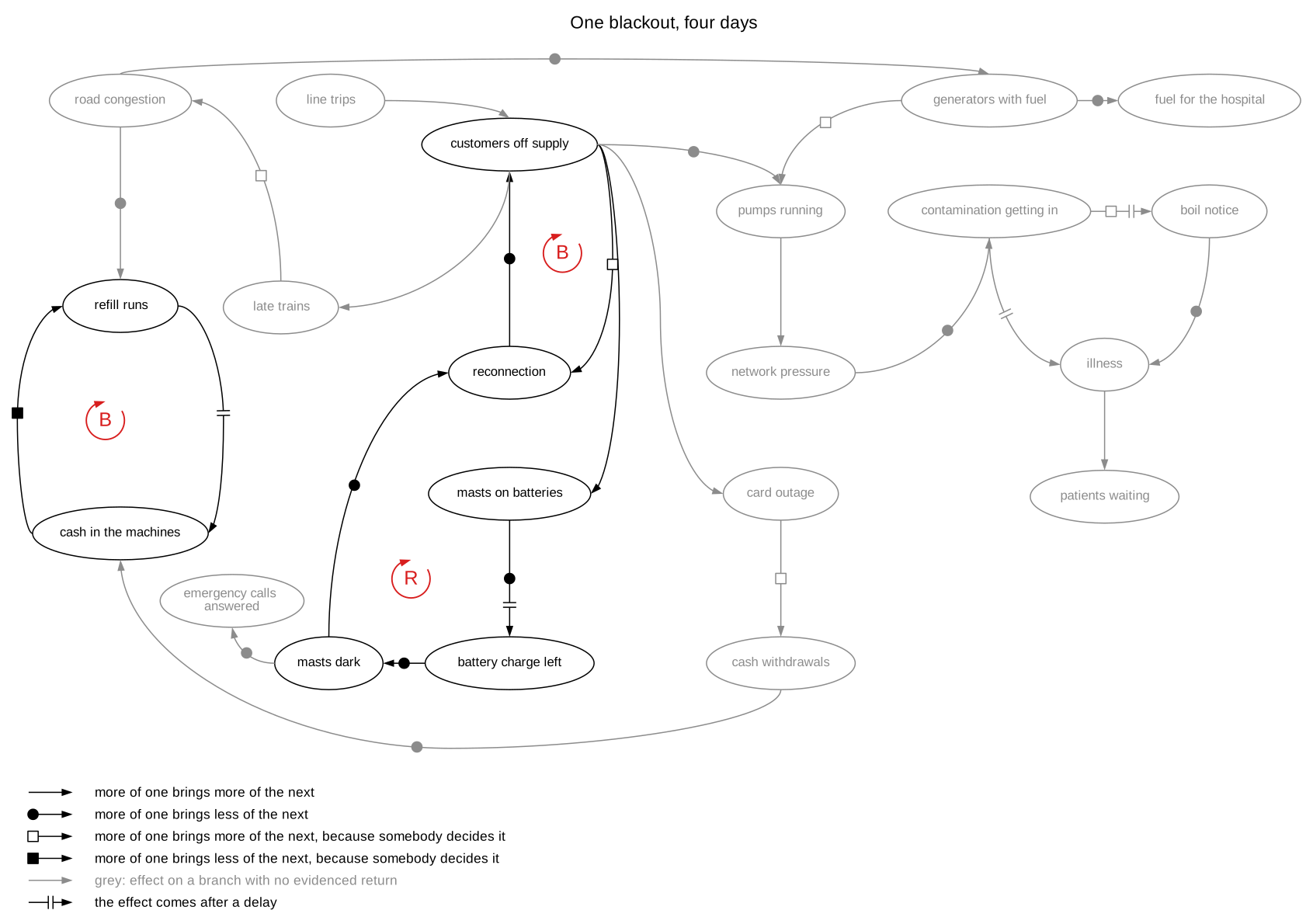
Click to enlarge.
The three loops
Reinforcing (R):
more customers off supply -> more masts on batteries -> less battery charge left, after a delay -> more masts dark -> less reconnection -> more customers off supply
Balancing (B):
more customers off supply -> more reconnection -> fewer customers off supply
less cash in the machines -> more refill runs -> more cash in the machines, after a delay