Commerce and industry
It is market day on Sator Square, and at a quarter past nine the clacks line that carries the Royal Bank’s payments goes quiet. By ten every stall on the square takes cash only. By half past there is a queue at every cash machine in the city.
Mr Dibbler has taken cash only since before anyone can remember. He regards the morning as vindication.
Cash only
On May 24th, 2022 card terminals began failing across Germany. At Aldi Nord, Rossmann, dm and a scattering of Edeka branches, customers could often pay only in cash. The terminals, an old Verifone model run by Payone, had lost a security certificate when it expired, because the update meant to replace it had never reached all of them. Each one had to be put right by hand, on site, and it took weeks.
A shop that cannot take cards sends its customers to the cash machine, and a crowd at a cash machine is the most persuasive argument there is for joining it. When the Iberian Peninsula lost its power on April 28th, 2025, some machines ran out of notes, and the rest still held notes and had no power to hand them out. Over the next two days the banks and the security vans refilled them, the places that needed it most first.
The small shops of the Shades fall back on the slate, writing down what each customer owes and trusting them to come back. Dibbler keeps no slate. He has met his customers.
In ordinary years cash is used a little less each year, so the banks close a few machines, and fewer machines make cash a little more trouble to use. Sweden, further down that road than most, posted a brochure to more than five million households in November 2024, advising them to keep cash at home. Mr Bent, chief cashier of the Royal Bank, has never trusted anything thinner than a gold coin, and found the brochure very sound.
The machines belong to the banks, and the banks close the ones that lose money. Keeping the rest open is something the Palace can require, and then pay for, in the quiet years when nobody can see the point.
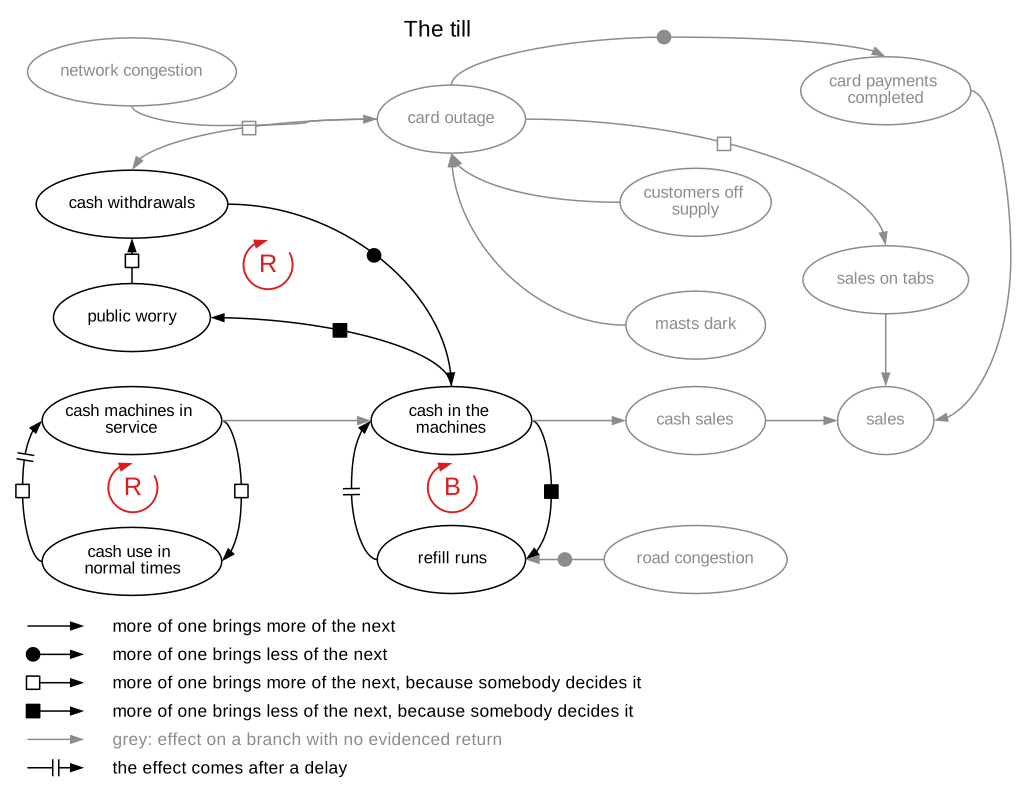
Click to enlarge.
The three loops
Reinforcing (R):
more cash withdrawals -> less cash in the machines -> more public worry -> more cash withdrawals
less cash use in normal times -> fewer cash machines in service, after a delay -> less cash use in normal times
Balancing (B):
less cash in the machines -> more refill runs -> more cash in the machines, after a delay
The two remedies
refill runs, sent by the banks and the security vans: more cash in the machines, after a delay, as long as the roads let the vans through.
cash machines kept in service, decided by the banks, or required by the Palace: more cash use in normal times, and a city that can still pay when the cards stop. It costs money every year, for a morning that may never come.
The works stops
At the end of August 2025 a cyber attack stopped Jaguar Land Rover’s car plants in Britain, and they stayed stopped for more than a month. About 120,000 people work for the firms that supply them. On September 28th the government backed a loan guarantee expected to unlock up to £1.5 billion, to give the suppliers some certainty that there would be a customer left.
A works that builds nothing orders nothing. Its suppliers live on the payments for last month’s parts, and a small one has a few weeks of cash at most. When a supplier fails, the parts it made go with it, and the works that starts up again finds that it cannot. The stock in the warehouse decides how long that takes to show, and the warehouse is kept small on purpose, because stock costs money.
In Ankh-Morpork the largest works belongs to Harry King, who began with the city’s night soil and now owns most of what is made from what the city throws away. When his yard stops, the carters, the sorters and the small foundries that live on his scrap stop with it, and Harry King goes to the Palace to explain how many voters that is.
The Palace pays, because a city cannot watch its suppliers fail one after another. Every other owner in the city watches it pay. A works that expects to be rescued spends a little less on locks, watchmen and clerks to check the clacks, and the next attack finds the door a little further open.
Norsk Hydro, hit by ransomware in March 2019, switched its aluminium smelters to running by hand, shut several of its other plants, and told the world in detail what had happened. It is still held up as the example, mostly by people who would prefer not to have to follow it.
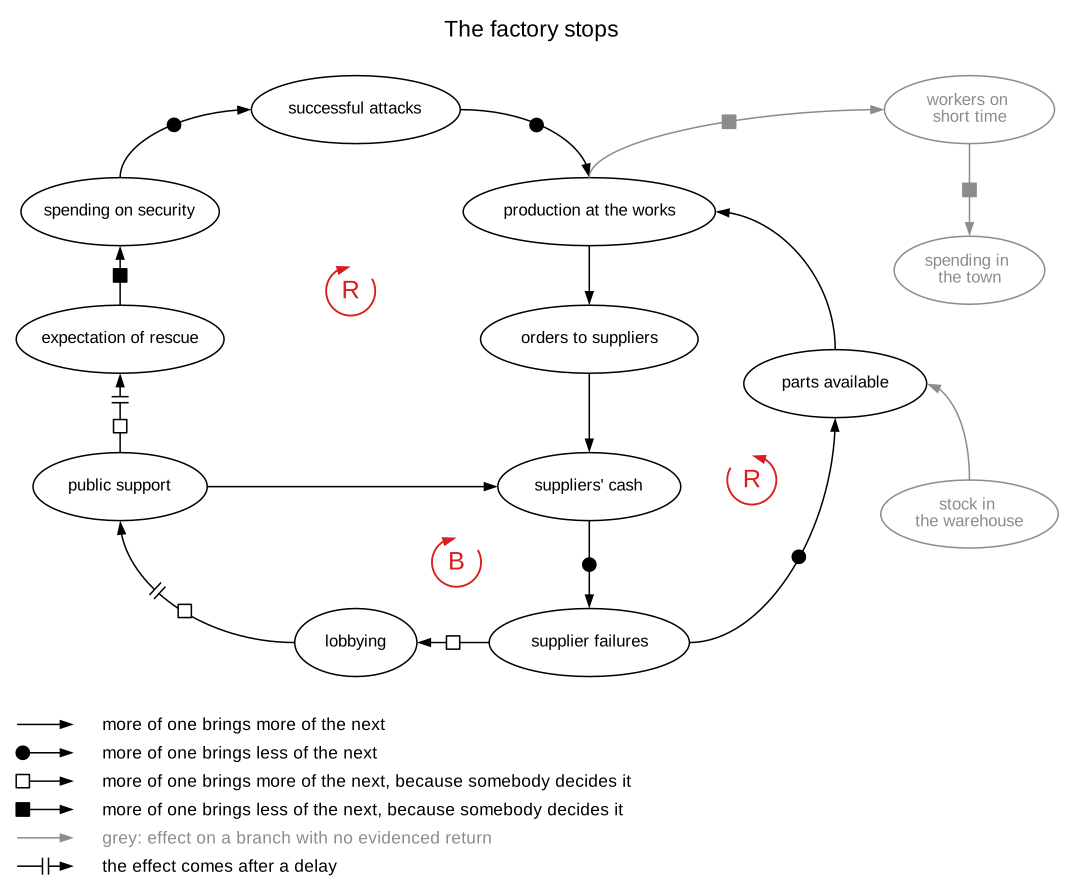
Click to enlarge.
The three loops
Reinforcing (R):
less production at the works -> fewer orders to suppliers -> less suppliers’ cash -> more supplier failures -> fewer parts available -> less production at the works
more public support -> more expectation of rescue, after a delay -> less spending on security -> more successful attacks -> less production at the works -> fewer orders to suppliers -> less suppliers’ cash -> more supplier failures -> more lobbying -> more public support, after a delay
Balancing (B):
more supplier failures -> more lobbying -> more public support, after a delay -> more suppliers’ cash -> fewer supplier failures
The two remedies
public support, decided by the Palace: more suppliers’ cash, after a delay, and fewer failures down the chain. It also teaches every owner in the city to expect the same.
spending on security, decided by the owners: fewer successful attacks. They spend less of it the more certain they are of a rescue.
Run on the bank
On September 13th, 2007 the news broke that Northern Rock had asked the Bank of England for emergency funding. The funding was meant to calm things. The next morning there were queues outside its branches, and they came back on the Saturday and the Monday, until the government promised on the Monday night to guarantee the savers’ money.
A queue outside a bank is the best advertisement a rumour can have. Nobody in it knows anything, and everybody walking past can see them standing there.
Credit Suisse lost its depositors more quietly. In the last quarter of 2022 its clients took out a net 110.5 billion Swiss francs, two thirds of it in October, when rumours about the bank were running round social media. Its chairman later said the social media storm had had enormous effects. There was no queue to see. The money left from sofas, and in March 2023 the bank was sold to UBS over a weekend.
The Royal Bank of Ankh-Morpork is chaired by Mr Fusspot, a small dog, with Moist von Lipwig as his dogsbody. Moist understands confidence better than any banker in the city, having spent his earlier career abusing it. A bank lives on the belief that everyone will not want their money back at once, and a bank that announces it is perfectly safe has just told everyone that the question has come up.
A bank losing deposits lends less. Businesses that cannot borrow fail, a few months later, and leave their loans unpaid, and the unpaid loans eat what is left in the vault and reach the newspapers in roughly that order. What stops it is somebody with deeper pockets lending to the bank, and a guarantee that the savers will be paid whatever happens, so that standing in the queue stops being worth the morning.
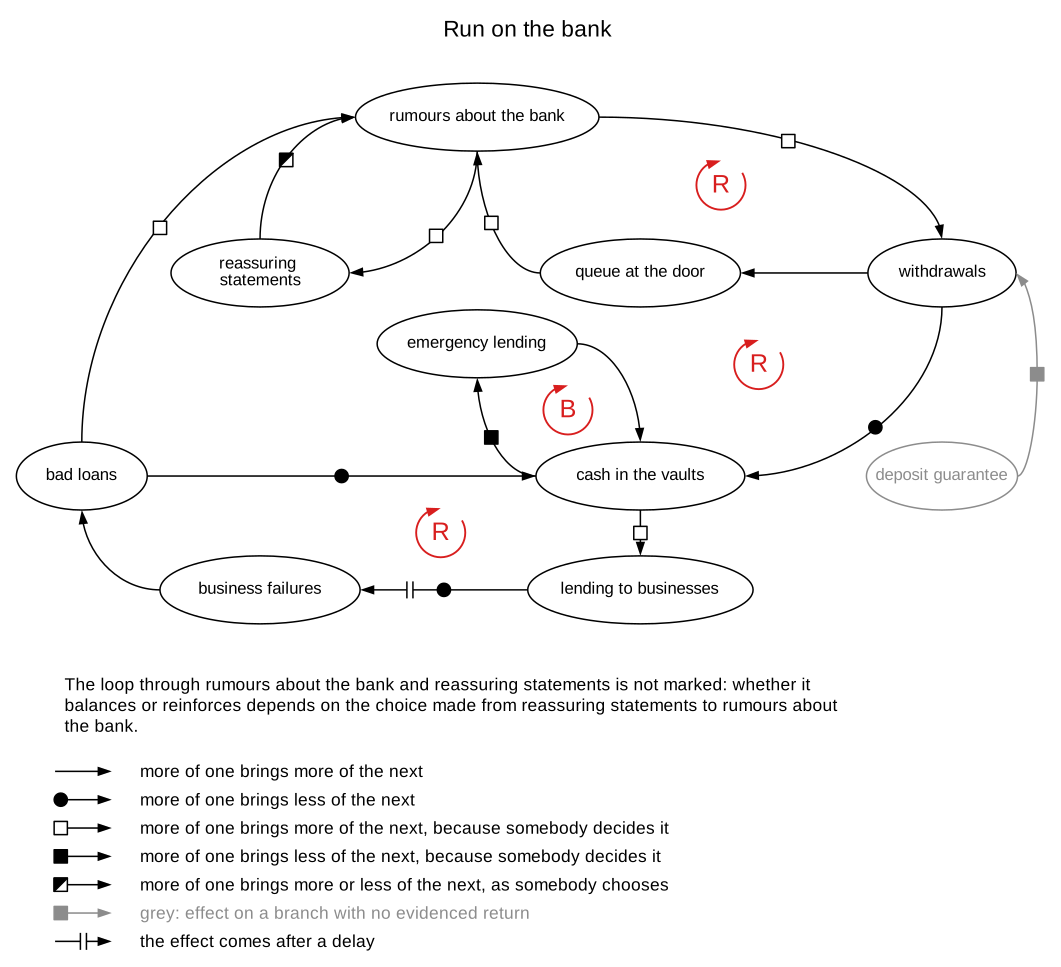
Click to enlarge.
The four loops, and one that can go either way
Reinforcing (R):
more rumours about the bank -> more withdrawals -> a longer queue at the door -> more rumours about the bank
less cash in the vaults -> less lending to businesses -> more business failures, after a delay -> more bad loans -> less cash in the vaults
more rumours about the bank -> more withdrawals -> less cash in the vaults -> less lending to businesses -> more business failures, after a delay -> more bad loans -> more rumours about the bank
Balancing (B):
less cash in the vaults -> more emergency lending -> more cash in the vaults
Either way:
more rumours about the bank -> more reassuring statements -> more or fewer rumours, depending on whether anyone believes them
The three remedies
emergency lending, decided by the Palace: more cash in the vaults. Announced too early, it tells everybody the bank needed it.
a deposit guarantee, decided by the Palace: fewer withdrawals, because the queue stops being worth the morning. The treasury stands behind every account in the city while it lasts.
reassuring statements, made by the bank or the Palace: fewer rumours if anyone believes them, more if nobody does.
Tractors at the gates
In December 2023 the German government, short of money after a court struck down part of its budget, decided to end the farmers’ tax relief on agricultural diesel and their exemption from vehicle tax. The farmers drove their tractors to Berlin. On January 4th, 2024, before their main week of protest had even begun, the government dropped the vehicle tax change and spread the diesel cut over three years. The farmers’ association called it a first step, and the protest week went ahead.
The next government restored the full diesel refund from the start of 2026, at about €430 million a year. Every other trade in the country was paying attention.
In Ankh-Morpork the cabbage growers of the Sto Plains bring their carts to the city gates and stop there. Nothing green gets in. By the second day the price of cabbage has doubled, which the growers find gratifying, and the Patrician’s clerks are drafting a subsidy. The Guild of Carters, which asked for a subsidy two years ago and was told there was no money, reads about it in the Times.
The only thing working against the growers is the city’s patience, and it lasts about as long as the cabbage does.
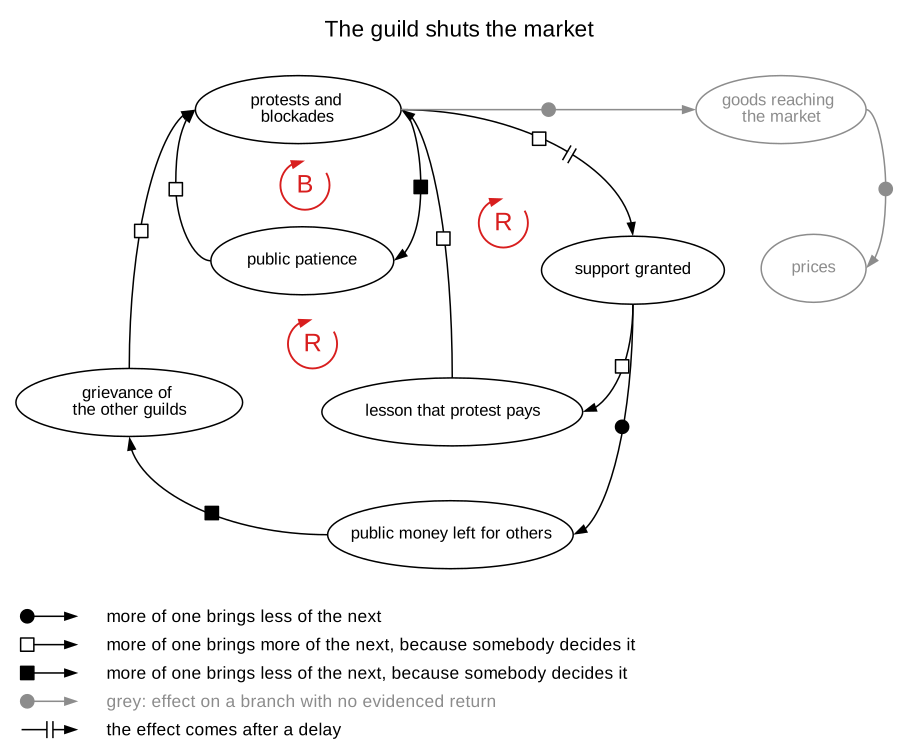
Click to enlarge.
The three loops
Reinforcing (R):
more protests and blockades -> more support granted, after a delay -> more belief that protest pays -> more protests and blockades
more protests and blockades -> more support granted, after a delay -> less public money left for others -> more grievance among the other guilds -> more protests and blockades
Balancing (B):
more protests and blockades -> less public patience -> fewer protests and blockades
The remedy
support granted, decided by the Palace: the blockade lifts, after a delay, and every other trade learns how. Refusing it costs cabbage, and waits on the public’s patience to run out before the growers’ does.
Hubert’s Glooper
In the cellar of the Royal Bank stands Hubert’s Glooper, a model of the city’s economy built from glass pipes, valves and coloured water, made to show where the money goes. Hubert eventually noticed that it did more than show. When he changed the flow in the Glooper, the flow in the city followed.
The flows in the real city are thinning in several places at once. Cash is used less each year while governments ask people to keep some at home. The works hold a few days of parts and buy them from a few suppliers. Every rescue teaches the next owner to expect one, and every protest that wins teaches the next trade to protest. All of it runs on confidence, and confidence is the one stock nobody has found a way to keep in a warehouse.
The free market
Imagined conversation with Lord Vetinari.
Lord Vetinari: “Every merchant in this city believes in the free market, Drumknott, right up to the morning he needs rescuing from it.”