Residential areas
The Cockbill Street Pump stops on a Monday. Nobody reports it. Cockbill Street fetches its water from the river, boils it twice, and says nothing, because Cockbill Street does not complain.
The Palace hears on the Saturday, from Commander Vimes, in person.
Nobody complains
A broken pipe on Nap Hill is known about within the hour, because a butler sends a note. In Small Gods it takes a day or two, since everyone assumes a neighbour has already said something. In the Shades it takes three days or five, and on Cockbill Street it can take ten, or never. Cockbill Street is the poorest street in the poorest district, and the one thing it has plenty of is pride.
People who have complained before and seen nothing happen stop complaining. A failure nobody reports runs longer, and a failure that runs longer teaches the street, once again, that complaining is a waste of breath.
In November 2016 the Grenfell Action Group wrote on its blog that only a catastrophe would expose how their landlord ran Grenfell Tower. They had been writing about fire safety for years. In June 2017 the tower burned and 72 people died.
A failure in the Shades reaches the Ankh-Morpork Times as a paragraph on page eleven, a week late. The same failure on Nap Hill is the front page by lunchtime, and the front page is what the Palace reads first. The one thing that moves the Shades up the front page is Vimes, who grew up on Cockbill Street, still listens to it, and has never been able to leave a broken thing alone there.
The Palace can move the Shades up the list without waiting for the front page. Doing so costs patience on Nap Hill, whose patience is louder, and it means acting on failures nobody has reported, which takes either Vimes or a Patrician who goes looking.
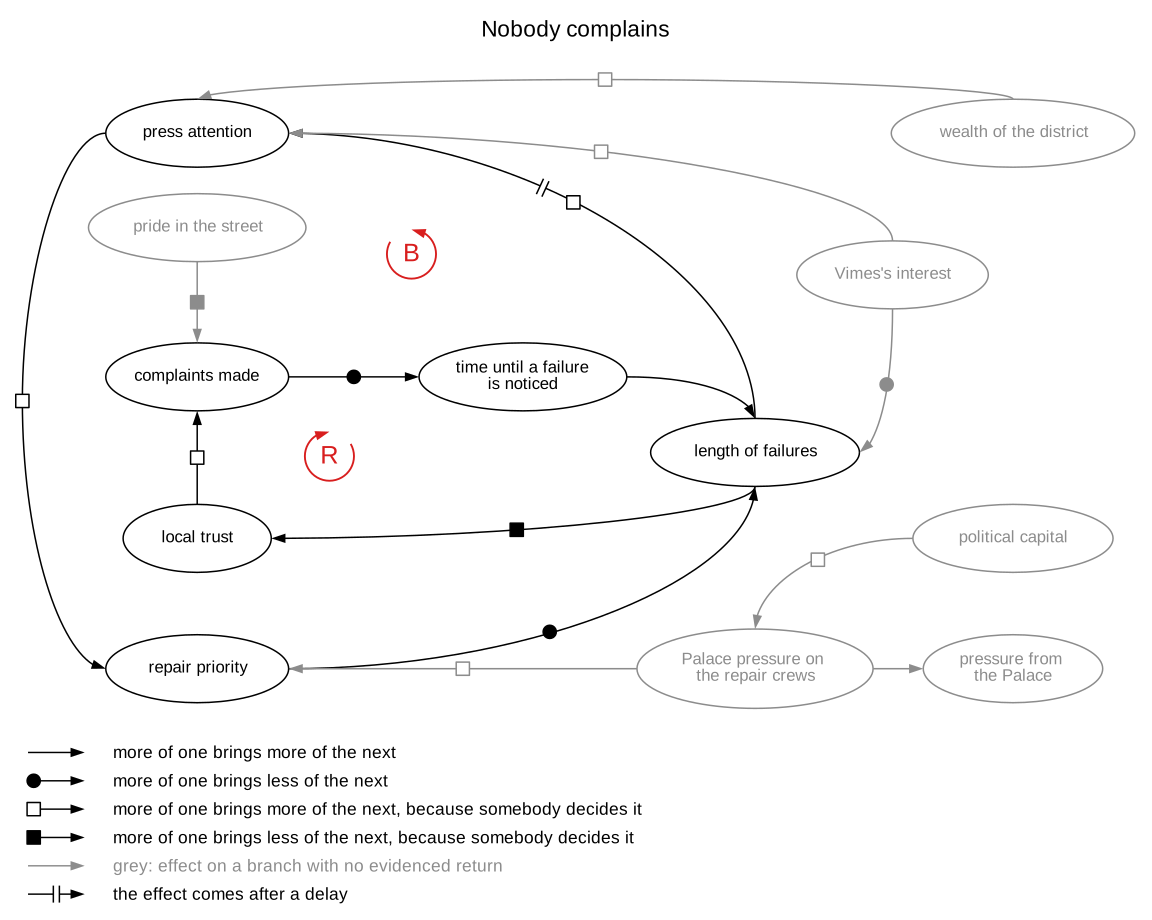
Click to enlarge.
The two loops
Reinforcing (R):
lower local trust -> fewer complaints made -> more time until a failure is noticed -> longer failures -> lower local trust
Balancing (B):
longer failures -> more press attention, after a delay -> more repair priority -> shorter failures
The three remedies
repair priority, set by the repair crews and moved by the Times: shorter failures where the press is looking.
Palace pressure on the repair crews: higher repair priority for districts the press is not looking at, while political capital lasts. It is paid for in capital and in Nap Hill’s patience.
Vimes’s interest, decided by Vimes: shorter failures on Cockbill Street, and the press arriving sooner. The Palace can press him to look elsewhere, and he pushes back.
The pump
A house in the Shades needs very little from the city. It has no clacks and no heating to speak of, and it does not travel. It needs water, and it gets its water from one pump.
When the pump stops, the neighbours share what they have, which lasts a day. Then the street goes to the river. The Ankh is too thick to drink and too thin to plough, and three days of it put people in bed. A neighbour in bed carries no buckets for the woman upstairs, so the woman upstairs goes to the river too.
The Shades are built of old timber and thatch, packed close, and a fire there crosses a street in minutes. The Shades Fire Post fights it with buckets, and buckets need a pump.
Richer cities lean on their neighbours in the same way. When an arson attack on a cable bridge cut the power to some 45,000 households in the south-west of Berlin on January 3rd, 2026, most of them lost their heating as well, since pumps and controllers run on electricity. The emergency shelters stood largely empty. The police asked people to think of their older and needier neighbours and offer help.
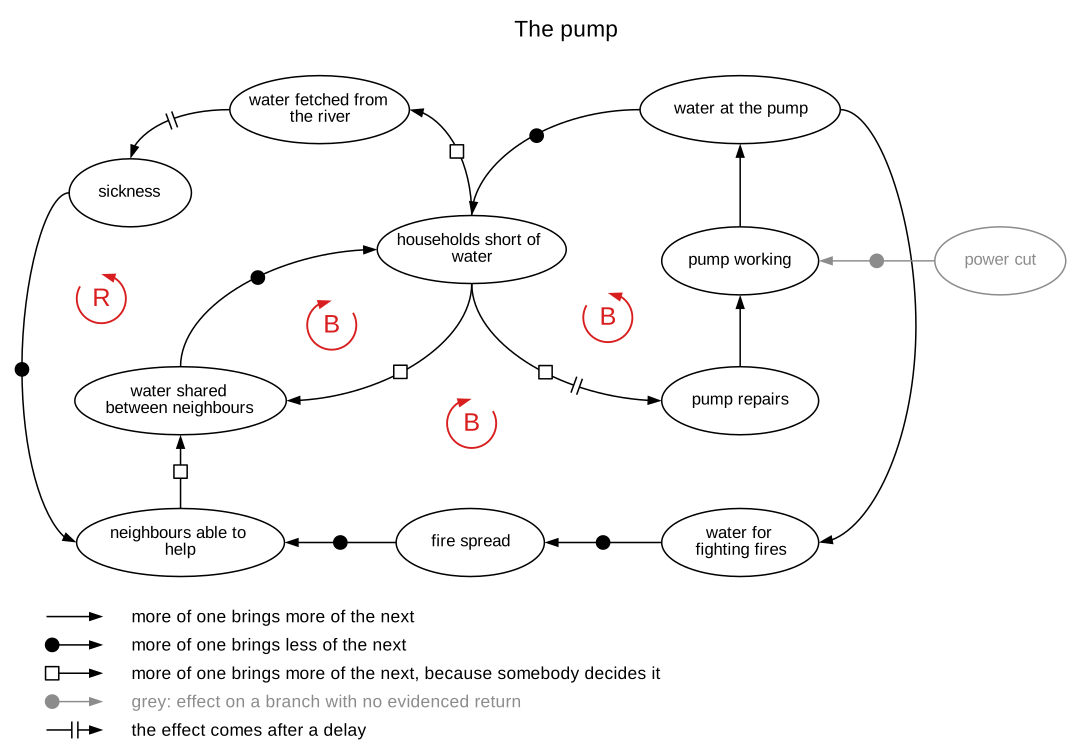
Click to enlarge.
The four loops
Reinforcing (R):
more households short of water -> more water fetched from the river -> more illness, after a delay -> fewer neighbours able to help -> less water shared between neighbours -> more households short of water
Balancing (B):
more households short of water -> more water shared between neighbours -> fewer households short of water
more households short of water -> more pump repairs, after a delay -> more pump working -> more water at the pump -> fewer households short of water
more water at the pump -> more water for fighting fires -> less fire spread -> more neighbours able to help -> more water shared between neighbours -> fewer households short of water -> fewer pump repairs, after a delay -> less pump working -> less water at the pump
The remedy
pump repairs, ordered by the Palace once it knows: the pump working again, after a delay, and water at the pump for drinking and for fires. It costs money and a crew, and it waits on somebody telling the Palace.
Cracks in the walls
The tenants of 65 rue d’Aubagne in Marseille had reported walls that moved and cracked, doors that no longer closed, and water running into the flats and the cellar. Every expert called in since 2005 had said the building was in a bad way. On October 18th, 2018 the tenants were hurriedly evacuated because a wall in the entrance hall, swollen with water, looked about to give. On November 5th the building and its neighbour at number 63 collapsed, and eight people died.
In the year that followed the city evacuated more than 3,000 people from 356 buildings, and a year on some 300 of them were still living in hotels. In July 2025 a court convicted a co-owner, a landlord and his son, the architect who had inspected the building three weeks before, and a former deputy mayor, among others. The prosecution appealed.
A collapse sends the inspectors out, and inspectors who are looking find things. Every condemned building puts families into rooms the city pays for, and the money that pays for the rooms is money that does not mend the next building. The landlord of the Ragged Flophouse has noticed that inspections are followed by repairs, and has arranged to be out whenever an inspector calls.
The tenants have noticed something too. A crack reported is a crack inspected, and a crack inspected may be a building condemned and a family in a hotel in Dolly Sisters for a year. In the Shades the cracks are now papered over by the people who live behind them.
The inspectors are the Palace’s, and so is the rehousing bill. Sending them out less saves the bill until a wall decides otherwise. Sending them out more finds the cracks, and empties the purse that was meant to mend them.
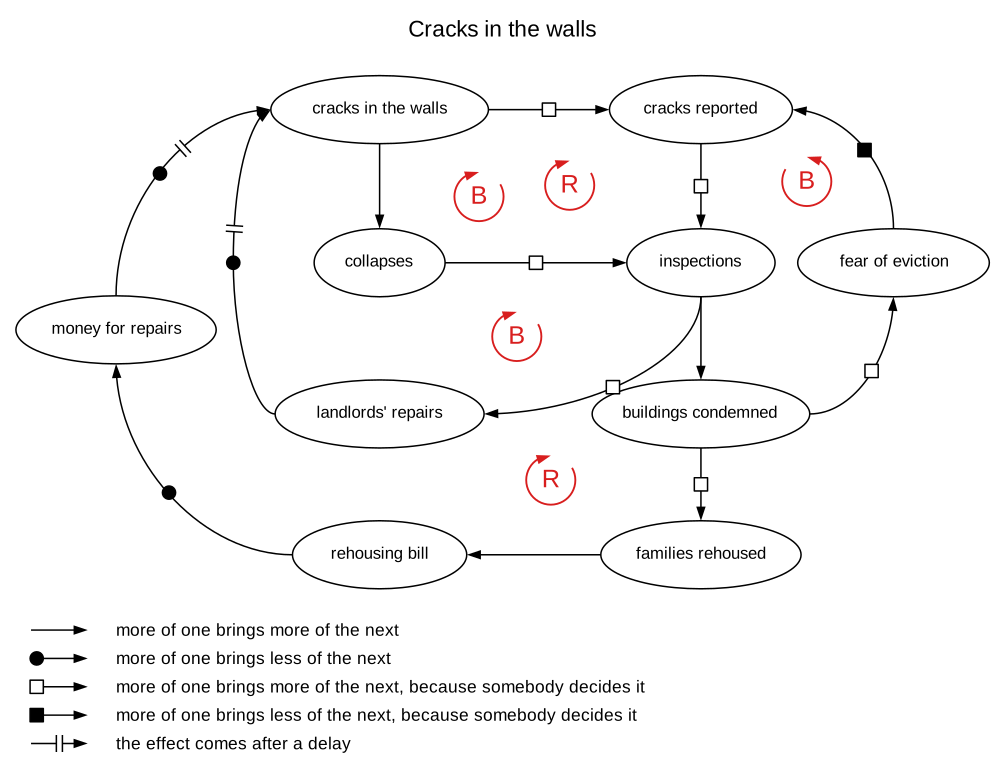
Click to enlarge.
The five loops
Reinforcing (R):
more cracks in the walls -> more cracks reported -> more building inspections -> more buildings condemned -> more families rehoused -> a bigger rehousing bill -> less money for repairs -> more cracks in the walls, after a delay
more cracks in the walls -> more collapses -> more building inspections -> more buildings condemned -> more families rehoused -> a bigger rehousing bill -> less money for repairs -> more cracks in the walls, after a delay
Balancing (B):
more cracks reported -> more building inspections -> more buildings condemned -> more fear of eviction -> fewer cracks reported
more cracks in the walls -> more cracks reported -> more building inspections -> more landlords’ repairs -> fewer cracks in the walls, after a delay
more cracks in the walls -> more collapses -> more building inspections -> more landlords’ repairs -> fewer cracks in the walls, after a delay
The three remedies
building inspections, sent by the Palace: landlords’ repairs, and condemned buildings. Each condemned building adds to the rehousing bill and to the fear that stops the next crack being reported.
landlords’ repairs, decided by the landlords once inspected: fewer cracks, after a delay. The Palace can press a landlord, provided it can find him in.
rehousing, paid for by the Palace: families safe in rooms elsewhere, and less money for repairs.
Boots
Commander Vimes has a theory of economic unfairness, worked out in boots. A rich man buys good boots that last ten years. A poor man can only afford cheap boots that last a season, so over the same ten years he spends far more on boots than the rich man and still has wet feet.
The city mends the Shades the way the poor man buys boots. A failure there gets a patch, because a patch is cheap and quick and the Shades are not on anyone’s front page, and a patched pump is far more likely than a rebuilt one to fail again. Each repair bill leaves less for rebuilding, so the Shades go on being patched, and go on failing more often than anywhere else in the city.
Nap Hill has stopped needing the city’s pipes and wires to work. It has its own private supply exchange and its own clacks terminal, and its residents now take a dignified, distant interest in the public ones. The money for upgrades goes where the voters are loud, and the voters on Nap Hill are loud about other things.
Small Gods can see Nap Hill from across the river. The gap is visible from every window, and when the anger it produces gets loud enough, some money crosses the river, a year or two late.
Rebuilding instead of patching is the Palace’s choice, and it costs more this year and less every year after. Few Patricians have stayed long enough to collect.
Poor households also pay for energy in their own way. In Britain a supplier could move a customer who had fallen behind on bills onto a prepayment meter, by force if need be, and when the credit runs out so do the heat and light. In February 2023 the Times found debt agents for British Gas letting themselves into vulnerable people’s homes to fit the meters, and the regulator suspended forced installations across the industry while it worked out what to do.
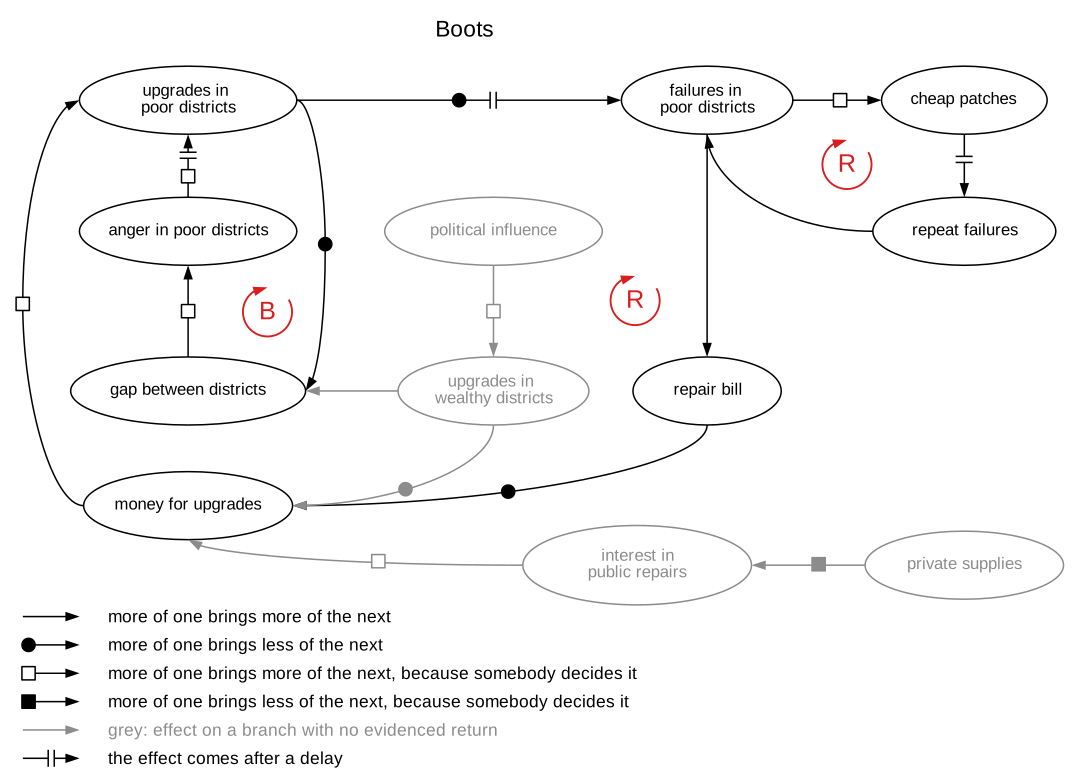
Click to enlarge.
The three loops
Reinforcing (R):
more failures in poor districts -> more cheap patches -> more repeat failures, after a delay -> more failures in poor districts
more failures in poor districts -> a bigger repair bill -> less money for upgrades -> fewer upgrades in poor districts -> more failures in poor districts, after a delay
Balancing (B):
a wider gap between districts -> more anger in poor districts -> more upgrades in poor districts, after a delay -> a narrower gap between districts
The two remedies
upgrades in poor districts instead of cheap patches, decided by the Palace: fewer repeat failures, after a delay, and a narrower gap. They cost more this year than any patch.
money for upgrades, set by the Palace: more upgrades wherever it is sent. Sent where the voters are loud, it widens the gap. Sent to the Shades, it narrows it, and Nap Hill notices.
Everything at once
Every other system in the city ends at somebody’s front door. An artisan’s house in Small Gods needs power, water, the clacks and the roads, its children need the school, and the workshop on the ground floor needs a week without power about as much as it needs a fire. When the systems fail together, they fail together in the same kitchen.
Compensation helps for about a month. A household paid for its trouble says that at least somebody cares, and four weeks later the same household says the Palace is throwing money at the problem. Nobody is ever held to account for a home, because a home is everybody’s responsibility and so, in practice, no one’s.
More of the city lives alone each year, and more of it lives up a flight of stairs from the nearest neighbour who could carry a bucket. The landlords defer, the repairs go where the voices are, and the districts that can afford it are quietly buying their way out of the city’s shared pipes. The Shades will be the last to notice, and the last to be noticed.
In person
Imagined conversation with Lord Vetinari.
Lord Vetinari: “Every crisis in this city reaches me eventually, Drumknott. Cockbill Street’s arrive in person, wearing a Watch commander.”