The Palace
The Oblong Office has no dials. What reaches it is paper: the treasury’s ledgers, the Times, and visitors who would like a word. From these the Patrician works out how much money the city has left and how much patience, and both run lower than the ledgers admit.
The purse
On September 5th, 2023 the finance officer of Birmingham City Council issued a section 114 notice, the nearest an English council comes to declaring itself bankrupt. Equal pay claims the council was obliged to honour, put at £650 million to £760 million, had outgrown its reserves, and all non-essential spending stopped. The government then said it was minded to let the council borrow or sell assets to cover up to £1,255.1 million of its running costs, and allowed it to raise council tax by 9.99% in each of two years, above the limit that would otherwise have needed a referendum.
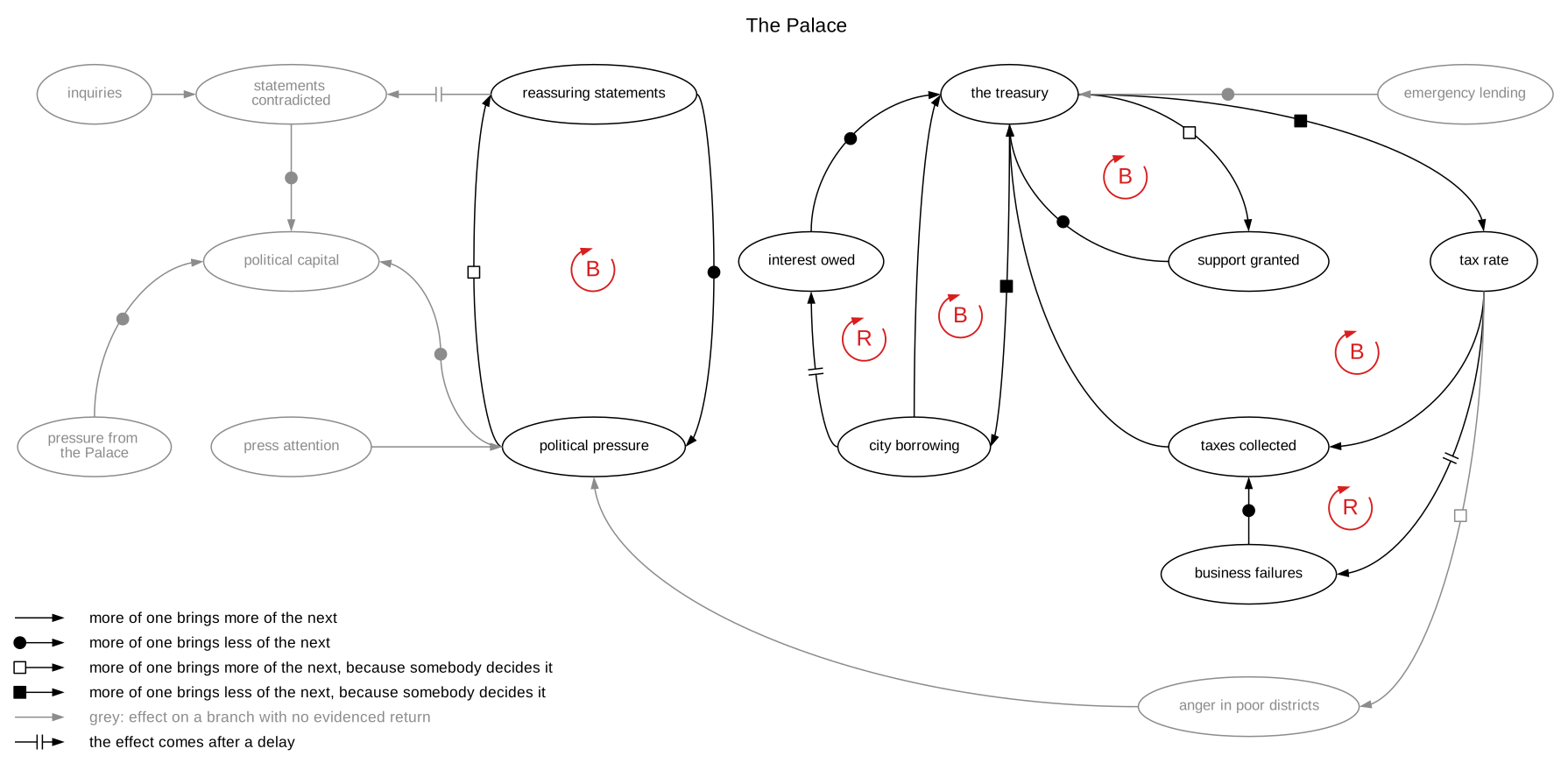
The treasury in Ankh-Morpork fills and empties the same way. Borrowing fills it now and the interest empties it later. Taxes fill it, and a rate set high enough closes the businesses that paid them, the poorer districts noticing first. Support for a guild in trouble and emergency lending to the Royal Bank come out of it. Each of these steadies the treasury on its own. Borrowing and taxes also each carry a reinforcing loop, in which the cure, given time, becomes the next shortfall.
The Patrician prefers the city to owe money to a great many people at once, each of whom then takes a close interest in its survival.
Authority
On October 18th, 2017, after a weekend of fires that killed at least 41 people, Portugal’s minister of internal administration, Constanca Urbano de Sousa, resigned. It came hours after a hard speech by the President, and her letter said she had already asked to leave after the fires at Pedrogao Grande in June.
On February 10th, 2026 one of her successors, Maria Lucia Amaral, resigned after criticism that she had stayed out of sight during storm Kristin. She said later that she had lost her authority, and that a minister without any did the country and the government more harm than none at all.
Political capital is that authority, kept as a number. The Palace spends it by pressing people whose decisions it cannot make, such as a network company deciding whose street comes back first, the engineers deciding how fast to switch it back on, or the crews deciding which pump to mend first. Each press is drawn on the page of the decision it leans on, and each adds to the Palace’s pressure, which is where the capital goes. Capital left decides how hard the next press can be. The Palace loses capital to every failure the Times keeps on its front page. The longer a failure runs, the more pressure arrives, the less capital is left, and the less the Palace can press to end the failure. Authority runs out exactly when it is needed. When it runs out altogether, the guilds remove the Patrician, and Vimes, who pushes back on principle, is not consulted.
A reassuring statement is cheaper than a repair, and it does quieten things. It also waits. When an inquiry later finds what the statement said was not so, the capital it saved is spent after all, and then some.
Click to enlarge.
The six loops
Reinforcing (R):
less in the treasury -> more city borrowing -> more interest owed, after a delay -> less in the treasury
less in the treasury -> a higher tax rate -> more business failures, after a delay -> fewer taxes collected -> less in the treasury
Balancing (B):
less in the treasury -> more city borrowing -> more in the treasury
less in the treasury -> a higher tax rate -> more taxes collected -> more in the treasury
more in the treasury -> more support granted -> less in the treasury
more political pressure -> more reassuring statements -> less political pressure
Loops through other pages
Each press is drawn on the page of the decision it leans on, so these loops close across two pages. The repair crews on the homes page stand in for every target.
Reinforcing (R):
longer failures -> more press attention, after a delay -> more political pressure -> less political capital -> less Palace pressure on the repair crews -> lower repair priority -> longer failures
more political pressure -> more reassuring statements -> more statements contradicted, after a delay -> less political capital -> less Palace pressure on the repair crews -> lower repair priority -> longer failures -> more press attention, after a delay -> more political pressure
Balancing (B):
more political capital -> more Palace pressure on the repair crews -> more pressure from the Palace -> less political capital
The three remedies
a higher tax rate, decided by the Palace: more taxes collected -> more in the treasury. After a delay it closes some of the businesses that paid, and it angers the poorer districts at once.
city borrowing, decided by the Palace: more in the treasury now, and interest owed later.
pressing, on a decision that belongs to somebody else: the engineers, the network company, the repair crews, each drawn on its own page. Every press adds to the pressure from the Palace and spends political capital. It does not always work, and Vimes pushes back.