Energy supply
The lights go out in the Shades at dusk and stay out. Nap Hill loses its lights for eleven minutes, and the Patrician hears about it within ten.
By the time the Shades are reconnected, Mr Dibbler has sold every candle in the city, several of which were candles.
Made as it is used
Water can wait in a tower and grain in a barn. Electricity is made in the same second it is used, so somebody in a control room spends every second of the day matching what the power stations send to what the city switches on. In Ankh-Morpork that somebody is Dick Simnel, who looks at the dials the way other men look at the sea, and who has never in his life been thanked for an evening on which nothing happened.
Everything else in the city is plugged into his evenings. The water pumps stop without him, and so do the clacks towers, the trams, the cold stores at the docks, the card terminals in every shop that has stopped taking coins, the lifts in the new tall buildings, and the heat pumps that the Patrician’s own office has been encouraging people to buy.
Ninety seconds in April
On April 28th, 2025 the whole of mainland Spain and Portugal went dark shortly after noon. European grid operators later traced it to voltage that rose faster than anyone controlled it, and to cascading generation disconnections, each power station dropping off and leaving the rest to carry more until they dropped off too. How a disturbance like that travels across borders belongs to the grid.
A grid fails the way a queue of men carrying a piano fails. When one line trips, its load moves onto the lines beside it, and the lines beside it were already carrying their own. The protection on them is set to save the line, not the city, and it does its job admirably.
The city has one mercy built in. When the frequency falls because supply has gone missing, relays start cutting off customers automatically, a district at a time, until what is left matches what can still be made. The district they cut first is decided years in advance by an engineer with a list, and Simnel would very much like nobody to ask to see the list.
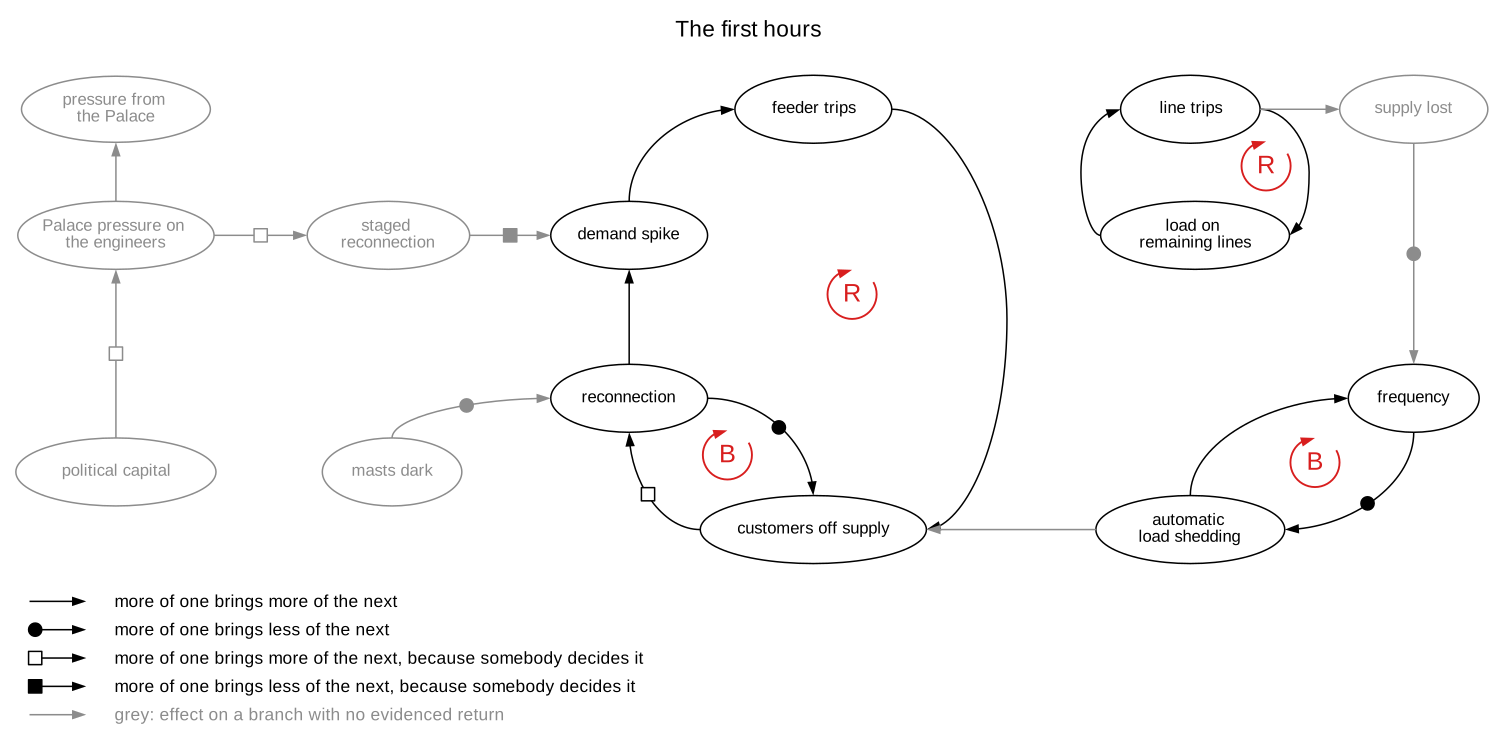
Click to enlarge.
The four loops
Reinforcing (R):
more line trips -> more load on the remaining lines -> more line trips
more customers off supply -> more reconnection -> a bigger demand spike -> more feeder trips -> more customers off supply
Balancing (B):
lower frequency -> more automatic load shedding -> higher frequency
more customers off supply -> more reconnection -> fewer customers off supply
The two remedies
staged reconnection, decided by the engineers in the control room: a smaller demand spike -> fewer feeder trips -> fewer customers off supply. It is slower, and somebody’s street is last.
Palace pressure on the engineers: more staged reconnection when a loud district wants everything switched back at once. It costs political capital, and the Palace sets the order and takes the complaints.
Everyone switches on
Switching a district back on is harder than switching it off. During an outage every fridge warms, every heater cools and every kettle in the Shades is left switched on by somebody who wants tea the moment the power returns. When it does, all of them start at once, the demand is far larger than anything the street normally draws, and the feeder trips again.
So the engineers bring the city back a street at a time. It is slow, and somebody’s street has to be last. The street that is last will remember it.
Staging costs the engineers a long night and a queue of complaints, every one of them from a street still dark. When a loud district complains loudly enough, the temptation is to throw every switch at once and hope. The feeders trip, everybody is dark again, and the complaints now come from the whole city. At that point the order of reconnection becomes the Palace’s, and so do the complaints.
Who stays dark
When there is not enough power for everyone, somebody chooses who goes without. France planned for exactly that in the winter of 2022, with much of its nuclear fleet out of action: cuts of no more than two hours at a time, in the mornings and the early evenings, announced the day before at about five o’clock, with some 14,000 sites such as hospitals kept off the list.
The network operator later reckoned that people using less and a kind winter had spared the country up to twelve red alert days, the days on which the cuts would have come.
Ukraine has lived with such a rota for years, because Russian strikes keep taking the power stations and substations away. Households are sorted into groups and the groups take turns in the dark, and heated relief centres called Points of Invincibility open where the cuts run longest. On November 3rd, 2026 one of the largest attacks of the war on the energy system put most regions back on hourly schedules.
In Ankh-Morpork the rota is fair for about a week. Then Nap Hill’s feeders become essential, because the Patrician lives there, and the Opera House’s feeder becomes essential, because the Opera House says so, and the Guild of Merchants explains that commerce is a public service.
Every feeder taken off the rota leaves fewer feeders to share the cuts, so the rest are cut for longer, and the districts cut for longer start explaining why they are essential too. The Shades are not consulted, being quiet, and stay on the rota.
Each exemption costs the network company nothing and buys it a quieter week, so it grants them. Refusing one costs the Patrician a visit from the Opera House. A fair rota is a remedy only the Palace can afford, and only for as long as it can stand the visitors.
The better districts also buy generators. A household with a generator complains less, which takes a loud voice away from the queue at the Patrician’s office, and the generator drinks diesel that the Lady Sybil Free Hospital was hoping to have for its own. The Palace can ration the diesel, and find out how many friends a generator has.
Dark streets are good for business in some trades. Copper cable fetches a fine price, the Thieves’ Guild has never issued a licence for it, and a feeder with its cable stolen trips as reliably as one hit by a storm. Commander Vimes has views on darkness. He holds that the Watch works best when the criminals can be seen, and that a city which cannot light its streets has decided to employ more watchmen.
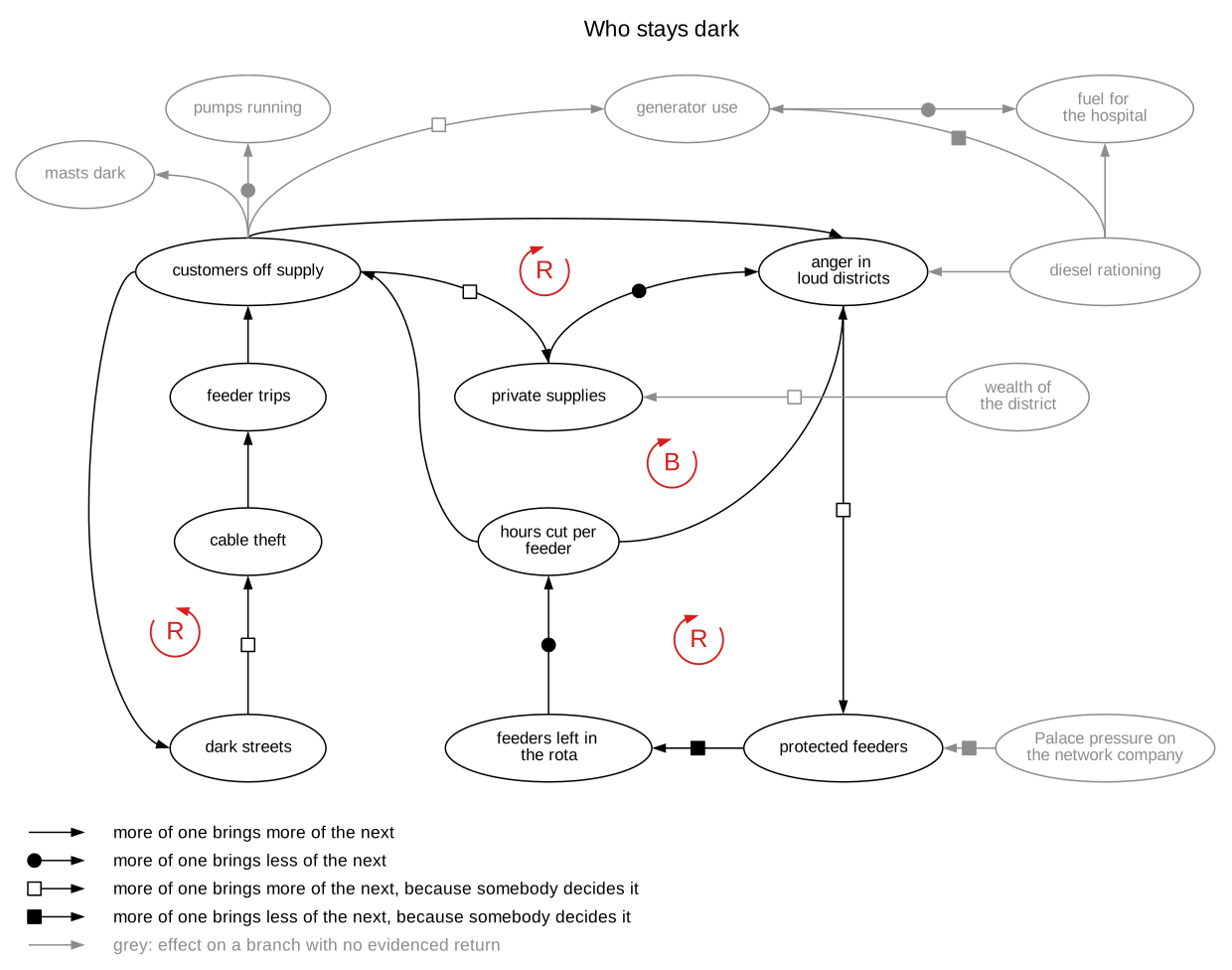
Click to enlarge.
The four loops
Reinforcing (R):
more anger in loud districts -> more protected feeders -> fewer feeders left in the rota -> more hours cut per feeder -> more anger in loud districts
more customers off supply -> more anger in loud districts -> more protected feeders -> fewer feeders left in the rota -> more hours cut per feeder -> more customers off supply
more customers off supply -> darker streets -> more cable theft -> more feeder trips -> more customers off supply
Balancing (B):
more customers off supply -> more private supplies -> less anger in loud districts -> fewer protected feeders -> more feeders left in the rota -> fewer hours cut per feeder -> fewer customers off supply
The four remedies
protected feeders, granted by the network company, which keeps the rota, under pressure from the loudest districts: fewer feeders left in the rota -> more hours cut per feeder. The company grants them because they cost it nothing.
Palace pressure on the network company: fewer protected feeders, and a fairer rota. It costs political capital and keeps the loud districts angry.
generators, bought by households in the better districts: less anger in loud districts, and diesel the hospital was counting on.
diesel rationing, decided by the Palace: less generator use and more fuel for the hospital, and more anger in the districts that bought the generators.
A storm in January
Storm Eowyn crossed Ireland on January 24th, 2025 with record gusts and took the power from about a third of the customers of ESB Networks, some 768,000 homes, farms and businesses at the peak. Crews came from Northern Ireland, Britain, France, Germany, the Netherlands, Austria, Finland and Norway, and skilled retirees came back from retirement. The last customers were reconnected on February 11th. ESB ruled out a compensation scheme.
In south-west Berlin, after the arson attack on the grid in January 2026, about 45,000 households and some 2,200 businesses spent up to four days without power in the middle of winter. The district put camp beds in sports halls, opened warming rooms and set up places to charge a phone. Schools closed, and the people who suffered most were the ones who needed a lift, a carer or a neighbour they did not have.
A city learns a great deal in four days without power, most of it about who lives next door.
Waiting for the wire
In the Netherlands the grid is full. By the middle of 2026 some 15,500 requests for a connection to take power from the regional networks were waiting in congested areas, and from July 2026 households can end up in the same queue for a heat pump or a car charger. The queue holds demand back. It is the only thing the queue does quickly. The cables and substations that would empty it take years to permit and build.
The Alchemists’ Guild applied for a larger connection in Ankh-Morpork three years ago. The network company is still deciding whether this counts as industrial demand or as a fire risk with a meter.
Reinforcing the grid costs the network company years of digging and money it will not see again until the customers it kept waiting are connected. The queue costs it nothing, so it keeps the queue. A Palace that wants the heat pumps it has been encouraging can pay towards the cables, or take the blame for the wait. The permits are its own, and they are the one part of the wait it can shorten.
Heat squeezes from both sides at once. A hot summer switches on every fan and cooler in the city and warms the river that the power station needs for cooling, so it makes less just as the city wants more. In 2022 some French nuclear plants had to cut output because their rivers were too warm. When the margin gets thin the price rises, and the price does what the queue does: it persuades some people to use less, and they are rarely the people who could most afford to.
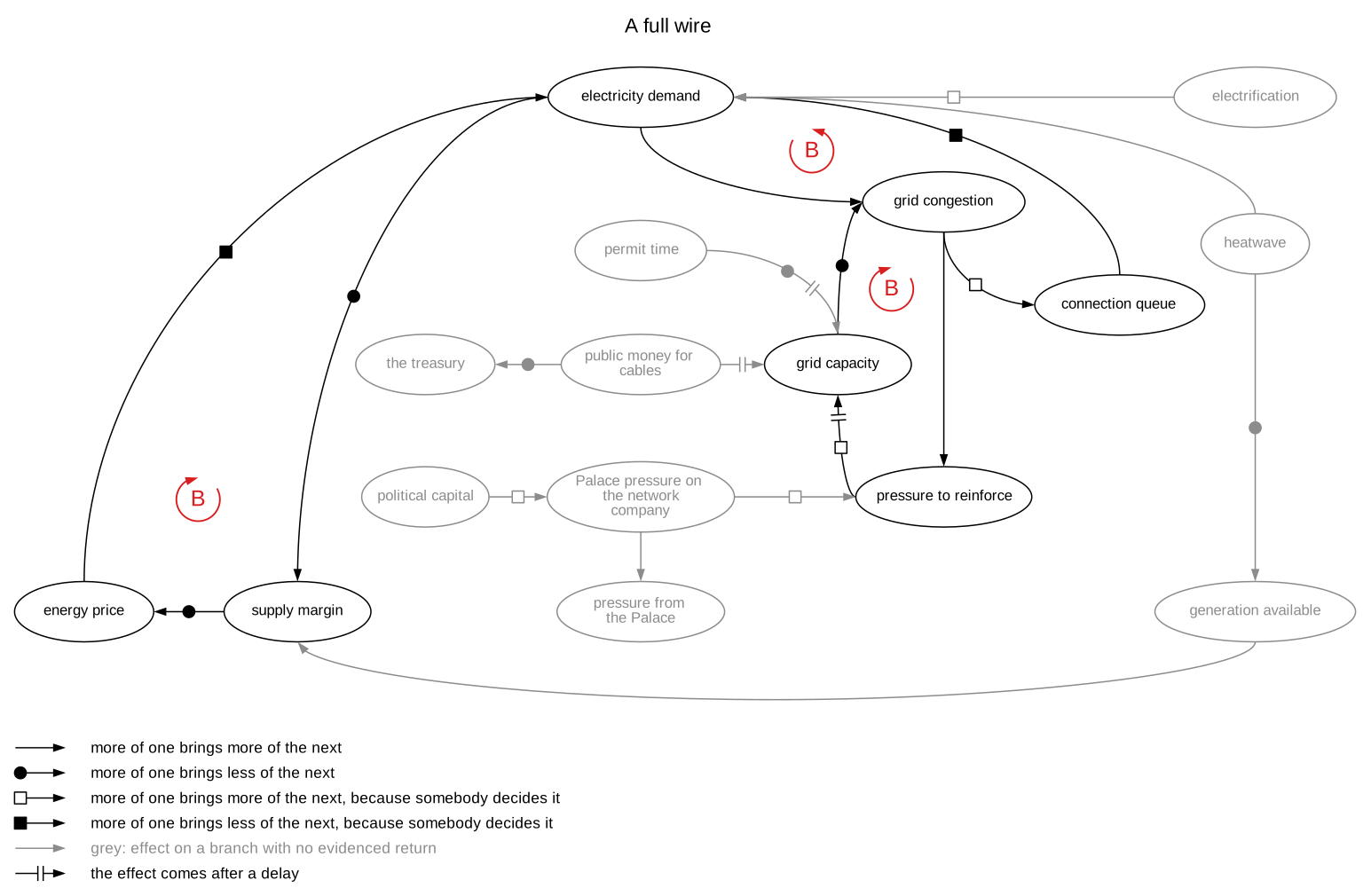
Click to enlarge.
The three loops
Balancing (B):
more electricity demand -> more grid congestion -> a longer connection queue -> less electricity demand
more grid congestion -> more pressure to reinforce -> more grid capacity, after a delay -> less grid congestion
more electricity demand -> a thinner supply margin -> a higher energy price -> less electricity demand
The six remedies
the connection queue, kept by the network company: less electricity demand -> less grid congestion. The Alchemists’ Guild waits, and so does every heat pump.
reinforcement, decided by the network company under pressure: more grid capacity, years later, because cables and substations take years to permit and build. The company would rather keep the queue.
Palace pressure on the network company: more pressure to reinforce, at a price in political capital.
public money for cables, decided by the Palace: more grid capacity, years later, out of the treasury.
shorter permit time, decided by the Palace: more grid capacity sooner, and the neighbours of every new substation at the Palace door.
using less when the energy price rises, decided by each household: less electricity demand, mostly from the people who could least afford to cut back.
A box from Ueberwald
The large transformers that step power down from the main lines weigh as much as a small house and are made by a handful of factories. Orders for them have grown faster than the factories, so the wait for a new one has roughly doubled since 2021 and now runs to years. The special steel inside them is short too, and German electrical manufacturers have said that European steelmakers cannot make enough of it.
A network company that loses a transformer in a storm takes a spare from its store, and a store with no spare left means a district waits for the next one to arrive from somewhere like Ueberwald. So companies order earlier and order more, which fills the makers’ order books, which lengthens the wait, which persuades everyone else to order earlier and more. The queue for transformers is the one queue in the city that everybody joins in order to be safe.
A spare transformer is a small house’s worth of money standing in a yard doing nothing, which is what a spare is for and what no accountant can bear. Companies keep fewer than they should and order when the store is already empty. The Palace can insist on a store, pay for one, or wait with the district for the next box from Ueberwald.
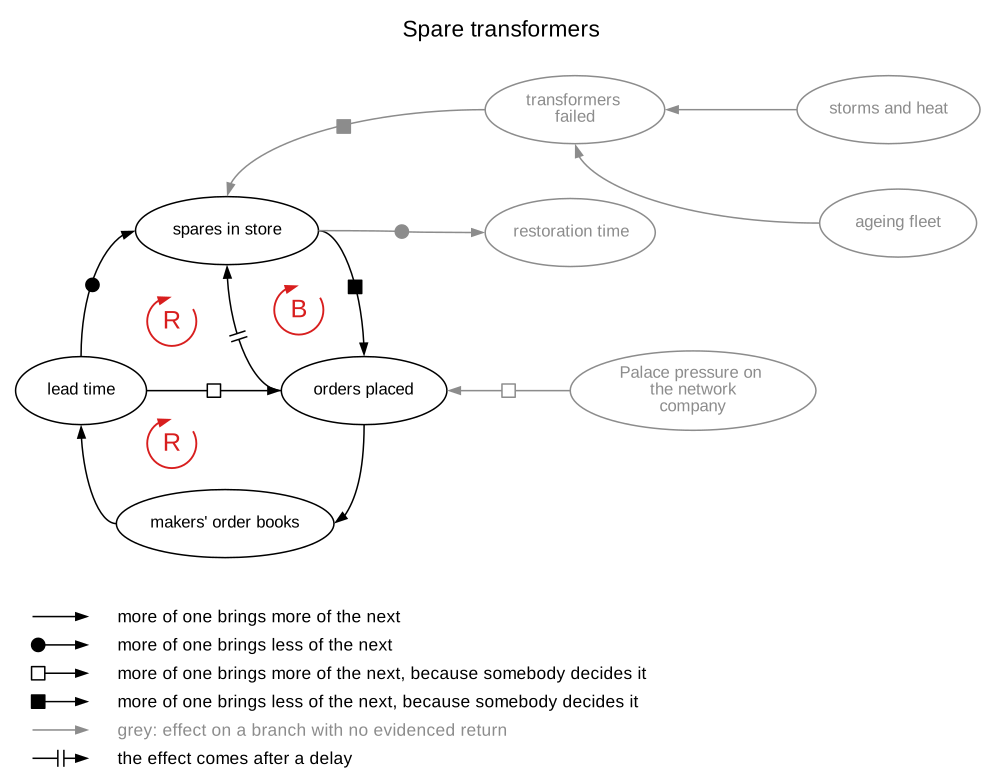
Click to enlarge.
The three loops
Reinforcing (R):
more orders placed -> fuller makers’ order books -> a longer lead time -> more orders placed
a longer lead time -> fewer spares in store -> more orders placed -> fuller makers’ order books -> a longer lead time
Balancing (B):
fewer spares in store -> more orders placed -> more spares in store, after a delay
The two remedies
ordering transformers, decided by the network companies when spares run low: more spares in store, after a delay. Ordering earlier and ordering more fills the makers’ order books and lengthens the wait for everyone. Spares tie up money, so companies keep too few.
Palace pressure on the network company: more orders placed and a store kept, at a price in political capital. The Palace can also pay for the store, or wait.
One wire for everything
Every year more of the city’s life moves onto the wire. Heating moves off gas and coal into heat pumps, carts and cabs move onto batteries, and the shops stopped taking coins some time ago. Each move makes sense on its own, and each one makes an hour without power cost a little more than it did the year before. The storms are getting stronger at the same time, and the transformers that would repair the damage are years away.
The city has a great many reasons to keep that wire up, and fewer ways each year to manage without it.
Essential feeders
Imagined conversation with Lord Vetinari.
Lord Vetinari: “A city that runs everything on one wire has made a single decision a great many times. It would be impolite to call it a single point of failure, so we call it modernisation.”