Transport and movement
The Brass Bridge is closed for an inspection, and the inspection finds something. The bronze hippos at either end are unharmed and look, if anything, relieved.
Every cart that used the Brass Bridge now takes Misbegot Bridge, which was built for people on foot and the occasional pig. By evening the queue reaches the Shambles, Mr Dibbler is selling hot sausages along the length of it, and the Watch, called to a fight on the far bank, is in the queue as well.
Something was found
In December 2021 an inspection found serious damage to the Rahmede viaduct, which carries the A45 motorway across a valley in the Sauerland. The bridge was closed. A month later it was clear that it could never be repaired, and in May 2023 it was blown up. The first half of its replacement opened on December 22nd, 2025, earlier than planned, and the officials thanked the people along the detour for their enormous patience. They had needed it for four years, during which the lorries went through Luedenscheid instead.
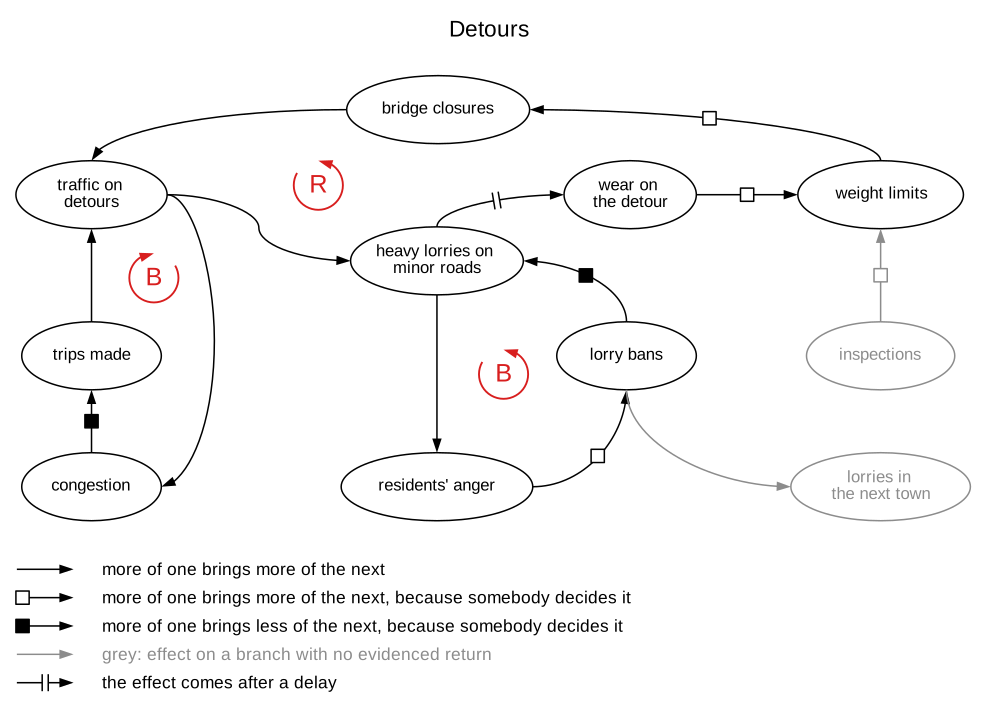
A closed bridge does not take its traffic away. It moves the traffic onto roads that were never meant to carry it, and the heavy lorries wear those roads out in a few seasons. Worn roads get weight limits, and a weight limit is a small closure in its own right, which sends the lorries somewhere else again. The residents of the detour, who never asked to live on a motorway, win a ban on lorries, and the lorries move on to the next town, whose residents begin organising. A ban is the Palace’s to grant, and every one it grants moves the anger along the road to a town that also knows where the Palace is.
Some of the traffic gives up. People leave earlier, travel less or stay at home. It is the only part of a detour that makes it shorter.
In Ankh-Morpork the trolls who work the bridges charge carts by weight, and have never seen a reason to stop doing so merely because the bridge has become the only one.
Click to enlarge.
The three loops
Reinforcing (R):
more bridge closures -> more traffic on detours -> more heavy lorries on minor roads -> more wear on the detour, after a delay -> more weight limits -> more bridge closures
Balancing (B):
more traffic on detours -> more road congestion -> fewer trips made -> less traffic on detours
more heavy lorries on minor roads -> more residents’ anger -> more lorry bans -> fewer heavy lorries on minor roads
The three remedies
bridge inspections, decided by the bridge wardens: weight limits before the bridge decides for itself. Every inspection that finds something closes a little more of the city.
weight limits, set by the bridge wardens: fewer heavy lorries on a worn bridge, and more of them on the next one.
lorry bans, granted by the Palace when the residents are angry enough: fewer heavy lorries on minor roads, and more in the next town.
Three in the morning
In the early hours of September 11th, 2024 a hundred metres of the Carola bridge in Dresden fell into the Elbe, the part that carried the trams. Nobody was hurt. The experts later traced the failure to corrosion in its prestressing steel, started by moisture while it was being built in the GDR, worsened by decades of fatigue and set off by a cold night after a warm spell. They also found that nothing on the bridge had given a reliable warning.
Inspecting more finds more, and closes more, and the city complains about the closures. Inspecting less finds it at three in the morning.
Germany built many of its motorway bridges in the 1960s and 1970s, for traffic a good deal lighter and thinner than the traffic that crosses them now. They are reaching the end of their lives together. Each inspection that finds something adds a weight limit or a closure, and each closure sends its lorries across another bridge of the same age.
Six minutes late
In 2025 only 60.1 per cent of Deutsche Bahn’s long-distance trains arrived on time, and on time means less than six minutes late. The railway blamed the age of its network and the steady growth in traffic.
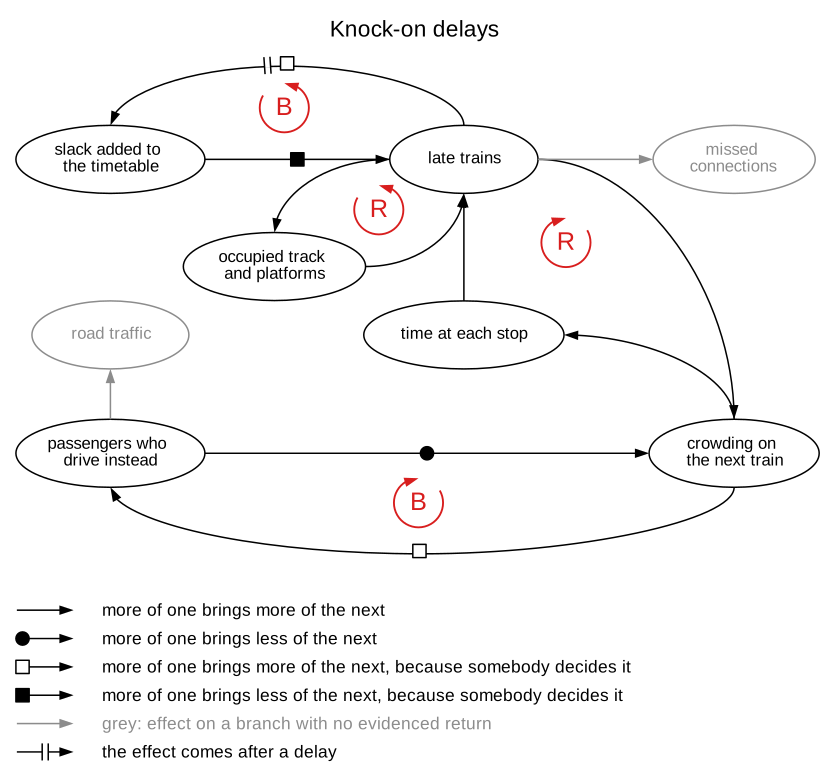
A late train is late for everyone behind it. It holds a platform the next train needed and a stretch of track the train after that was due to use, so one late train makes several. The passengers who missed the train they wanted pile onto the next one, and a crowded train spends longer at every stop while people push on and off, which makes it later still.
The Ankh-Morpork and Sto Plains Hygienic Railway deals with this the way railways always have. It adds slack to the timetable, so that a train can lose five minutes without anyone noticing, and then advertises the slower journey as a new and more reliable service. Some passengers give up and go by road, which eases the crowding on the trains and adds to the queue on Misbegot Bridge.
Click to enlarge.
The four loops
Reinforcing (R):
more late trains -> more occupied track and platforms -> more late trains
more late trains -> more crowding on the next train -> more time at each stop -> more late trains
Balancing (B):
more late trains -> more slack added to the timetable, after a delay -> fewer late trains
more crowding on the next train -> more passengers who drive instead -> less crowding on the next train
The remedy
slack added to the timetable, decided by the railway: fewer late trains, after a delay, and a slower journey for everyone. It costs nothing but the journey, which is why railways like it.
Cut in two places
On the morning of October 8th, 2022 somebody cut the cables of the railway’s own radio network in two places, and Deutsche Bahn stopped every train in northern Germany for nearly three hours. The minister called it deliberate and premeditated. The investigators assumed that whoever did it knew a good deal about how the railway talks to its trains.
It is a cheap way to stop a country. The Thieves’ Guild, which values its own reputation for proportion, considers it rather overdone.
The daily delivery
A shop in the Shades keeps a day’s stock in a back room the size of a wardrobe, and the rest arrives every morning. It works perfectly as long as the carts arrive every morning.
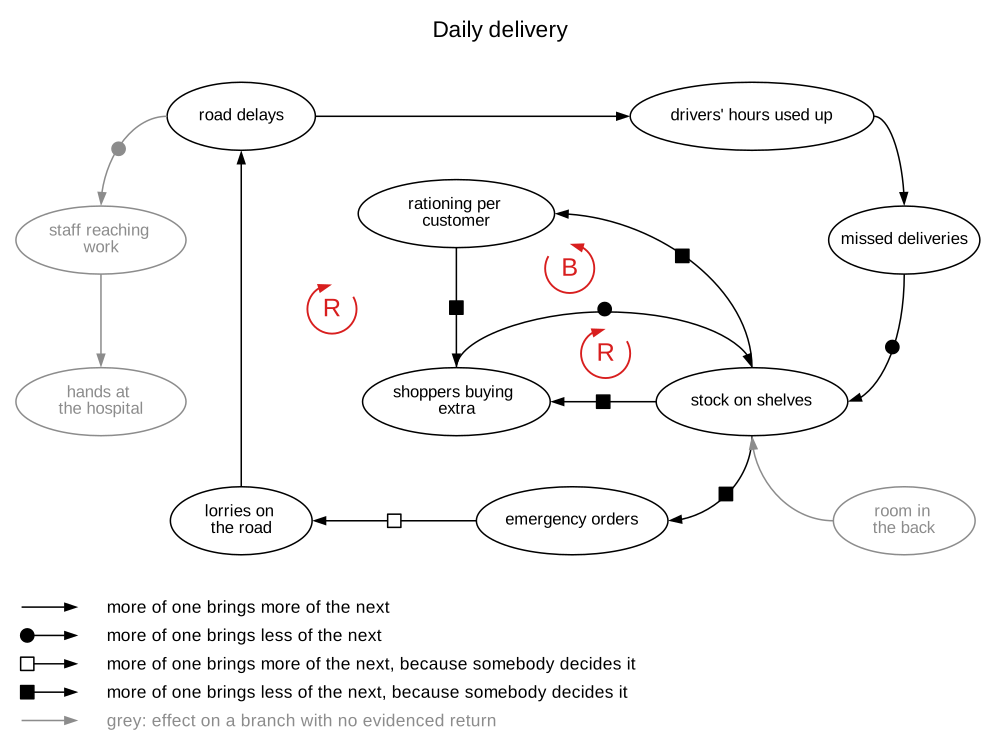
A driver stuck in a queue still has to stop when the legal hours for the day run out, wherever the queue has got to, so a slow road turns into missed deliveries. How few drivers there are to begin with belongs to the people who move Europe’s goods. Thin shelves bring out the shoppers who buy three of everything, and the shelves thin faster. The shop sends emergency orders, which put more carts on roads that were already too slow to deliver the first ones.
The shopkeeper can ration, one loaf per customer, and is called a tyrant for it by people who would otherwise have bought six. When the shops will not ration, the Palace can, and is called a tyrant on a larger scale. The nurses of the Lady Sybil Free Hospital are in the same queue as the bread, and the hospital runs short of hands on the days the bridge runs short of space.
Click to enlarge.
The three loops
Reinforcing (R):
less stock on shelves -> more panic buying -> less stock on shelves
less stock on shelves -> more emergency orders -> more lorries on the road -> more road congestion -> more drivers’ hours used up -> more missed deliveries -> less stock on shelves
Balancing (B):
less stock on shelves -> more rationing per customer -> less panic buying -> more stock on shelves
The two remedies
rationing per customer, decided by the shopkeepers, or by the Palace when the shops will not: less panic buying. It is called tyranny by exactly the people it stops.
emergency orders, placed by the shops: more stock on the way, and more lorries on roads that were already too slow, so the remedy feeds the queue it is waiting in.
After the funeral
The Morandi bridge in Genoa fell on August 14th, 2018 and killed 43 people. Its replacement, designed by Renzo Piano, opened less than two years later, with 43 lamps along it. A bridge can evidently be built very quickly once enough people have died for want of one.
The bridges that have not fallen are rebuilt at the usual speed, and the usual speed is slower than they are wearing out. The traffic on them keeps growing, heavier rain washes out the lines in the valleys, and the summers buckle the rails. A city that moves everything by road and rail has made a long series of promises to steel and concrete, and the steel and concrete are beginning to collect.
The only bridge
Imagined conversation with Lord Vetinari.
Lord Vetinari: “The queue, Drumknott, is the one public service in Ankh-Morpork that has never once failed to turn up.”