Beds without staff
What happens to Europe’s hospitals when the beds are there and the staff are not?
In autumn 2020, Czechia built two temporary hospitals, one in Prague and another in Brno. Together they offered room for 800 additional beds. Neither hospital was used: during the COVID-19 surge Czechia was short of the people to staff them, nurses above all. The Prague site eventually closed; the Brno site became a vaccination centre.
The beds were real. So was the shortage. A bed becomes a place of treatment only when qualified people can assess the patient, give medicines, watch for deterioration and act when something goes wrong. A mattress has never yet noticed a failing pulse.
The pandemic was an exceptional emergency. It exposed a limit that ordinary wards face too: staff, not beds. A hospital can keep its doors open while closing beds, postponing operations and sending patients elsewhere. The building survives. Part of its purpose does not.
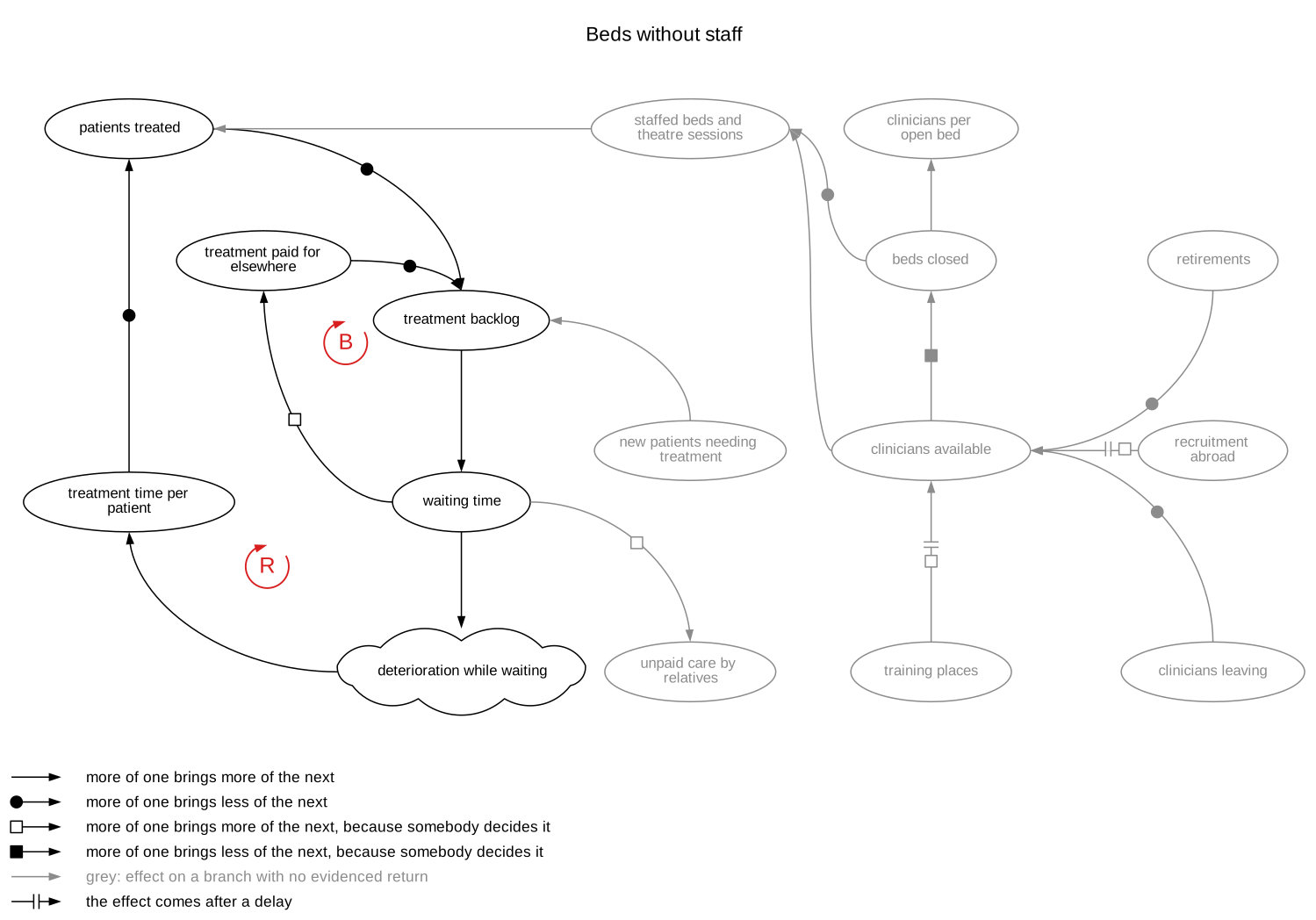
Click to enlarge.
Patients who cannot be treated join the backlog. Some deteriorate while they wait and need more treatment when their turn comes, and a list that shrinks because patients pay elsewhere has shrunk without the hospital treating anyone.
The two loops
Reinforcing (R):
more treatment backlog → longer waiting time → more deterioration while waiting → more treatment time per patient → fewer patients treated → more treatment backlog
Balancing (B):
more treatment backlog → longer waiting time → more treatment paid for elsewhere → less treatment backlog
The room stays shut
In March 2024, Greece introduced afternoon operations in public hospitals to reduce long surgical waiting lists. Some were offered for a fee and others were to be paid for with public recovery funds. There was a practical difficulty: an assessment by the European Observatory on Health Systems and Policies reported that about 40% of operating rooms in public hospitals were closed because of personnel shortages. It also warned that extra afternoon sessions might draw clinical time away from ordinary free operations.
A surgical team needs more than a surgeon. Anaesthetists, theatre nurses, recovery staff, sterile equipment specialists and people to care for the patient afterwards must all be available. A missing member can make an otherwise equipped operating room unusable. Opening another session on the timetable does not necessarily create another team.
For someone waiting for a hip replacement, the missing team means a longer wait. An operation can be classified as non-urgent without being unimportant. The person may spend months in pain, give up work, depend more heavily on relatives or lose mobility while waiting. Long waits can worsen some patients’ health. They also postpone the benefits that treatment was meant to bring.
When staff are scarce, hospitals make choices. They may protect emergency care and postpone scheduled treatment, limit admissions or send patients to another hospital. Those decisions can be necessary for safety. They also transfer the consequences to patients, families, ambulance services and the hospitals receiving the extra work. Closing an inadequately staffed ward may prevent immediate harm while still leaving a community with less care.
The queue moves
Imagine a hospital that can no longer staff one surgical ward reliably. It reduces the number of patients it admits. The remaining wards work close to capacity, and patients wait longer for planned operations. Some people pay for treatment elsewhere. Some travel farther. Others wait because they have neither the money nor the means to leave.
The failure moves rather than disappears. The hospital may report fewer cancellations after reducing its operating timetable. The waiting list may even shrink if patients are transferred, treated elsewhere or removed for other reasons. None of those figures, alone, tells whether the people who needed treatment received it.
There is a second cost to delay. A person waiting for treatment may need pain relief, repeat appointments and help at home. For some conditions, waiting can make eventual treatment more difficult. A family member may take leave from work to provide support. The care system then absorbs work that hospital treatment might have reduced.
The effects fall unevenly. People with money can sometimes travel, take time off or buy alternatives. People with fixed shifts, limited savings or no nearby transport have fewer options. A closure counts the same on the hospital’s spreadsheet wherever the patient lives; the journey to the replacement does not.
Hospitals can consolidate services into larger units, and sometimes that improves expertise and safety. The question is whether the receiving service has enough people and capacity, and whether patients can reach it. Moving an operation from one building to another does not make the need disappear.
Staff still leaving
The people who remain must manage the patients who remain, often with fewer colleagues and less room for error. Extra shifts and temporary staff may keep services running. But a rota held together by overtime is vulnerable to sickness, retirement and one more resignation.
The OECD and European Commission describe an observed danger: understaffing increases stress, which can encourage workers to leave, making conditions harder for those who stay. A hospital can lose capacity without anyone deciding to close it. Each departure makes the next departure more tempting.
Replacing the people who leave takes time. Nursing and medical training last years; new graduates need experienced colleagues to help them learn safely. A hospital struggling to cover today’s shifts also has less time for mentoring tomorrow’s workforce. More training places are a slow remedy for a ward that needs a nurse tonight.
Nor are all clinicians interchangeable. A doctor trained in one specialty cannot simply replace an anaesthetist. A ward nurse cannot be reassigned indefinitely to intensive care without the appropriate preparation. A healthcare assistant can relieve trained staff of suitable tasks, but cannot assume every clinical responsibility. Shortage figures that lump all staff together conceal the particular qualification that is missing.
A commonly repeated estimate of 1.2 million missing doctors, nurses and midwives across the EU in 2022 illustrates that problem. It measures the gap against a population-based staffing benchmark, not actual vacancies. It cannot tell a patient whether an anaesthetist will be there for the operation.
Borrowing a workforce
Hospitals recruit beyond their own borders because they cannot wait for every replacement to finish training locally. European rules make it easier to recognise certain qualifications gained in another member state. But the automatic recognition system covers specified qualifications and training standards; specialist roles, language requirements and registration can still require additional steps. Safety checks are necessary. So is the time to complete them.
Ireland offers a revealing case. More than half its nurses were foreign-trained, according to WHO Europe’s 2025 account of health-worker migration. The OECD also describes Irish-trained nurses leaving for other countries while Ireland recruits abroad to fill shortages. Ireland can train nurses, lose some of them, and then recruit nurses trained elsewhere. Ireland has a working recruitment system and a difficult retention problem at the same time.
A nurse moving from Romania to Germany can help a German hospital once the paperwork is done. If the Romanian hospital was already short of staff, the move may leave it struggling. No new nurse has been created by the journey. Recruiting from outside Europe can enlarge the workforce available within Europe, but the country of departure may have its own shortage. The calculation must include those patients too.
Clinicians have every right to seek safer work, better pay and a life they prefer. WHO’s recruitment safeguards concern the conduct of employers and governments, not restrictions on an individual’s freedom to move. A sensible response must improve training and retention in receiving countries without treating other health systems as stores of spare staff.
Whether people arrive and choose to remain also depends on the wider conditions of migration: recognition of skills, housing, family life and working rights. A job offer is only one part of making a hospital somewhere a person can work for years.
The wrong measure
The familiar story says Europe needs more doctors and nurses. It does. But their numbers have grown in many EU countries even while shortages have persisted. More clinicians in the national total can coexist with fewer staffed beds in the wrong town, specialty or shift. A hospital can close beds until the number of nurses per remaining bed looks reasonable again. The staffing ratio improves. The patients who would have used those beds still need treatment.
A shortage may mean too few people have been trained. It may mean people have left the profession, or that their hours are no longer sustainable. It may mean a hospital cannot afford to employ the staff it needs, even when trained people are available. Each cause calls for a different remedy. Recruiting abroad will not, by itself, fix a rota that drives people away. Building a new wing will not bring an anaesthetist to the operating theatre.
Better pay, safer workloads, more flexible careers and sensible use of clinical skills can retain workers and increase useful capacity. Hospitals can also reduce unnecessary paperwork and use technology to free clinicians for patient care. But more throughput is not necessarily better care if it depends on fewer staff caring for more patients without sufficient time or support. Nor can a hospital simply reassign every nurse to the task its statistics find most urgent.
Other shortages can compound the failure. A hospital might have clinicians but lack particular medicines; during an epidemic it may have to shift staff towards urgent cases and delay other treatment. Treating these as one vague shortage produces confident plans and cancelled operations.
The Czech temporary hospitals made the gap between beds and staff unusually visible. Buildings and beds were provided, but there were not enough people to turn them into care. In ordinary times, the same loss can be harder to see. A ward closes to admissions, a waiting list lengthens, an experienced nurse leaves, and another hospital accepts the next patient.
A health system may remain open while offering less treatment. The eventual loss is borne by the people who must wait, travel, pay or go without, and by the workers asked to make the remaining service function.