Care without carers
What happens when Europe’s old need looking after and there is nobody paid to do it?
On Tuesday morning an older woman needs help out of bed. Someone must help her wash, get dressed and have breakfast. Her tablets are waiting. If she has dementia, she may need reassurance from somebody who knows her routines. Then the care agency calls: nobody can come.
Her daughter takes the morning off work. Or a neighbour visits. Or her husband tries to help, although he needs assistance himself. Sometimes nobody comes, and the woman misses a meal, stays in bed or attempts something she cannot do safely.
The care worker is missing. The work isn’t. It has been handed to somebody else, whether that person can manage it or not.
As Europe grows older, more care work may be handed on this way. Europe’s care system already leaves needs unmet: the Commission found that almost half of older people who needed long-term care lacked some help. That covers needs of different kinds and degrees, and many of those people had part of the help they needed. The system still has less spare capacity than the waiting lists alone suggest.
Click to enlarge.
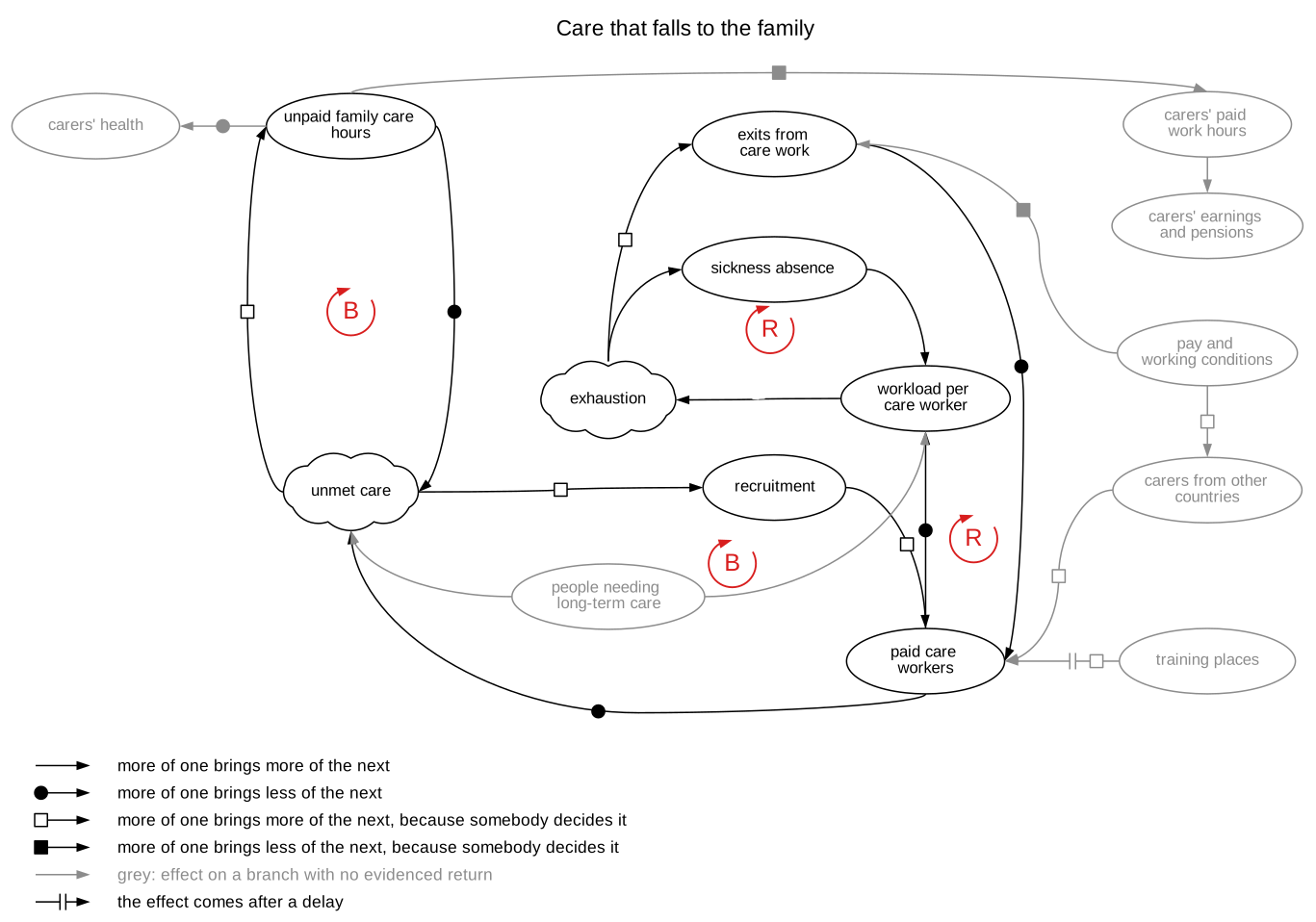
A shortage spreads in two ways. Families take on care that paid workers cannot provide. Meanwhile, the workers who remain carry heavier loads, making further absences and departures more likely. Recruiting replacements can help, but neither family time nor recruitment is an unlimited reserve.
The four loops
Reinforcing (R):
fewer paid care workers → more workload per care worker → more exhaustion → more exits from care work → fewer paid care workers
more workload per care worker → more exhaustion → more sickness absence → more workload per care worker
Balancing (B):
more unmet care → more unpaid family care hours → less unmet care
more unmet care → more recruitment → more paid care workers → less unmet care
The cancelled visit
Long-term care keeps ordinary life possible when illness, disability or age makes daily tasks difficult. It can mean washing and dressing, preparing food, helping someone move about or noticing that a familiar person has begun to behave differently. It can involve nursing, though much of it happens outside hospitals.
In a residential home, an absent worker leaves colleagues with more residents to help. A visiting agency may shorten appointments, cancel less urgent calls or stop accepting new clients. A live-in carer may have to remain longer than planned because nobody arrives to take over.
Each response can protect the most urgent care for a while. Each also removes something. A shorter visit may get someone washed but leave no time for breakfast. A care home can keep residents safe by refusing admissions, but the people it refuses still need somewhere to go.
Those choices eventually reach households. A parent who could remain at home with two visits a day may not manage with one. A family may pay privately for the missing visit. If it cannot afford to, somebody has to find the time.
The family reserve
Family care can be generous, skilled and freely chosen. Relatives know the people they care for. They notice changes and provide company that a paid visitor on a crowded rota may struggle to offer.
But relatives have other lives. Most unpaid long-term care takes place within families, and many carers also hold paid jobs. If a daughter covers Tuesday’s missed visit, her employer loses her hours. If the visits keep failing, she may cut her working week or give up her job. Her household loses income and pension contributions just as it may need to spend more on help.
The original shortage can therefore create another. A shop loses an experienced employee. A care home loses someone from its own rota because she is now caring for her father. An employer trying to recruit staff may discover that applicants cannot accept the hours without care for relatives at home.
The public service may record one fewer visit delivered. The household has supplied the missing work without putting it on the public payroll. That isn’t necessarily a saving for society. It is a transfer of cost, much of it paid in time and health.
And a family that can manage for a week may not manage for a year. Unpaid carers can become exhausted or ill themselves. Women often carry a disproportionate share of the work, but the limit applies to everyone: there are only so many hours in a day, and sleep eventually makes a claim on some of them.
When nobody can
Some older people have no relatives nearby. Others have family who are ill, working fixed shifts or unable to lift them safely. Even willing relatives cannot provide every kind of care. A neighbour can bring lunch; that does not make them a trained nurse.
When paid care withdraws and families reach their limits, needs go unmet. Meals may be missed, medication routines disrupted and small changes in health overlooked. Some people who could have stayed at home with reliable support may need more intensive care. Help that comes too late can send people to hospital. None of these outcomes follows from every missed visit. The risk grows when the missing help becomes routine.
Moving into residential care is not necessarily an answer. Residential homes need staff too. A bed may exist on paper but lack the staff to fill it safely; another may be far from family or beyond the household’s means.
The people most easily overlooked are those who cannot buy private help and have nobody with the time to argue on their behalf. An agency may have cleared its waiting list by refusing new clients. The people it refused still need care.
Across the border
Europe already keeps parts of its care system working with people who travel from elsewhere. What happens when those people cannot, or no longer wish to, come?
Austria offers a particularly clear example. Its 24-Stunden-Betreuung allows households to arrange live-in assistance, often from carers travelling from Romania and Slovakia. Carers commonly alternate stays with time at home. When pandemic border restrictions interrupted that rotation in 2020, Austria’s government arranged a special train to bring Romanian carers through Hungary. The train showed how much of a household’s daily routine could depend on somebody crossing a border on time.
Germany employs substantial numbers of people with foreign citizenship in home-care services and residential facilities. Italy depends in a different way on household employees, including badanti who assist older people day to day. Its domestic-work records show the importance of foreign workers, though they also include domestic cleaners and miss unregistered work. These aren’t interchangeable employment systems, and their shortages will not look identical.
A worker deciding whether to return to Austria has a home life elsewhere. A badante deciding whether to stay in Italy has to live on the wage and under the conditions offered. Recruiting people from another country can fill a real gap, but it does not suspend their own needs or the care requirements of the places they leave. A vacancy is filled only if people can come and stay.
The exhausted rota
One care worker resigns. Colleagues take extra visits or heavier shifts. Some become exhausted, take sick leave or reduce their hours. The employer has more gaps to fill, and the job looks less attractive to the next applicant.
A staffing problem can feed itself like this. Difficult workloads and insecure conditions are established problems in long-term care. Across the wider social-services sector, pay has also remained markedly below national averages. More recruitment does little if the service keeps losing the people it recruits.
A provider may reduce the district it covers, stop taking new clients or close. Reducing visits can keep the remaining rota safe for a time. Closure is harder to reverse. Workers find other jobs, clients make other arrangements if they can, and a replacement service needs staff, management and funding before it can reopen.
The apparent improvement can be misleading. Fewer appointments are booked because fewer appointments can be offered. A family stops asking after being turned down repeatedly. On a spreadsheet, demand may appear to have eased. In the kitchen, it has not.
Getting care back
The Commission’s care strategy projected that maintaining existing coverage would require more than 1.6 million additional long-term care workers by 2050. Those workers would only maintain a level of coverage that already leaves some people without enough help.
Training more carers and recruiting from other countries can expand capacity. Both take time. Retaining workers may have a more immediate effect. Better pay, safer workloads, reliable rosters and paid travel time can make the job one that people can afford to keep. Equipment can spare someone’s back and planning can reduce wasted journeys. Neither can replace every hour spent helping a person eat, wash or feel safe.
Family carers need support too: respite care and arrangements that let them keep paid jobs if they wish. But a relative’s willingness to help is not a permanent substitute for an adequate service.
On Wednesday the older woman still needs help out of bed. A functioning care system is one that can send somebody, and can send them again on Thursday, without quietly consuming the health and livelihood of everybody involved.