Keeping Europe moving
What happens when Europe’s goods are in the warehouse and nobody can move them?
In December 2025, German hauliers reported parking usable lorries and turning down work. They could find customers and vehicles, but not enough drivers. More revealing than any count of vacancies was what companies said they were doing: refusing business they would once have accepted.
A warehouse full of goods is reassuring until somebody asks for one of them. A pallet still needs loading, a driver, a road and someone to receive it. A factory waiting for a component cannot fit a delivery promise into its machinery. Nor can a shop put an expected shipment on a shelf.
Transport can fail without a road closing or a vehicle breaking down. Goods remain available. The service that connects them to their users becomes harder to buy.
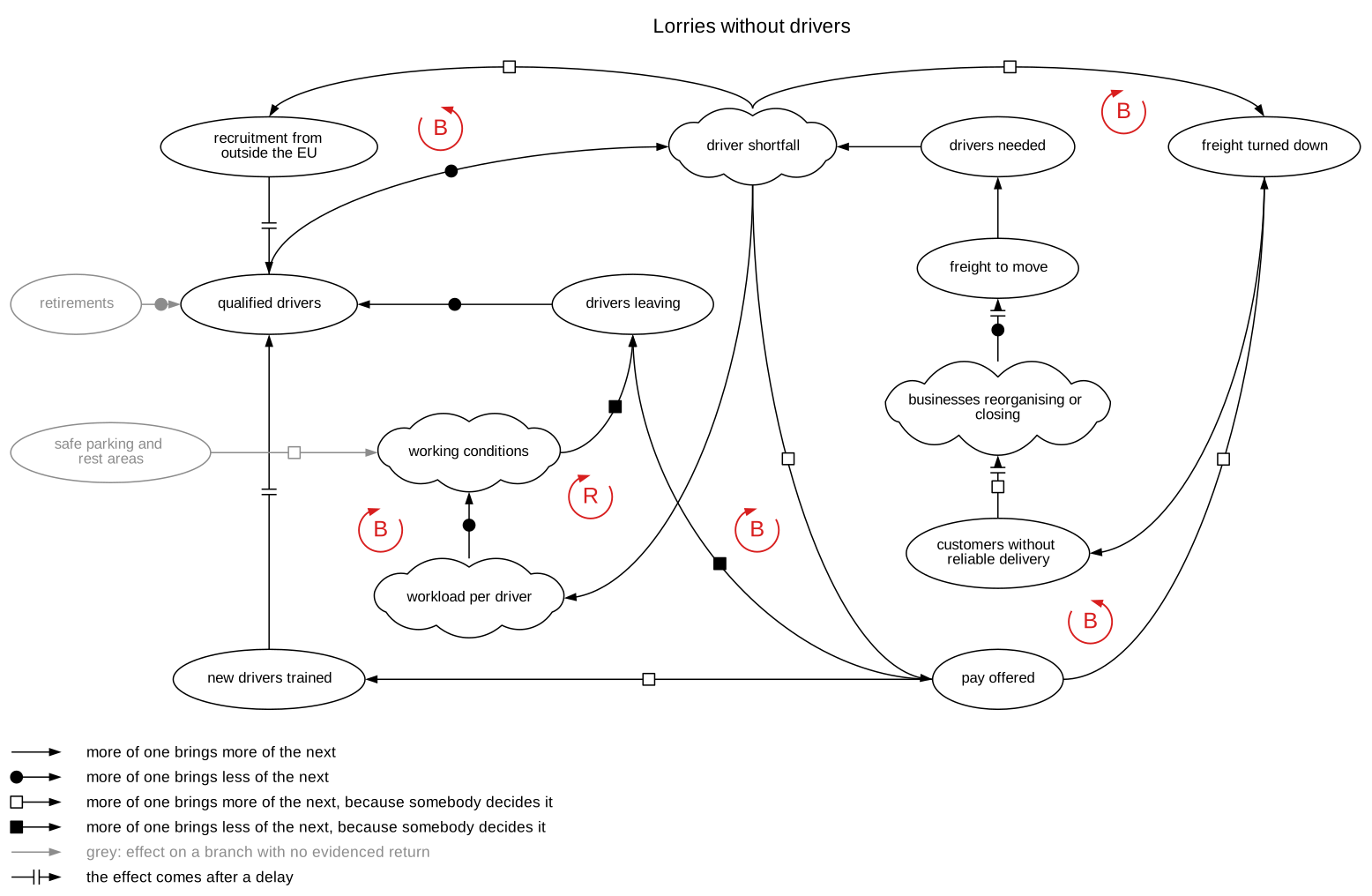
Click to enlarge.
A driver shortfall leads hauliers to turn down freight, and customers left without delivery reorganise or close. The shortfall then eases because the work has gone, while heavier workloads drive more drivers out.
The six loops
Reinforcing (R):
more driver shortfall → more workload per driver → worse working conditions → more drivers leaving → fewer qualified drivers → more driver shortfall
Balancing (B):
more driver shortfall → more freight turned down → more customers without reliable delivery → more businesses reorganising or closing, after a delay → less freight to move, after a delay → fewer drivers needed → less driver shortfall
more driver shortfall → higher pay offered → more freight turned down → more customers without reliable delivery → more businesses reorganising or closing, after a delay → less freight to move, after a delay → fewer drivers needed → less driver shortfall
more driver shortfall → higher pay offered → fewer drivers leaving → more qualified drivers → less driver shortfall
more driver shortfall → higher pay offered → more new drivers trained → more qualified drivers, after a delay → less driver shortfall
more driver shortfall → more recruitment from outside the EU → more qualified drivers, after a delay → less driver shortfall
The deliveries left behind
A haulier short of drivers has choices. It can raise its prices, accept fewer orders, combine journeys or concentrate on regular customers whose loads pay enough to cover the trip. Germany’s hauliers were already declining tenders they considered uneconomic. The practice keeps a haulier in business and leaves the customer whose freight nobody wants without a carrier.
If drivers stayed scarce for long enough, the effects would be uneven. A large retailer filling several lorries each day might still obtain deliveries by paying more or contracting well ahead. A small manufacturer shipping irregular loads would have less room to bargain. A remote shop at the end of an expensive route might wait longer or have to order in larger quantities.
When a delivery arrives can count for more than how many drivers are missing nationally. A shipment delayed for a day is an inconvenience when it contains something a household can buy elsewhere. The same delay may stop production when it contains the part needed to finish a machine. A fresh-food delivery has a clock of its own. Delivering everything eventually is not the same as delivering it when it can still be used.
Businesses can hold larger stocks, order earlier or pay for dedicated transport. Those responses tie up money, require storage and favour firms able to afford both. Smaller suppliers may lose orders because customers want a delivery promise they cannot make. The manufacturer that survives by keeping extra components in a warehouse has reduced its immediate vulnerability by taking on a different cost.
The people in between
Road freight is only part of the journey. At Rotterdam, a container needs people to secure or release it aboard ship and to move it inland, and others to run the terminal equipment, handle the documents and maintain the machinery. A driver waiting outside the gate cannot do the work of a crane operator. A warehouse picker cannot stand in for a licensed driver simply because both jobs involve boxes.
In October 2025, a strike by the workers who secure containers aboard ships, combined with storms, brought container-handling productivity at Rotterdam close to a standstill. Maersk reported a backlog even after work resumed. The harbour was there; so were the ships and cranes. One missing job stopped most of the chain.
Those workers had withheld their labour in a dispute over pay and conditions, and an agreement was reached. But the interruption shows how much a working transport system depends on particular people doing particular jobs at the right time. The shipping passages may be open while a shipment remains stuck on the quay.
The European Commission identifies shortages across several transport professions, including lorry and bus drivers and some seafarers. Bus operators compete for some of the people who might drive lorries, while a shortage of ship officers cannot be fixed with another forklift driver. A failure at one handover can hold up everyone who follows it.
An uneven shortage
Europe does not have too few people in every transport job. The European Labour Authority found an overall surplus of general freight handlers in its warehousing analysis, alongside shortages of mechanics and repairers. Elsewhere, the vacancy may be for a driver qualified to carry a heavy load across borders, or for somebody prepared to work nights in a particular depot.
A company can report a shortage while unemployed people live nearby. The people available may lack the required licence, have caring responsibilities that rule out the shift, or be unwilling to accept the pay and conditions. A national employment total won’t tell the company which problem it has.
A professional lorry driver needs the right driving licence and the EU’s professional qualification. Someone recruited from another country may need documents recognised or training completed before taking the wheel. Safety rules protect everyone sharing the road. They also mean that a vacancy cannot be filled merely by finding somebody who can drive a car.
Moving a qualified driver from one European country to another may solve one employer’s problem and create another’s. Recruitment from outside the EU can enlarge the workforce, but permissions, qualifications, housing and a worker’s decision to stay all affect whether the lorry actually moves. Migration involves people choosing a life, not spare drivers waiting at a border for instructions.
Making tomorrow worse
When companies cannot recruit, they ask existing staff to cover more work. Some drivers welcome overtime. Others reach the limits of safe hours or decide that life on the road has already taken enough of their time. EU driving and rest rules exist for good reasons; missed delivery slots do not make fatigue harmless.
Working conditions can themselves be a cause of the shortage. Long periods away from home, unpredictable loading times and inadequate places to rest make the work harder to sustain. The Commission has documented a serious shortage of suitable safe and secure lorry parking. The problem isn’t that drivers have forgotten the value of sleep. The infrastructure needed to take a safe rest is part of the transport system too.
Parcel delivery presents another version. A customer sees one company name on the van; the work may pass through several subcontractors. The European Labour Authority has documented unpaid waiting time, under-declared hours and obscured responsibility in parts of the courier industry. Making delivery cheaper by pushing costs and risks onto workers can keep prices down for a while. It can also make it harder to keep people in those jobs.
If understaffing means heavier workloads, more sickness and more departures, a temporary shortfall can begin to reinforce itself. Better pay, schedules, facilities and training can interrupt it. But the first employer to offer tolerable conditions may also be recruiting from a neighbouring company whose work still needs doing.
The smaller network
A transport firm that cannot cover every route need not collapse. It may become smaller and more profitable. It can stop serving difficult destinations, turn down low-paying customers or switch to fuller loads. Its surviving drivers may be better paid, and the firm’s accounts may improve.
From the firm’s perspective, that is recovery. From the perspective of a business left without affordable delivery, it may be the beginning of a decline. A shop that receives fewer shipments may reduce its range. A manufacturer may move work closer to suppliers or withdraw a product. A remote community may become more dependent on the few firms still prepared to serve it.
Once customers reorganise around reduced service, restoring it is not as simple as finding another driver. A supplier may have lost its contract. A warehouse may have closed. A haulier may have sold a vehicle, surrendered a route or left the business. Demand for transport can then fall because there are fewer businesses left to transport goods for.
That is the trap: a shortage of transport can appear to improve because the work it used to carry has disappeared. Fewer unfilled orders may mean that deliveries have recovered. They may also mean that customers have stopped placing orders.
Keeping routes open
Firms can train drivers, improve jobs, combine loads and invest in vehicles that reduce labour-intensive tasks. Automation can help terminals and warehouses move goods with fewer hands. It also needs mechanics and technicians, some of whom are already difficult to recruit. No warehouse software can make a driver arrive qualified and rested.
Nor is every delay a labour failure. Storms, congestion, customs procedures, industrial disputes and blocked sea routes can interrupt freight even with every shift staffed. The remedy depends on the mechanism. More drivers will not reopen a blocked canal. Another motorway lane will not staff a lorry.
The German hauliers who parked vehicles were not reporting the end of European freight. They were describing something more selective: work they could no longer take, even though vehicles were available. If hauliers keep choosing their loads, the important question is no longer how many lorries Europe owns. It is which businesses, households and places can still get a delivery, and which have quietly stopped asking.