By the book

The Treaty on European Union says the Union shall promote economic, social and territorial cohesion, and solidarity among Member States. The Treaty on the Functioning of the European Union gives the central bank one primary objective, to maintain price stability, and asks it to support the Union’s other objectives only without prejudice to that one.
Cohesion sits high in the Union’s list of aims. Budgets, credit and savings are moved by narrower rules, each written for its own institution, and the objective can be in the hierarchy without being in the rule that decides.
Charged with it
One set of rules is written for the gap itself. The regional fund shall contribute to reducing disparities between the levels of development of the various regions, and each cohesion programme has to set out its main challenges taking into account economic, social and territorial disparities as well as inequalities. For 2021 to 2027 that comes to €392 billion, almost a third of the EU budget. Since September 2025 the regional fund’s rules also allow it to support industrial capacity for defence and affordable housing.
Duly noted
The Union’s other policies, and the internal market, shall take into account the cohesion objectives and contribute to them. The central bank’s support for those objectives comes after price stability, and its operative rule is a two per cent inflation target in the medium term. Its strategy says the Treaty objectives it supports include balanced economic growth, a highly competitive social market economy aiming at full employment and social progress, and a high level of protection and improvement of the quality of the environment.
The fiscal framework names convergence as a purpose of the yearly surveillance cycle: closer coordination of economic policies and sustained convergence of the economic and social performance of the Member States. The path itself is set in net expenditure, a single operational indicator anchored in debt sustainability, and it has to put the debt ratio on a plausibly downward path, keep the deficit below 3%, and meet the safeguards on both.
Spending on programmes funded by the Union, cohesion among them, and the national money that co-finances it are kept outside the path, which spares that spending without making convergence the target.
Rules of their own
The banking supervisor works with a view to contributing to the safety and soundness of credit institutions and the stability of the financial system. A recital of its founding regulation asks it to take full account of the relevant macroeconomic conditions in Member States, in particular the stability of the supply of credit and facilitation of productive activities for the economy at large. The task it carries out is the prudential supervision of each bank.
Pension funds invest in the best long-term interests of members and beneficiaries as a whole, and member states shall not require them to invest in particular categories of assets. Insurers invest in the best interest of all policy holders and beneficiaries, diversified so as to avoid excessive reliance on any one geographical area, and member states may not require the assets covering their technical provisions to be held in any particular member state. Dutch pension funds holding three times as much in US non-financial companies as in EU ones are operating under the first of those rules.
The savings and investments union, a strategy and not a law, aims to improve the way the EU financial system channels savings to productive investment, with funding available to businesses regardless of where they are based in the EU.
The loop between them
Each rule can be followed to the letter while the rules together can widen the gap between member states. In a member state with high debt and weak growth, the fiscal path asks for consolidation, and consolidation in a downturn can raise the debt ratio before it lowers it. Lower growth there plausibly lowers the returns its firms are expected to earn.
Pension funds and insurers invest in the interests of their members and policy holders, and diversify, and the EU rules they follow do not require them to keep capital in a member state whose firms offer less. Where firms do get less finance, limited access to finance costs them productivity. The mechanisms are separate, and they can meet in one member state: weak growth that makes its firms less attractive to investors, and a fiscal path that leaves less room for public investment.
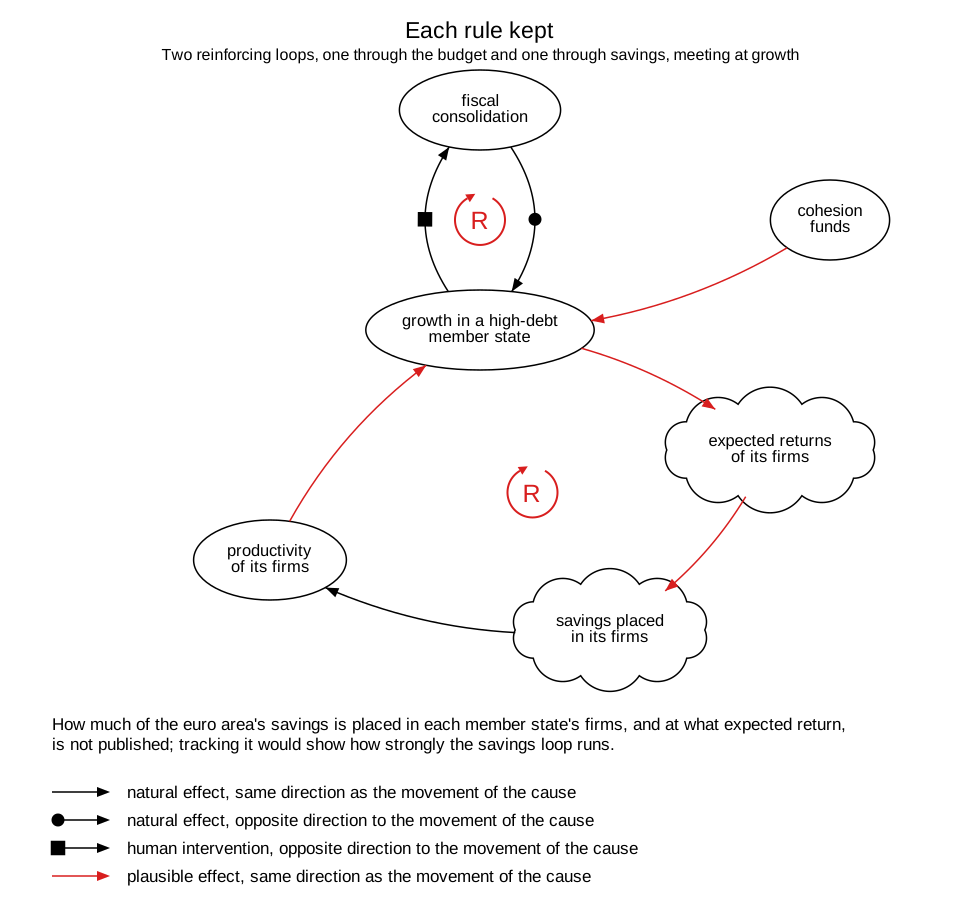
Cohesion policy has €392 billion over seven years for that gap, and since September 2025 some of it may support defence.