The denominator

Between 2009 and 2012 the euro area tried to cut its way out of debt. Governments raised taxes, cut public pay and trimmed benefits, and the euro area’s public debt rose from 80.0% of GDP to 90.8%. Greece went from 128.5% in 2009 to 175.1% in 2011, and its ratio fell in 2012, the year private creditors took losses in a restructuring. The cuts were real. So was the arithmetic that undid them.
A debt ratio has two ends. The top is what a state owes, the bottom is what its economy produces in a year, most of it paid out as wages and profits to the people in it. Nearly every rule written to keep the euro area’s public finances in order runs through that ratio, as the spiral between states and banks does. The rules read the top. The bottom moves on its own, and it does not always move the way the rules expect.
Half a fraction
Since 30 April 2024 each member state agrees a path for its spending over an adjustment period of four or five years, extendable to seven in return for reforms and investment. Debt above 90% of GDP has to fall by at least one percentage point a year on average, debt between 60% and 90% by half a point, and, in a member state with debt above 60% of GDP or a deficit above 3%, structural deficits have to come down far enough to leave a margin of 1.5% of GDP below the 3% ceiling.
A country in an excessive deficit procedure opened on its deficit has to improve its structural balance by at least 0.5% of GDP a year as a benchmark while the deficit stays above 3%. In July 2024 the Council opened such procedures against Belgium, France, Italy, Hungary, Malta, Poland and Slovakia.
The rules do not cut anything themselves. Governments cut, under the rules, and the cut is a decision every time: which tax, which benefit, which ward, which school. What the rules fix is the direction. A higher debt ratio calls for more consolidation.
The measure the rules watch is spending net of interest, among other exclusions. What a state pays its creditors sits outside the path; what it spends on everything else sits inside it.
Penny wise
Before the crisis, the standard assumption was that a euro of consolidation took about half a euro off output. In the first years of the crisis it took more. For 2010 and 2011, each percentage point of GDP of planned consolidation went with roughly a 1% loss of output relative to forecast, which puts the multipliers actually at work substantially above one. The effect looks weaker in later forecasts, either because multipliers fell or because forecasters learned.
A multiplier near one changes the sign of the result. With a multiplier of one, consolidation raises the debt ratio in its first year in countries whose debt is above 60% of GDP; in high-debt countries that keep tightening year after year, a notable decline may only come in the third year, especially in a downturn.
The cut lowers the debt, and it lowers the output the debt is measured against, and for a while the second effect is larger. Over the longer run the damage may not wash out at all: attempts to reduce debt through consolidation have very likely raised debt ratios, because the loss of output proved long-lasting.
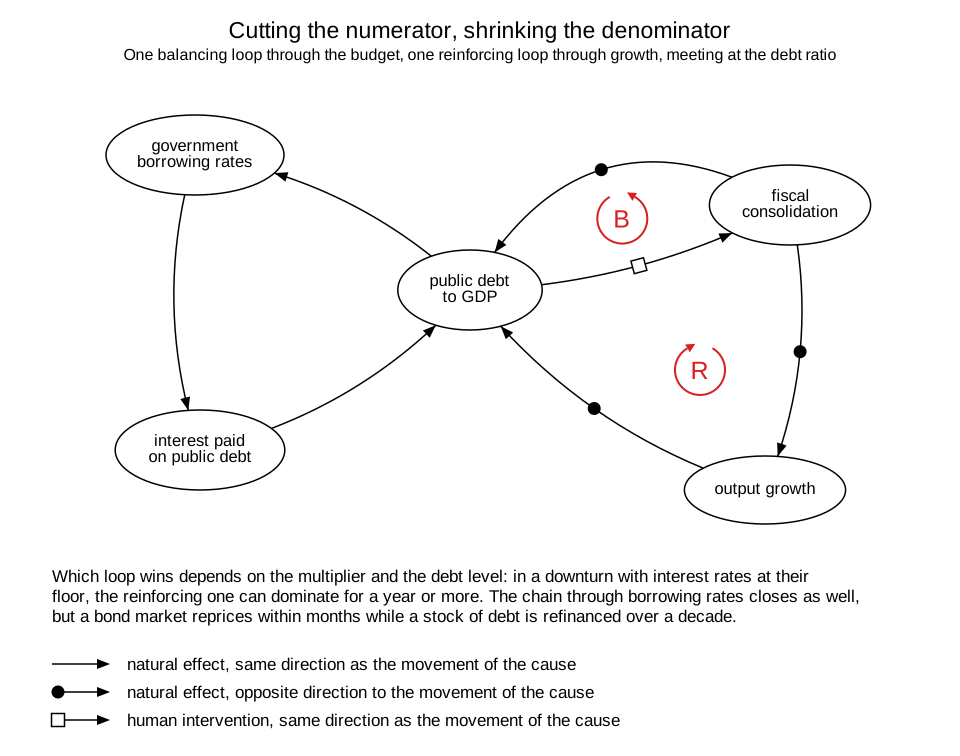
One decision, two effects, pulling in opposite directions on the same ratio. Through the budget, a cut brings the debt down, and the rules are written as if that were the whole story. Through the economy, the same cut brings output down, and with it the bottom of the ratio.
Which effect wins depends on how large the multiplier is and how high the debt already stands, and the answer changes with the times: in a deep downturn, with interest rates at their floor and the debt above 60%, the second effect can win for a year or more. Short of an escape clause, the rules make the same demand in both cases.
Time is money
Interest is the other way into the ratio. While the interest a state pays stays below the growth of its economy, debt erodes on its own; a state can roll its debt over and watch the ratio drift down, and in that case public debt may have no fiscal cost. As late as 2024 the projected path of the euro area debt ratio was driven up by primary deficits and partly held down by an interest rate below the growth rate.
The condition can turn. The ECB’s deposit rate went from zero in July 2022 to 4% in September 2023, came down to 2% by June 2025 and has been rising again since June 2026. Higher rates reach a government slowly, as old debt matures and is replaced: euro area debt-servicing costs were expected to rise by around one percentage point of GDP over ten years, and possibly by more than two for countries with high debt.
In 2025 interest already took 7.6% of all government spending in Italy, 6.5% in Greece and 5.3% in Spain. Long-term rates repriced across the euro area that year, and among the four largest member states borrowing costs rose most in Germany and France, whose debt outlook was worsening.
That chain closes as well: more debt, dearer borrowing, more interest, more debt. But its parts run at different speeds. A bond market reprices in months; a stock of debt is refinanced over a decade. It works less like a spiral than like a slow tide, and it may rise furthest where debt is highest, in the member states whose rules already ask the most.
The other end
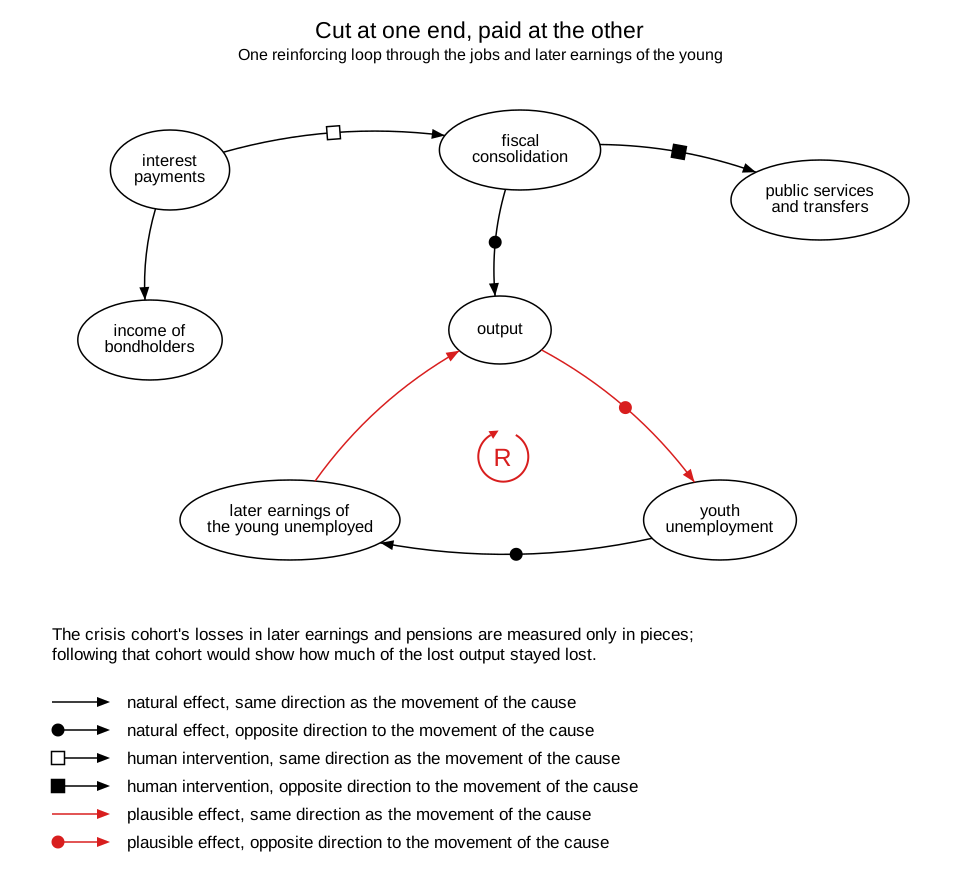
A rule that caps spending net of interest protects one kind of payment and squeezes every other. When rates rise, interest grows outside the path; the debt it adds can tighten the next path; and the adjustment falls on what is inside it, which is most of what a state does for the people who live in it.
The people who receive the interest are not, on the whole, the people who use the services. In 2025 euro area governments paid €303 billion in interest, 1.9% of GDP.
Government debt is held by banks, insurers, pension funds, central banks and foreign investors, and increasingly by households again: the household share of the government debt of ten euro area countries was by late 2023 back to where it had been a decade earlier. Some of what pension funds and insurers receive reaches ordinary savers through their pensions and policies. Among households, about 80% of equities, fund shares and bonds belong to the wealthiest tenth. The services sit at the other end.
In Greece, the poorest tenth of households lost on average 8% of their incomes from the tax, benefit and public pay measures alone, before any cut to public services, which that count leaves out.
A household with savings, or a house it owns outright, can live through a cut in its income and wait. A household without them meets the cut in its wage, its benefits and the services the state stopped providing, and can come out of it further behind as well as poorer.
Household income per person, adjusted for prices, fell by a third in Greece between 2008 and 2013. The usual poverty rate barely registered it, rising from 20.1% to 23.1%, because it is measured against a median that fell too. Held against the 2008 line, the share of Greeks in poverty went from 20.1% to 44.3%.
In 2013 more than half of young Greeks and Spaniards in the labour force were unemployed. Across 21 EU countries, Eurofound found that people who had been out of work for more than a year still had household incomes about 7% lower more than five years later.
In southern Europe, those born in the 1980s owned their homes less often at 35, by more than 10 percentage points, than those born from 1965 to 1979. Between 2008 and 2013 almost 223,000 Greek residents aged 25 to 39 left the country permanently. If the output lost in those years was lost for good, so were the careers that would have been built in it.
The rules can bend. In March 2025 the Commission made room for defence: member states may deviate from their agreed path by up to 1.5% of GDP for four years from 2025 to pay for higher military spending. The limits are a ranking of purposes, and the ranking can be changed when the purpose is judged important enough.
Growth as weather
Nobody in the framework decides growth. It arrives, or does not, and the debt ratio follows.
A union whose members borrow in a currency they do not issue, whose rules ask for cuts when the ratio rises, and whose interest bill now climbs, can only bring its ratios down reliably when the bottom of the fraction grows faster than the interest on the top. In that plain sense the euro area has to grow: the arithmetic of its debts has been written so that nothing else closes the books without someone paying for it.