The price of owning

If budgets were not allowed to supply growth, the arithmetic of the euro area’s debts still needed it from somewhere. For eight years the answer came from Frankfurt. In June 2014 the ECB became the first major central bank to take one of its key interest rates below zero, and it kept cutting in small steps until the deposit rate reached −0.5% in September 2019.
From March 2015 it also bought government bonds, adding to its purchases of private ones, until net purchases ended in July 2022. Money had rarely been cheaper, for longer, in Europe.
Cheap money is meant to reach the economy through two doors. One is spending and hiring: lower rates make borrowing cheaper, firms invest, people find work. The other is wealth: lower rates raise the price of assets, owners feel richer and spend more. Both doors open.
The first door
By the central bank’s own account, negative rates stimulated the economy and raised inflation, pushed sovereign yields down and were followed by steadily faster growth in bank lending. In an ECB model of a QE shock, unemployment fell significantly in all the large member states, and most of all in Spain. Because the people who found work were concentrated at the lower end of the income distribution, the same purchases slightly reduced income inequality. Between mid-2021 and the peak of inflation, real wages fell by about 5%.
The evidence comes from inside the institution whose policy it measures. Taken at face value, the first door worked roughly as designed: a weaker economy brought looser money, and looser money undid some of the weakness.
The second door
Asset prices rose faster and further: a gain for whoever already owned them, a higher price of entry for whoever was trying to buy. In the same estimates, stock prices rose about 10% at the peak, two quarters after the modelled purchases, before fading; house prices rose around 0.5 to 1%. House prices kept rising for years, dipped after the rate rises of 2022 and 2023, and were rising by more than 5% a year across the euro area in 2025.
Very little of that comes back as spending. In the euro area, a euro of extra financial wealth adds between one and seven cents of consumption over the long run, and a euro of extra housing wealth between minus one and plus two, not always distinguishable from zero. For housing, Spain is the exception among the large economies. Studies of individual households find the propensity to spend lower at higher wealth, so gains that land at the top return least of all.
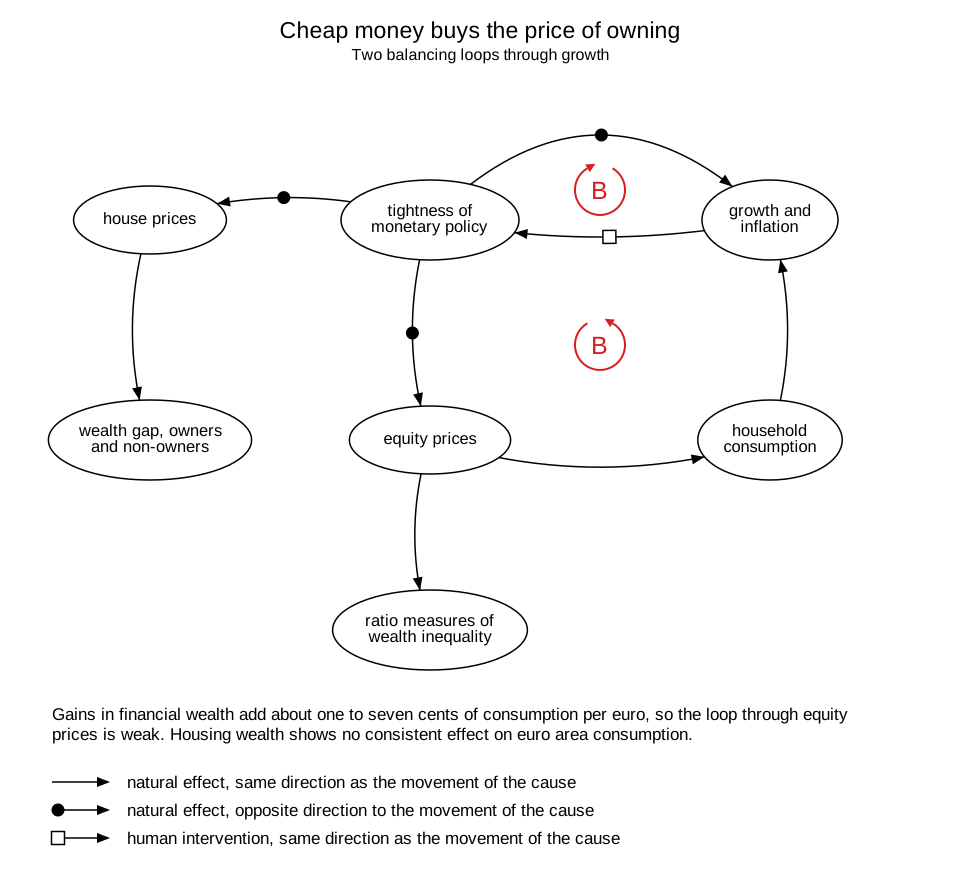
Both doors close the circle back to growth, and both steady it: when the economy weakens, money loosens, and the economy recovers some ground. The first does it through jobs and does it well. The second does it through share prices and does it faintly. The housing route shows no consistent effect in the euro area evidence. House prices rise, and what they change is not how much people spend but who owns what.
Mind the gap
In the ECB’s own model, wealth inequality hardly moved. Across the four largest euro area economies, the net wealth Gini went from 69.17% to 69.15% after a year, because two effects cancelled. Equity gains go mainly to the top of the distribution and widen inequality; house price gains go mainly to the middle, while the poorest and the richest gain least.
In the ECB’s distributional accounts, revised since, the top 5% held 44.4% of net wealth at the start of 2016, 43.8% at the end of 2019, and 44.5% at the end of 2025. The fall reflected, among other things, house prices lifting the bottom half from 2015; the share recovered in 2021 and dipped again in 2022, when share prices fell.
Between the start of 2016 and the end of 2025 the average household in the poorer half of the euro area gained about €19,000 of net wealth, reaching €44,800; the average household in the richest tenth gained about €900,000, reaching €2.5 million. The richest tenth went from 64 times the wealth of the poorer half to 56 times, which reads as less inequality, while the distance between them grew by €880,000.
Those figures depend on households a survey misses. The ECB estimates the richest from national rich lists, because its survey does not always reach them, and the estimate moves the result: in an earlier ECB test, Italy’s top 1% held 12% of net wealth in the survey and 29% once the missing wealthy households were added.
A flat Gini hides the line that moved. Between the start of 2016 and the end of 2025 the average owner household gained about €239,000 of net wealth and the average tenant household about €36,000, so the gap between them grew by €202,000. The median renter held €14,100 in 2023. In 2010 more than 36 million euro area households had little of their wealth in bonds, shares or property, so they failed to benefit from capital gains. For them the price of entry went up faster than anything they held.
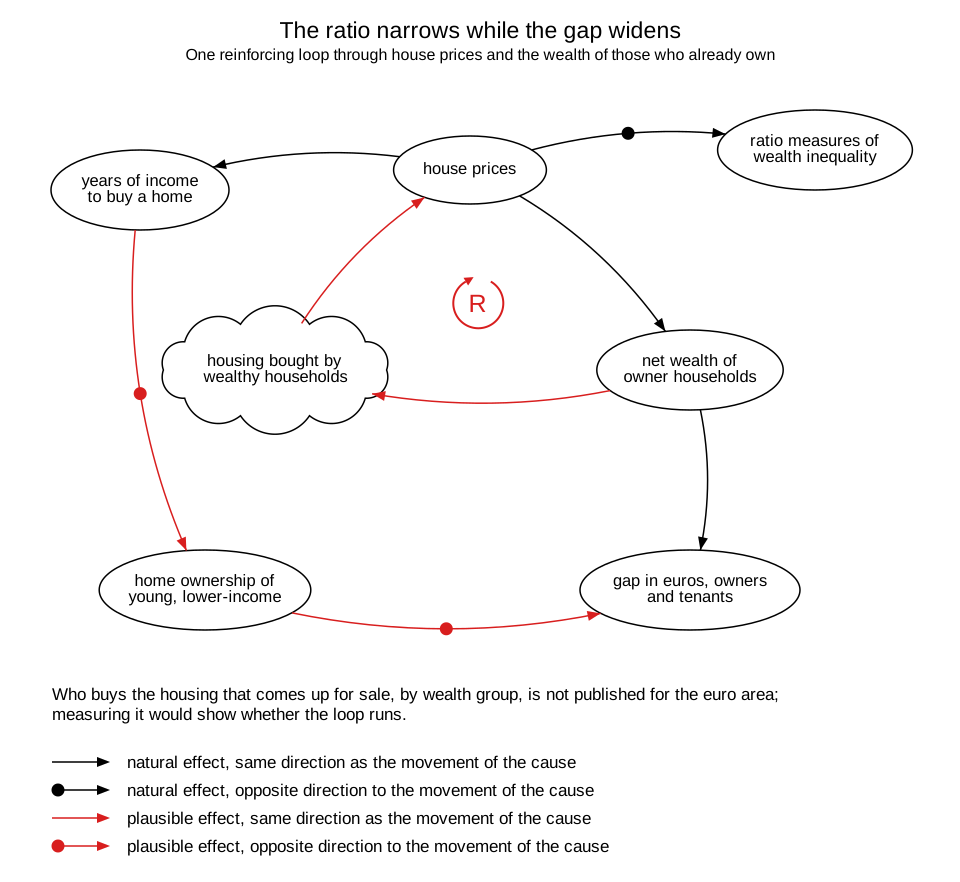
Cheap money did not so much make the rich richer as make owning dearer. Those already inside, owners of a home or a portfolio, were carried upwards together, the top on shares and the middle on bricks. The wealth statistics record a society that became slightly less unequal by one measure while the distance between renting and owning grew. Which one a household lives in depends on whether it already owned when the money became cheap.