Money with a passport

In 2025 the euro area earned more from the rest of the world than it spent there, a current account surplus of €255 billion, 1.6% of its GDP. In the same year its residents made net purchases of €598 billion of foreign debt securities and €169 billion of foreign equity. A current account surplus means the euro area saves more than it invests at home. The excess goes abroad.
It is not that Europeans save too little. EU households save more than their US counterparts, yet their wealth has grown by only a third as much since 2009.
The lie of the land
Euro area households keep about a third of their financial assets in bank deposits, against 11% for US households; nearly €10 trillion is held in cash and low-yield deposits, and 80% of households own no shares or other market instruments at all. Deposits are safe and they are lent on by banks, but they earn little, and the poorer half keeps about a quarter of its wealth in them; the richest tenth hold about 80% of the equities, fund shares and bonds.
Half of euro area households’ equity holdings, direct and through funds, were issued outside the EU; US markets take 34% of their equity holdings, almost as much as the 35% held in shares at home, and of the capital invested through European funds, half goes to the United States. Over the past decade, total returns reached about 300% for the S&P 500 and 150% for the STOXX Europe 600.
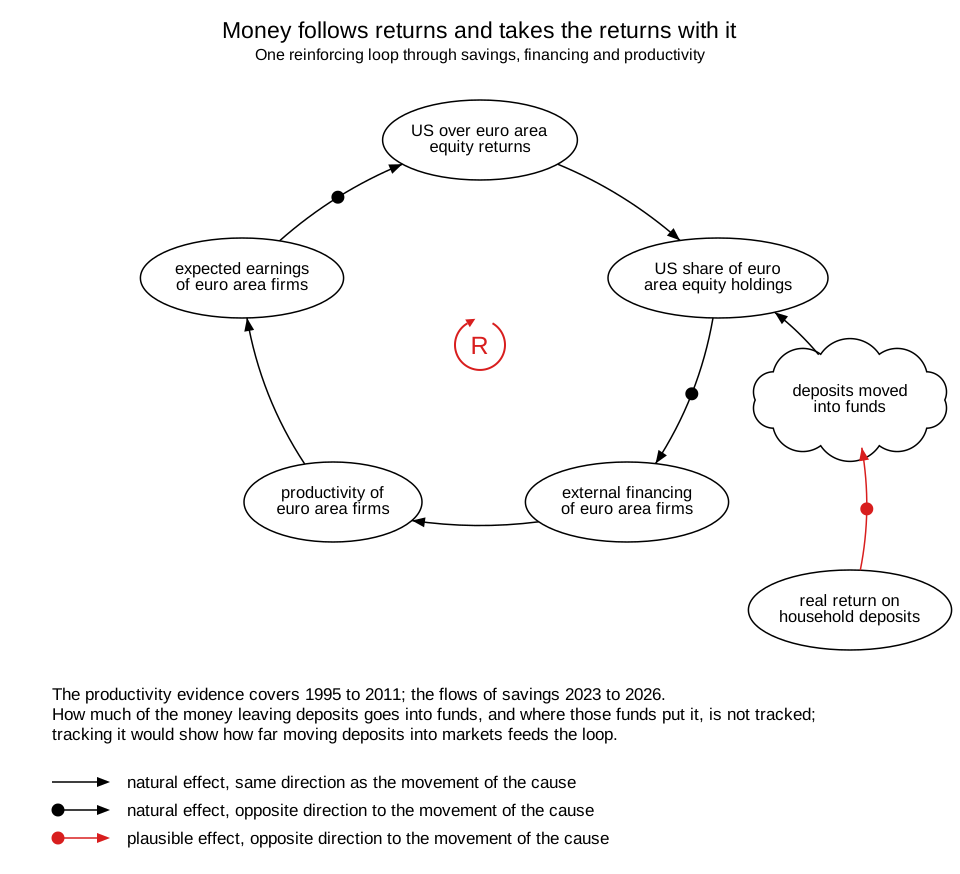
The drift continues. Euro area non-bank financial institutions, mostly investment funds, held about €17 trillion in securities at the end of 2025; since late 2023 they have raised the share of US company shares in their portfolios by about 2.7 percentage points and cut the share of euro area company shares by about 1.5. Each additional point allocated to American equities goes with about a third of a point less for euro area firms.
Dutch pension funds show the pattern in miniature. At the end of 2024 they had €293 billion invested in US non-financial companies against €97 billion in EU ones, while their total holdings were larger in Europe, €679 billion against €499 billion, because of government bonds and financial institutions. In their case European savings lend to European states and own American companies.
Built somewhere else
The gap it leaves is the one that shows in growth. Around 70% of the difference in income per head between the EU and the US is explained by lower productivity.
Between 2008 and 2021 close to 30% of the start-ups founded in Europe that reached a billion dollars in value moved their headquarters abroad, most of them to the US, and no EU company worth over €100 billion has been built from scratch in fifty years. Fragmentation of the single market keeps innovative firms from scaling up at home, which in turn reduces their demand for financing.
The investment share of the European economy would have to rise by around five percentage points of GDP to meet the aims set for it, €750 to €800 billion a year, while flows of savings into Europe’s capital markets are lower.
The cross-border flows through funds and other non-bank lenders have contributed to a sluggish recovery in firms’ external financing. Banks also lend to non-banks. About 80% of the increase in that lending went to securities dealers and Cayman Islands hedge funds outside the euro area. A bank that raises such lending by one percentage point cuts its firms’ access to credit by about half a point.
The pieces line up, but they do not establish one direction of causality. Higher returns draw savings abroad, while the shift in portfolios leaves euro area firms with a smaller share of the available capital. In the eight euro area countries studied, limited access to finance cost an estimated 21% of labour productivity in Italy and Portugal, and around 11% and 15% in Germany and the Netherlands.
Two steps remain plausible rather than measured: that lower productivity weakens the earnings investors expect from euro area firms, and that weaker earnings keep their returns lower. The first is argued for the US tech sector, whose earnings expectations arguably rest on hoped-for productivity gains from AI. With those steps allowed, the story closes on itself: money follows returns, and in leaving takes some of the returns with it.
The evidence also comes from different decades, productivity from 1995 to 2011 and the flows from 2023 onwards, and the story may run the other way round as much as this way: firms that cannot scale in a fragmented market do not ask for the capital, so the capital looks elsewhere.
What pulls money back, where anything does, is mundane. In 2025 Dutch pension funds sold €30 billion of US securities and bought €27 billion of European debt. DNB says they sold equities worldwide partly for a reason that was neither patriotism nor strategy: rising share prices and falling bond prices had pushed equities above the share a fund allows itself, so equities were sold to restore the balance between shares and bonds.
The pull outwards is a matter of size and returns. The pull back, in that case, was partly a matter of proportions in a spreadsheet, and it brought money home mainly as loans to governments.
Small change
A pension or a fund holding in the euro area now rests to a large extent on the profits of companies elsewhere, and over the last decade that has served its holders well. The return comes back to the euro area owner. The investment, the firms and the jobs they create stay where the capital went.
A retiree and a school leaver in the same town can sit at opposite ends of the arrangement: one receives returns from foreign companies, the other looks for work in a local economy that may have fewer firms and less investment.
The households that never reach the markets carry it differently. Their savings sit in deposits that earned next to nothing through the years of cheap money, while the minority holding shares, and above all foreign shares, collected the returns.
Deposits earned little more when money became dear. Between May 2022 and December 2023 the ECB’s deposit rate went from −0.5% to 4%, the rate on households’ overnight deposits from 0.01% to 0.37%, and the cost of a new mortgage from 1.78% to 3.97%. With inflation at 8.4% in 2022 and 5.4% in 2023, the purchasing power of money left in those accounts fell by about an eighth over the two years.
EU banks’ net profits rose by around 32% in 2023, driven by a large rise in net interest income, and the ECB’s supervisory chair said banks have been slow to pass on the increases to deposit rates. The same inflation shrank mortgages in real terms: in the Commission’s estimate for 2021 to 2023, households with mortgages generally gained, while non-homeowners lost wealth across all income deciles.
The Commission’s answer is to bring those deposits into the markets: the Savings and Investments Union aims to channel some of the €10 trillion of EU household savings held in bank deposits into productive investment.
The risk of that move would be carried by households, and the money would follow the returns to wherever the market is largest; of the capital invested through European funds, half goes to the United States. Unless European firms can grow into something worth owning, a deposit moved into a fund is, as often as not, a deposit moved out of Europe.