The harvest clock
What happens to Europe’s food when nobody is there to pick it?
In October 2025, strawberry growers in Huelva, southern Spain, were putting plants into the ground and worrying about the people who would pick the fruit months later. They said the planned recruitment from abroad would leave them short of workers. The warning concerned a future harvest.
A strawberry does not wait for a work permit. Once ripe, it needs picking, cooling and packing. A farmer can have healthy plants, buyers ready to take the fruit and no one available on the morning the fruit is ready. More fertiliser will not help. There are other ways to lose a crop; this one begins after it has grown.
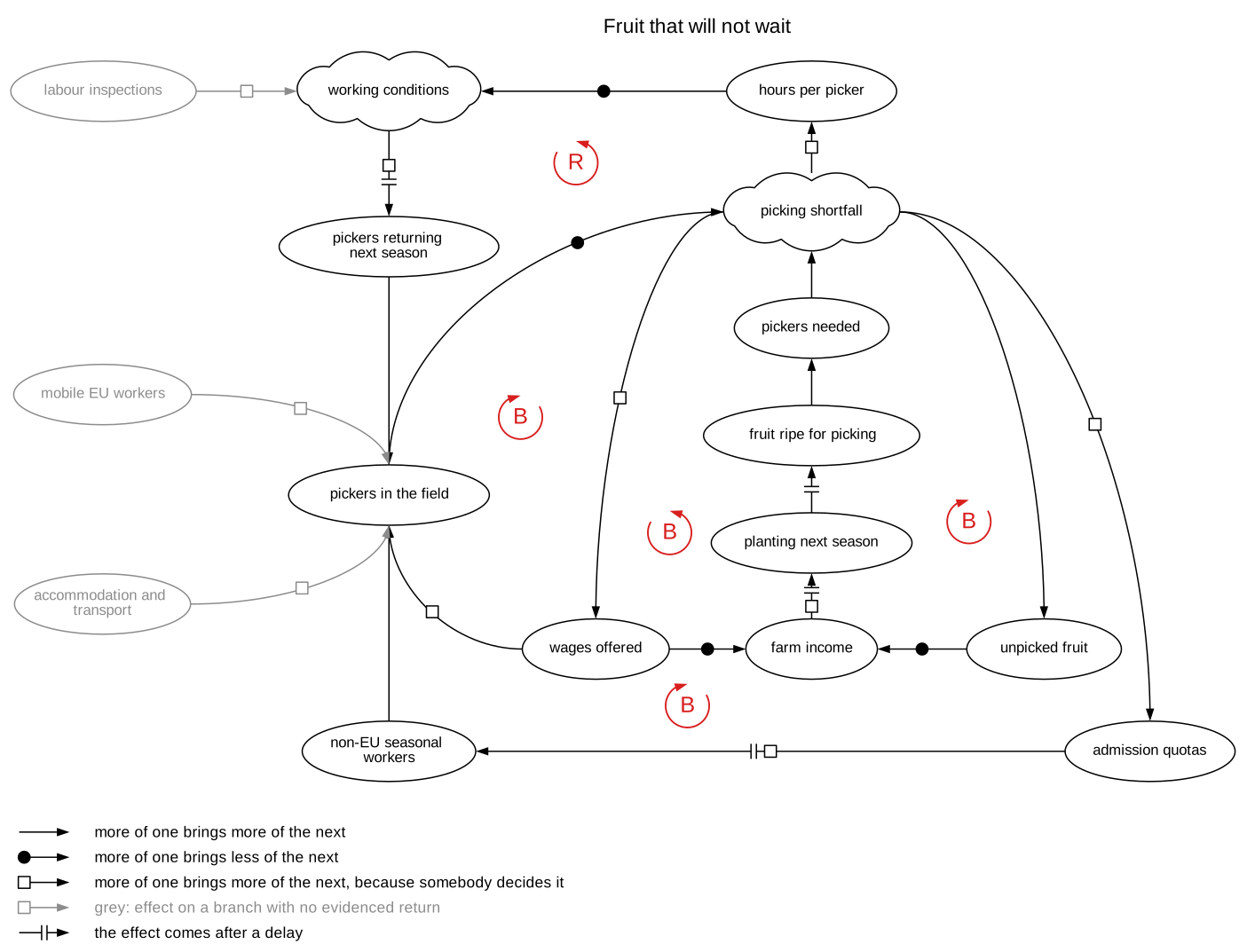
Click to enlarge.
A picking shortfall brings quotas and higher wages that add pickers, and longer hours that drive pickers away for the next season. If none of that closes the gap, the farm closes it by planting less.
The five loops
Reinforcing (R):
more picking shortfall → longer hours per picker → worse working conditions → fewer pickers returning next season, after a delay → fewer pickers in the field → more picking shortfall
Balancing (B):
more picking shortfall → more unpicked fruit → lower farm income → less planting next season, after a delay → less fruit ripe for picking, after a delay → fewer pickers needed → less picking shortfall
more picking shortfall → higher wages offered → lower farm income → less planting next season, after a delay → less fruit ripe for picking, after a delay → fewer pickers needed → less picking shortfall
more picking shortfall → larger admission quotas → more non-EU seasonal workers, after a delay → more pickers in the field → less picking shortfall
more picking shortfall → higher wages offered → more pickers in the field → less picking shortfall
The ripe week
A farm needs different amounts of labour at different times. Trees must be pruned and plants tended, but the great rush comes when fruit ripens. Some produce can be stored after picking. Soft berries cannot spend another week in the field while an agency searches for workers. A machine can harvest grain efficiently; delicate fruit sold fresh still needs hands.
If the crew is too small, the farmer has choices, none attractive. Pick the ripest or most valuable fruit first. Pay for extra shifts. Leave part of the crop behind. By the time another worker arrives, what was worth picking on Monday may be unsaleable on Friday.
The loss travels beyond the field. Fruit left to spoil brings no return on the money spent growing it. The packing shed has fewer crates to process. A haulier loses a collection. Workers who did arrive may get fewer paid days if the farm finishes early. A shop may find another supplier, perhaps at a different price. The missing crop cannot simply be harvested next month.
The farm still exists, the land is fertile and the fruit grew. Only the chance to sell it has gone.
Permission arrives late
The difficulty begins before anyone is needed in the field. An EU citizen can take seasonal work in another member state without a seasonal residence permit. Someone recruited from outside the EU may need an employer, permission to enter, a journey and accommodation. Every step has a timetable. Ripening has one too, but it is not administered by the same department.
In 2024, a fruit grower in Lagnasco, northern Italy, told RAI that an authorisation under Italy’s decreto flussi had arrived after he no longer needed the workers. The decreto flussi sets routes and quotas for employing workers from outside the EU. Permission was granted. The season had not waited.
Huelva uses a different arrangement, Spain’s Gestión Colectiva de Contrataciones en Origen (GECCO), to recruit workers in their countries of origin. Growers wanted enough people admitted before the 2025–26 harvest began. Even a larger quota would not, by itself, have put people in the fields. Travel, housing, transport and the decision to accept the job still decided whether anyone came.
Spain also found workers already nearby. During the 2025–26 berry season, a government-backed programme connected refugees and asylum applicants with Huelva farms. Employers offered contracts, accommodation and transport. The programme provided work and helped farms recruit. Its useful discovery was practical: the person a farm needed might already be in Spain, provided that someone connected the job, the worker and a way to reach it.
A shortage of people in a field can therefore be a shortage of available workers, a failed recruitment arrangement or simply a missing bus. Counting vacancies alone conceals the difference.
The workers who return
Recruitment is often described as the farmer’s problem. Returning is the worker’s decision.
Seasonal picking can involve hard physical work, insecure hours, heat, cold and a home far from the field. A person may be willing to pick fruit and unwilling to do it again for a wage that barely covers the journey and accommodation. The shortage is of people willing to accept the particular offer.
Some workers have even less room to choose. Under the EU’s Seasonal Workers Directive, workers admitted from outside the Union have rights over their working conditions and housing, and may legally change employer. But the Commission found in 2026 that a change often still requires a new authorisation and remains uncommon in practice. A right that needs a new authorisation in the middle of a short contract is worth less than it looks on paper.
Other workers may lack secure immigration status altogether. Field research in Lepe, near Huelva described undocumented agricultural workers enduring poor conditions while hoping to qualify for residence papers under Spain’s arraigo rules. Their circumstances differ from those of workers admitted under the seasonal scheme. The fruit does not carry a label explaining which employment arrangement brought it to market.
Conditions are a problem farther north too. During Dutch apple and pear harvest inspections in 2025, labour inspectors found underpayment and breaches of employment and working-time rules. Those findings concern inspected employers, not every Dutch grower. They are enough to show why filling vacancies cannot be separated from the conditions of the work.
A farm short of pickers can ask the remaining crew to work longer. That may rescue today’s fruit. Repeated often enough, it can exhaust the people whose return the next harvest depends on. The immediate remedy then helps produce the next shortage.
The farm chooses
Suppose too few workers arrive for a harvest. The farm may offer higher wages, but the buyer may not agree to pay more for the fruit. Higher pay can save the crop and squeeze the grower’s margin at the same time. Poorer conditions may hold down costs for a season and make recruitment harder the next. Neither cost can be removed by pretending it belongs to somebody else.
If missed picking becomes routine, the farmer has another option: grow less. Plant fewer rows, switch to crops that need fewer hands, invest in machinery where it works, or abandon a labour-intensive crop entirely.
For a surviving farm, planting less may be sensible. For the region, it can mean less work in packing, transport and processing, fewer opportunities for seasonal workers, and eventually less reason to maintain the businesses built around that harvest. A grower who stops planting strawberries does not have a strawberry labour shortage the following spring. The statistics may improve because the crop has disappeared.
And the loss can outlast the original recruitment problem. Establishing a different crop, buying equipment, rebuilding a picking crew or restoring a packing business requires time and money. A seasonal failure can change what a district produces for years.
The wrong diagnosis
Huelva’s own harvest is a warning against blaming the wrong cause. The 2025–26 strawberry crop did suffer losses, but growers’ subsequent account attributed the main damage to storms and persistent rain. The October recruitment warning cannot be used as evidence that missing pickers caused those losses.
Too few workers, rain-damaged fruit, drought, plant disease and poor prices can all end with fewer boxes leaving a farm. The remedy depends on the cause. Another recruitment campaign cannot keep rain off the berries, just as another irrigation scheme cannot pick them.
Sometimes several pressures meet. A damaged harvest cuts the money available to pay workers. A farm that offers fewer or less predictable shifts may struggle to persuade experienced pickers to return.
Another spring
The fastest defence against a failed harvest is to have people ready before the fruit ripens. That can mean timely permissions, dependable accommodation and transport, workable contracts and conditions that make experienced pickers want to return. Inspections can stop employers who ignore basic rules from undercutting those who pay properly. Machinery can help with particular crops, but it cannot harvest every fruit without damage or replace every task around the field.
Workers moving within Europe or arriving from elsewhere can help farms meet the seasonal peak. They also have families, other opportunities and good reasons to reject an arrangement that makes their lives precarious. A successful harvest needs their labour. A second successful harvest needs enough of them to choose the job again.
In Huelva, growers began asking about spring workers while planting in October. It was the correct time to worry. Once the fruit is ripe, a debate about who ought to pick it is already late.