The shrinking workforce
What happens to Europe’s work when there are fewer people of working age to do it?
Germany has around 5,000 unfilled positions for general practitioners. Nearly 40% of GPs in private practice are at least 60. The association representing doctors in the statutory health insurance system warns that practices may close when retiring doctors cannot find successors.
The position is vacant; the patients are not. If a village loses its GP, some people find another practice. Others must travel further, perhaps with help from a relative who has taken time off work. The remaining doctors can accept more patients only if they have room.
A missing worker can become a missing service. When that service goes, the cost moves to patients, families and the employers of relatives who take time off. If the loss makes the village a worse place to live, finding the next doctor becomes harder still.
A shrinking workforce can do lasting damage without a spectacular moment of collapse. The buildings and equipment may survive. What disappears is the staff to run them.
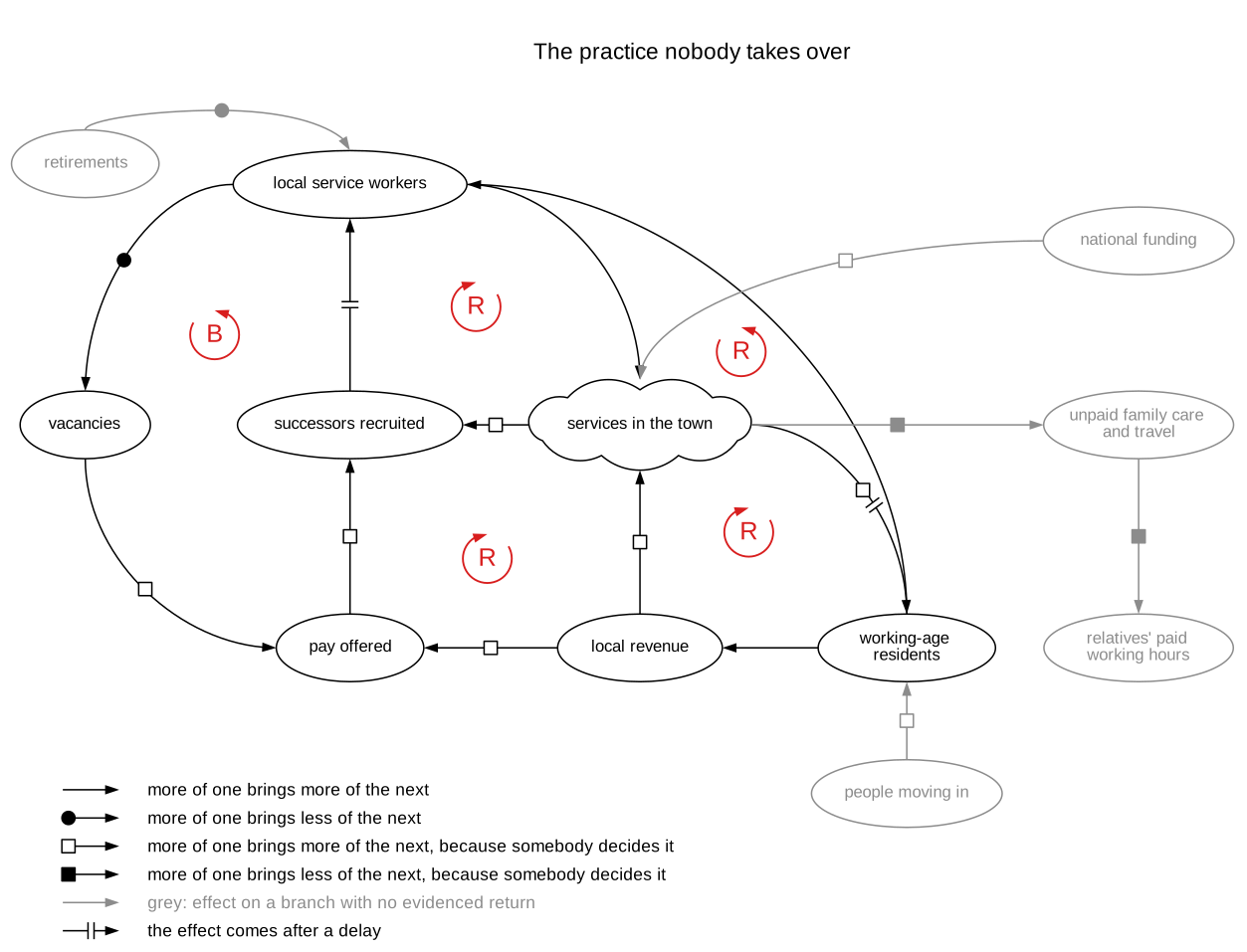
Click to enlarge.
A town that loses its doctor, its bus or its shop becomes harder to live in and harder to recruit to, so the next vacancy is harder to fill. Higher pay can draw a successor, but the money for it shrinks with the town.
The five loops
Reinforcing (R):
fewer local service workers → fewer services in the town → fewer working-age residents, after a delay → fewer local service workers
fewer local service workers → fewer services in the town → fewer successors recruited → fewer local service workers, after a delay
fewer services in the town → fewer working-age residents, after a delay → less local revenue → fewer services in the town
fewer local service workers → fewer services in the town → fewer working-age residents, after a delay → less local revenue → lower pay offered → fewer successors recruited → fewer local service workers, after a delay
Balancing (B):
fewer local service workers → more vacancies → higher pay offered → more successors recruited → more local service workers, after a delay
The slow arithmetic
Europe is getting older, though this is not the same as becoming helpless. Eurostat’s figures for 2025 put 22% of EU residents at 65 or above. Many older people work, volunteer, care for relatives and help raise grandchildren. Longer lives are an achievement. The problem is replacing people who retire from essential jobs while demand for some of those jobs increases.
Under the assumptions in the Commission’s 2024 Ageing Report, the EU labour force falls by about 25 million people between 2022 and 2070. The report also projects more people in work and higher productivity. The projections describe pressure on the supply of labour; they cannot tell which hospital shift or bus route will go unstaffed.
Nor does the pressure arrive on one clock. A seasonal crew can be missing when fruit ripens. A doctor can take years to replace. The need for long-term care is projected to grow, even as workers in that occupation retire. The daughter who can help her father this evening may not be able to do it every evening. Demography is slow; a missed visit is not.
Where work disappears
The loss will not be evenly spread. Italy has a much older population than Ireland, and within countries the difference can be sharper still. In 2025, Liguria’s median age was 52.6; parts of Eastern Germany were similarly old. Younger adults tend to move towards places with jobs, education and services. That movement can leave smaller towns with both fewer prospective workers and more demand for care.
Consider a place where the last local GP retires. The practice’s patients need appointments elsewhere. Some can drive; others need a bus, a taxi or somebody to take them. The loss reaches a daughter whose workday now includes a journey with her father, a care worker who now drives a client to the next town and has less time for the others, and another practice receiving patients it did not previously treat.
The same process can reach businesses. A workshop unable to replace its mechanic may turn away repairs. A shop unable to recruit staff may shorten opening hours. A bus operator may concentrate drivers on busy routes. None of these responses requires every worker in the town to disappear. They require only that keeping the service going becomes too difficult or too costly.
Declining populations can weaken local labour markets and the case for maintaining nearby services, the OECD finds. The damage falls unevenly. Someone with a car, savings and flexible hours has alternatives that a housebound neighbour does not.
The town pays twice
A town losing working-age residents also loses customers, volunteers, parents and sometimes the successors to family businesses. But its roads still need repairing, its water pipes still need maintaining, and older residents may need more help rather than less. The OECD describes the squeeze: local taxes and fees fall while the fixed costs of services stay the same. National funding can soften the blow. It does not conjure up a nurse or a driver willing to take the job.
Consolidation can keep services alive. Two small schools may share a building. A specialist clinic may serve several towns. A bus may run fewer but fuller journeys. These choices can be sensible, and sometimes they improve care. They also transfer time and expense to the people travelling further. A service may remain available on the regional map while becoming inaccessible to someone who cannot make the journey.
The losses then feed back into the shortage. A young family considering a move needs more than an advertised job. It may need childcare, a school and a way to reach the hospital. A recruit who cannot live comfortably near the workplace may not take the post. A resident whose family has lost those services may leave. The OECD identifies this possible cycle: falling population, weaker services and declining investment can reinforce one another.
Towns can reorganise successfully, attract new residents and maintain access through transport or shared facilities. But once people, businesses and services have gone, a later increase in population does not automatically bring them back. Someone has to reopen the practice, staff the school and decide that the bus route is worth running.
Not enough people
The familiar explanation is that Europe has too few people of working age. That may describe part of the problem, but it does not tell an employer why a particular vacancy remains empty.
The Commission’s 2025 employment analysis counted 51 million EU residents aged 20 to 64 outside the labour force. They are not 51 million spare workers waiting for collection. Some cannot work; some do not wish to; others face barriers such as disability, caring responsibilities, early retirement or benefit rules that penalise working more hours. A vacancy in a rural hospital is no use to someone who cannot obtain the required training or move there.
Care shows the cost of that gap. When a paid carer is missing, a relative may cut their own paid hours to provide the care that still has to happen. One employer reports a vacancy. Another loses part of an employee’s working week. The household loses income, and the older person may still receive less care than needed. Using families to patch a shortage can reduce the workforce available elsewhere.
A Commission study of persistent shortages found that low pay and poor job quality can coexist with chronic staffing problems, including in care and transport. Sometimes the workers have not vanished. They have declined the job being offered. That does not make the employer’s problem imaginary: a small service may be unable to offer better pay without charging customers more or receiving additional funding. But it changes the remedy. Counting more people will not settle what the work should cost.
Even a pay rise is not a universal cure. An extra applicant cannot immediately replace a trained doctor, and a raise in one town may attract a worker away from another town with the same shortage. Recruitment can redistribute scarcity as well as relieve it.
Buying time
Employers and governments have options before services fail. They can train replacements earlier, keep experienced workers in healthier jobs, change working hours, make childcare available, recognise qualifications gained elsewhere and improve pay where work has become unattractive. Some tasks can be automated. Some can be organised differently. In places where distances are long, transport and housing may be as important as a recruitment campaign.
Those measures work on different clocks. Extending someone’s working life may preserve expertise, but an older worker with an injured back cannot simply be ordered to remain on a night rota. Technology may help a smaller team organise appointments; it cannot always examine a patient or help someone out of bed. Training takes time. A harvest cannot be postponed until a course finishes, and a delivery vehicle still needs a suitably qualified person to drive it.
The missing successor
Return to the German practice. If a successor arrives, the patients keep their nearby doctor. If nobody comes, the practice may close. Other doctors may absorb some patients, while families, carers and local transport carry more of the burden. The building could be used for something else. On a national employment chart, the change may scarcely register.
The harder loss may come later. Once the practice has closed, an otherwise qualified doctor considering the town must judge whether there is enough support, whether a partner can find work and whether a family can live there. If a school, shop or bus service has also gone, the vacancy can be harder to fill than it was when the first doctor retired.
Europe can remain prosperous while particular places lose services essential to ordinary life. A government can count a higher employment rate, a company can report improved productivity, and a household can still spend half a day reaching the doctor who used to work down the road.