Who comes and stays
What happens when Europe needs workers, and they do not come, or do not stay?
For years, hospitals elsewhere in Europe recruited doctors trained in Romania. Then more Romanian doctors began staying home. The annual number leaving fell sharply between 2012 and 2021. WHO Europe links much of that change to better pay, training and working conditions, although pandemic restrictions probably also slowed movement in the later years.
For Romanian patients, keeping more doctors is welcome. For a hospital elsewhere that expects to recruit from Romania, it is a warning. A staffing plan can depend on somebody else’s decision to leave home. That decision can change.
Europe is getting older, and some essential jobs are already difficult to fill. The usual answer is to recruit more people. But needing a worker does not mean that somebody will come, be allowed to do the job, or want to stay. When recruitment stops filling the gaps, a hospital may close beds, a farm may plant less, or a haulier may abandon deliveries. The shortage can even appear to ease once the work is no longer offered.
Click to enlarge.
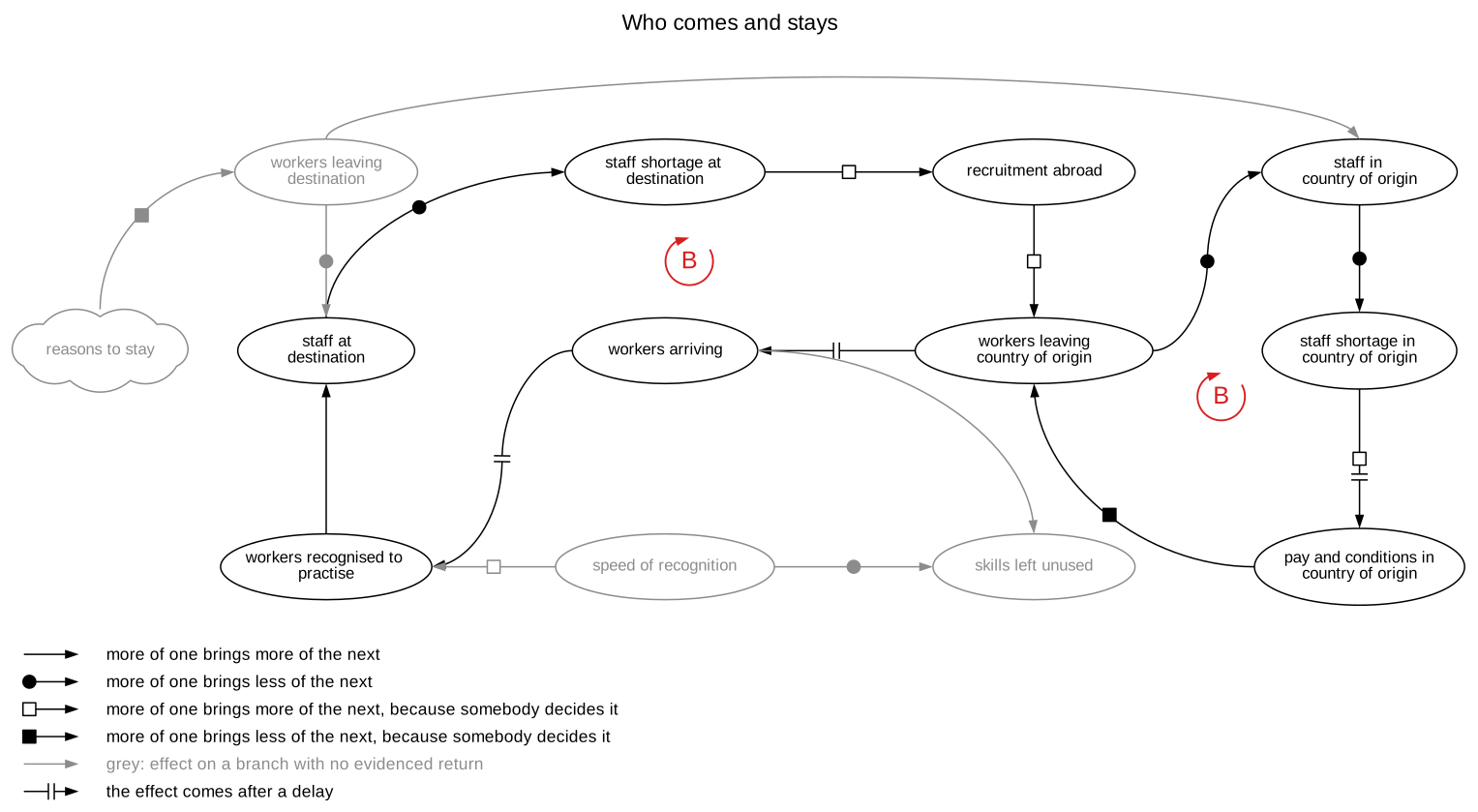
Recruitment eases a shortage at destination by moving part of it to the country of origin, and arrivals join the staff only after recognition. When the country of origin improves pay and conditions, as Romania did, fewer workers leave, and the recruitment that depended on them weakens.
The two loops
Balancing (B):
more staff shortage at destination → more recruitment abroad → more workers leaving their country of origin → more workers arriving, after a delay → more workers recognised to practise, after a delay → more staff at destination → less staff shortage at destination
more workers leaving their country of origin → fewer staff in the country of origin → more staff shortage in the country of origin → better pay and conditions in the country of origin, after a delay → fewer workers leaving their country of origin
One vacancy moves
A nurse moving from Romania to Germany can help a German hospital cover its rota. If the Romanian hospital also needed her, its rota becomes harder to cover. The move has improved one hospital’s capacity without increasing Europe’s total number of nurses. The patients who benefit and the patients who may lose out live in different places.
Workers have reasons to leave, including better pay, safer conditions and the chance to build the life they want. What is wrong is treating recruitment as if it created a new worker.
Movement within the EU is generally easier because EU citizens can take jobs in other member states without obtaining a work permit. Regulated professions still require recognised qualifications. Moving from Serbia to Austria is a different legal journey from moving from Romania to Germany. A nurse trained in the Philippines and recruited to Ireland faces another set of permissions and professional checks. Europe’s labour market is connected, but it has more than one entrance.
The WHO’s investigation of health-worker migration found countries recruiting abroad while losing staff they had trained themselves. A hospital can become skilled at replacing departures without becoming any better at preventing them. That can keep beds open today while leaving the next year’s rota just as fragile.
Before the first shift
A job offer is not a worker on the premises. Between the two may lie an employment permit, a recognised qualification, professional registration, adequate language skills, a place to live and transport to work. The employer may have a vacancy and an applicant while the shift remains empty.
Some barriers protect patients and workers. A hospital cannot waive professional competence because it is desperate for nurses; a haulage firm cannot dispense with safe driving qualifications. But the Commission has asked member states to speed up and simplify the recognition of qualifications earned outside the EU. A competent person can be present in Europe yet unavailable for the work they are trained to do.
Nor does a permit solve the practical questions. A seasonal picker needs accommodation and a way to reach the field before dawn. A newly recruited care worker needs somewhere to live on the wages offered. A skilled employee who cannot bring their family may accept the job for a while and then decide against making it a life. The paperwork can be complete while the recruitment fails.
For an employer short of staff, these obstacles are inconvenient. For the person being recruited, they are the difference between a possible move and an impossible one.
People already here
In its analysis of 2025 labour shortages and surpluses, published in 2026, the European Labour Authority found that almost every occupation reported as short of workers somewhere was reported as having a surplus somewhere else. The workers cannot all move into the vacancies. The job may demand different experience, be in another country, or pay too little to justify moving. But the finding undermines the idea that Europe simply has no people left.
Some people need not move at all. The Commission identified 51 million EU residents aged 20 to 64 outside the labour force in 2025. Many are disabled, retired early or providing unpaid care, or face benefit rules that penalise working more; some want work but cannot accept what is available. Better care services, accessible jobs and workable hours may release paid working time that a new recruitment campaign cannot.
Other people have already migrated but are working below their skills. Eurostat found that non-EU citizens with higher education were far more likely than nationals to be overqualified for their jobs. Not every qualification transfers. But Europe can be short of skills while failing to use skills that have already arrived.
A labour shortage can therefore coexist with jobseekers and underused workers. Calling every unfilled post a shortage of people may send governments looking for more arrivals when part of the answer is already living nearby.
The next departure
Recruitment gets a person into a job. Retention determines whether the employer has to fill it again next year.
People weigh pay alongside predictable shifts, housing, recognition of skills, fair treatment, prospects for advancement and family life. A worker who moves for a better future will eventually judge whether the future on offer is better. People may move on to another European country, return home, change occupation or reduce their hours. A migrant worker can also stay and build a lasting career. None of those choices is a defect in the person making it.
Departures can feed on each other. When a vacancy remains empty, colleagues cover more work. Longer hours and exhausting shifts can persuade some of them to leave. The next recruit encounters a less attractive workplace, with fewer experienced colleagues to help them settle. Hiring more people may keep the service running, but replacing those who leave without improving the job can become a permanent activity.
Constant replacement is costly for a country recruiting from abroad. For a country losing trained workers, the bill may be paid by patients, families or employers who can no longer find staff. Improving conditions at the destination can help retention; improving them at the origin can help people remain there. Romania’s experience shows why departure rates are neither fixed nor owed to the countries doing the recruiting.
When hiring fails
Suppose fewer people come for several seasons and those already employed keep leaving. The consequences need not look like a sudden European shutdown. They begin where the missing worker has the fewest substitutes.
A hospital may close staffed beds while the building remains open. A home-care service may stop taking clients, leaving relatives to cover visits or leaving care undone. A grower may plant less fruit after repeated trouble assembling a picking crew. A haulier may drop routes that no longer pay enough to attract drivers.
Some employers can raise wages, train staff or organise work better. Others cannot, or cannot do so quickly enough. The people who lose the service may have even fewer choices.
The damage can spread beyond the first vacancy. Someone looking after a parent cannot cover their own shift. A shop without deliveries loses customers and may stop offering work. A town without reliable care, transport or healthcare becomes a harder place for a new worker and their family to settle. The attempt to manage today’s shortage can remove some of the reasons anyone would come tomorrow.
There is a particularly deceptive form of recovery. A care agency that stops accepting clients has fewer vacancies to fill. A farm that grows less labour-intensive produce needs fewer pickers. A transport company that abandons difficult routes needs fewer drivers. Labour demand falls, and the shortage may look smaller. The households, patients, customers and workers who needed those services have not necessarily become better off.
Reasons to stay
There is no single switch marked more migrants. Free movement within Europe can shift a vacancy from one country to another. Recruitment from outside Europe can add workers, but it can also leave gaps in the communities they come from. Making it easier to come is useful only if the person can use their skills, afford to live and see a reason to remain.
Europe also needs to train and keep the workers it already has, and to offer conditions that allow people to take jobs without sacrificing their health or leaving relatives without care. International recruitment can be part of a durable answer; it cannot substitute for making essential work sustainable.
A Romanian doctor choosing to stay in Romania has not failed a hospital elsewhere. The hospital’s problem is real, but its solution was never guaranteed to arrive from another country. If Europe’s services depend on enough people deciding to come and stay, those services must offer people somewhere they can actually work and make a life. Otherwise, the vacancies may disappear only after the services do.