Shipping chokepoints
What happens in Europe when the narrow waters its trade passes through close?
The Red Sea was never closed. Nobody needed to close it.
From December 2023, Houthi attacks on ships at the Bab el-Mandeb, the southern entrance to the Red Sea, cut transit volumes there by about 70%, and major container lines paused or suspended their Red Sea services. The ships went round the Cape of Good Hope instead. Transits there rose by an estimated 74% on the year, and the detour added ten days or more to the average delivery. A voyage between Asia and Europe became about 30% longer.
A good deal of the world’s trade squeezes through a few narrow places, and Europe sits at the end of two of them. About 12% of global crude oil shipments and 10% of all seaborne trade by volume pass through the Suez Canal, and about 20% of oil trade through the Strait of Hormuz.
Click to enlarge.
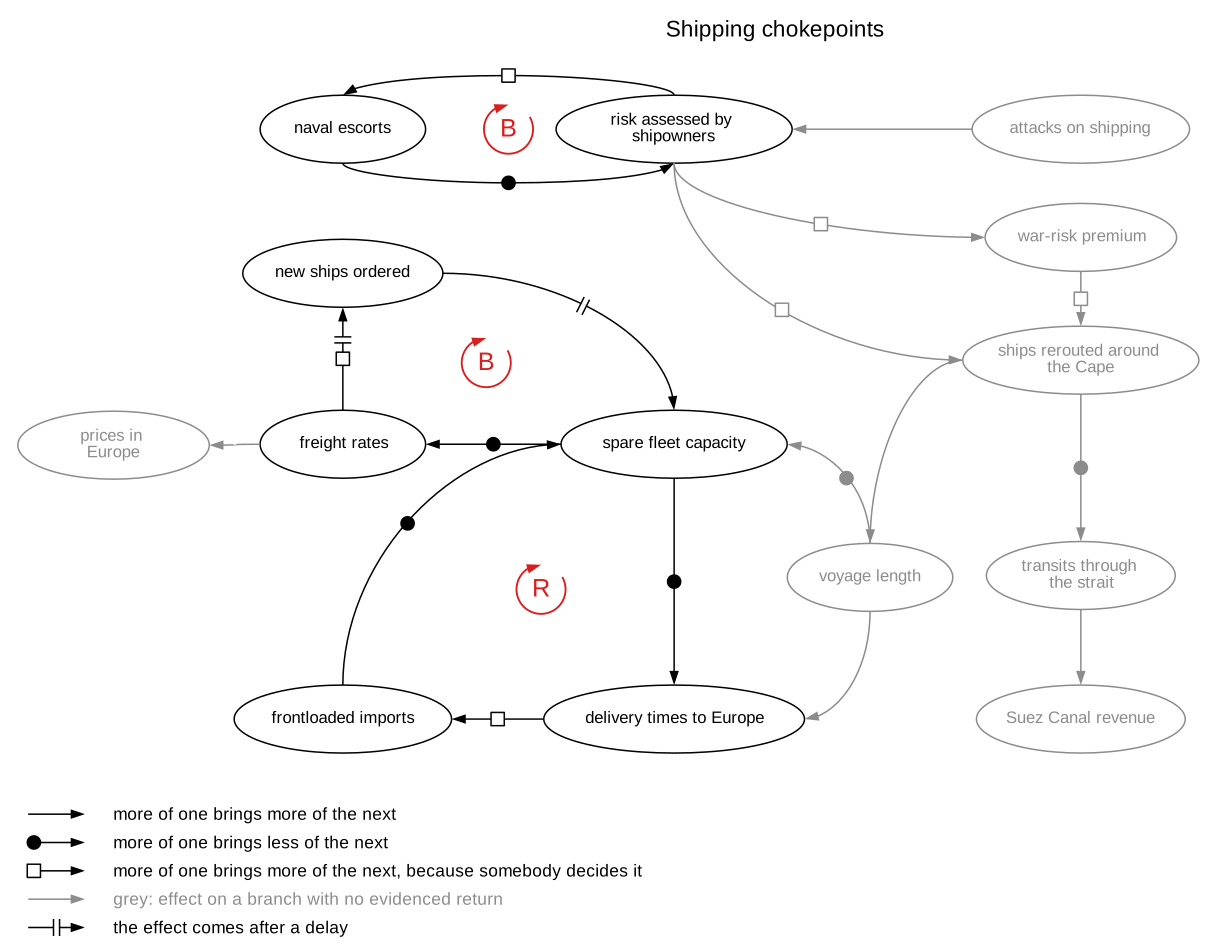
Shipowners who judge a passage too dangerous can lengthen Europe’s routes without anyone closing it. Importers then bring orders forward, using spare shipping capacity and making everyone else’s delay worse.
The three loops
Reinforcing (R):
longer delivery times to Europe → more frontloaded imports → less spare fleet capacity → longer delivery times to Europe
Balancing (B):
more risk assessed by shipowners → more naval escorts → less risk assessed by shipowners
less spare fleet capacity → higher freight rates → more new ships ordered, after a delay → more spare fleet capacity, after a delay
Narrow waters
The most important difference between Suez and Hormuz is whether there is a way round. Suez has one. A ship from Asia to Europe can go round Africa, and in 2024 the container lines did, paying in days and fuel. Much of what is loaded inside the Gulf has no Cape to go round. The oil and Qatari LNG of Europe’s energy imports leave through Hormuz, and so does nearly a quarter of the world’s urea exports. War in the Gulf therefore raised the price of fertiliser.
The way round Hormuz is a pipe, and only Saudi Arabia and the UAE have crude pipelines that skirt the strait, with “an estimated 3.5 million barrels per day to 5.5 million barrels per day of available capacity”. Iran, Iraq, Kuwait, Qatar and Bahrain “rely on the Strait to deliver the vast majority of their oil exports”. A pipe can be shot at too, and attacks have already shut Saudi Arabia’s East-West Pipeline.
In the second quarter of 2026 oil through Hormuz fell to 4.9 million barrels a day from 21.6 a year earlier, and oil through the Bab el-Mandeb rose to 8.1 million. The Red Sea got busier because the Gulf got shut.
Active ingredients from India and China and refined metals from China come from further east, and by sea the way to Europe runs through the Bab el-Mandeb and Suez or round Africa. In early 2024 Rotterdam noticed the detour mainly in its accounts. “Fewer ships are sailing to Europe, but those that do are more heavily loaded”, so port dues fell.
Ways the strait closes
The Red Sea showed that a strait can stay legally open and commercially shut. Hormuz in 2026 showed it again, and started an argument about who had done the shutting. Reports had it that insurers cancelled war cover and the ships stopped for want of it. The Lloyd’s Market Association called that “not accurate”.
On 23 March 2026 the Association said war insurance “remains available within the Lloyd’s and London company market today for vessels wishing to transit the Strait of Hormuz”, and that 88% of the main war underwriters it surveyed still had an appetite for hull war risks.
What changed was the price, by design: war premiums are “little more than notional” in peacetime, and the contracts carry a notice of cancellation so that the premium can be “reassessed when risk increases”, as it was over Ukraine and in the Red Sea. The underwriters were nervous within days, and they went on selling cover.
The ships stopped anyway, and the Association said why: “The reason ships are not moving is not through a lack of insurance; it is a question of the risk to crew and vessel safety being assessed by the ship masters and owners as too high.” Around 20,000 crew were affected, at least 11 people had died, and in the three weeks from the start of March Lloyd’s List counted 111 transits by cargo ships over 10,000 tonnes. The premium follows the risk. The ship follows the master.
Navies try to bring the risk down, and the EU launched Operation Aspides on 19 February 2024 to protect ships against attack and accompany them through the Red Sea, with a purely defensive mandate and, by July 2025, three naval units in the region. Three frigates can accompany some of the ships some of the way.
A strait can also close by accident. When the Ever Given stuck across the Suez Canal in March 2021, the canal authority lost revenue “including salvage costs, in the range of USD 100 million”, and “several weeks after the opening of the Canal, European ports experienced peaks in vessel arrivals”. One ship, sideways, and the queue arrived in Rotterdam a month later all at once.
The crews at sea
The ships carry people, and their assessment of danger is more immediate than a freight rate. The Houthis seized the car carrier Galaxy Leader in November 2023 and held its 25 sailors for more than a year. When they were released in January 2025 the UN envoy called it “heartwarming news that puts an end to the arbitrary detention and separation that they and their families endured for more than a year”.
Ten more days
The detour spends time before it spends anything else, and in early 2024 Europe had time to spare. The ECB found suppliers’ delivery times “lengthened only slightly”. It named three cushions: spare shipping capacity, “as global demand for goods is relatively subdued and the world’s cargo vessel fleet has expanded”, ports whose congestion stayed “broadly unchanged, signalling their capacity to cope with rerouted vessels”, and “manufacturers’ high stocks of inventories”.
Freight costs rose sharply on some routes but stayed “well below the highs recorded in 2021 and 2022”, and the effect on euro area inflation was expected to be “only a limited upward impact”.
Then the importers protected themselves. In the first half of 2024, the ECB found, world trade was carried by “strong demand for imported goods brought forward amid concerns about disruptions to shipping routes in the Red Sea”. The rise in shipping costs in the second quarter “reflected higher demand consistent with the frontloading of imports”. Each firm that made itself safe used up a little of the spare capacity that had been keeping all of them safe.
Click to enlarge.
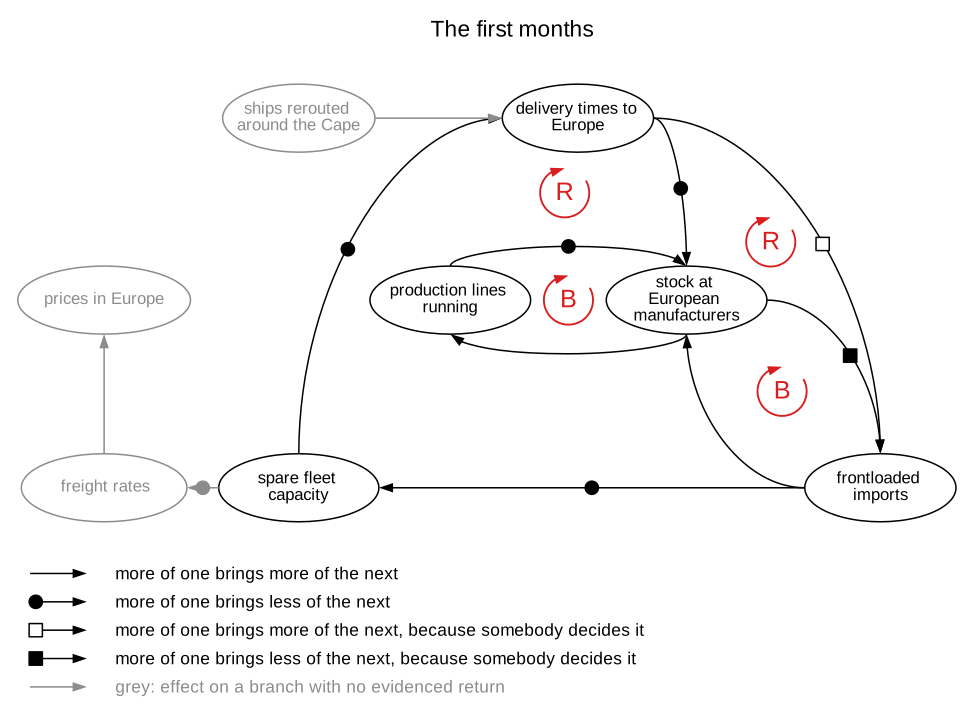
An extra ten days at sea draws down factory stocks. Importers try to protect themselves by ordering earlier, but collectively those orders consume the spare ships that kept the detour manageable.
The four loops
Reinforcing (R):
longer delivery times to Europe → less stock at European manufacturers → more frontloaded imports → less spare fleet capacity → longer delivery times to Europe
longer delivery times to Europe → more frontloaded imports → less spare fleet capacity → longer delivery times to Europe
Balancing (B):
less stock at European manufacturers → fewer production lines running → more stock at European manufacturers
less stock at European manufacturers → more frontloaded imports → more stock at European manufacturers
The delay lands first where there is no stock to absorb it. The ECB’s worry was production disrupted “via the reduced availability of raw materials and intermediate inputs, especially in industries relying on ‘just-in-time’ supply chains”. A plant that keeps two days of parts runs out on the third day of a ten-day wait.
The long way round
The ships have been slow to come back. In the fiscal year 2025/26 the Suez Canal averaged about 39 ships a day, against 73 in 2023, and its traffic “remains about 50 percent below pre-2023 levels”.
Freight rates came down faster than the traffic came back. By the autumn of 2024, the ECB reported, they were “falling once again as strong growth in shipping capacity currently outpaced demand”.
The underwriters’ map changes more slowly than the news. In December 2023 the Joint War Committee extended its listed area in the southern Red Sea as far north as latitude 18°N. In March 2026 it added the Gulf, the Gulf of Oman, Bahrain, Djibouti, Kuwait, Oman and Qatar, and kept the Red Sea in. Entering a listed area requires notifying the insurer, and may bring an additional premium. The committee draws the map. The underwriters negotiate the price.
Since January 2024 the EU emissions trading system has covered ships calling at EU ports for half the emissions on voyages from outside the EU, so Europe now charges for the detour as well. A longer voyage burns more fuel, so the detour raises both the fuel bill and the carbon bill.
Further down the quay
Every detour has two ends, and the far one is in Egypt. The IMF counted “substantial declines of up to 70 percent in Suez Canal receipts, which are a significant source of foreign currency for Egypt”. What European shippers pay in fuel and days, the canal loses in tolls.
The near end is the European factory and the shop. The ECB expected the shipping costs to feed through to consumer prices only a little, because in 2024 the fleet was large and demand was weak. That cushion belonged to the cycle, not to anybody’s plan.
Under the same water lie the cables that the internet runs on.
Gibraltar keeps the trade
�A detour that lasts also changes which ports get the ships. In 2024 the Piraeus Container Terminal lost throughput “due to continuous influence of the Red Sea incident”, while COSCO’s terminals in Spain and at Zeebrugge took “some of the shipping routes and volumes previously handled at Piraeus Terminal”.
Ships coming round Africa enter the Mediterranean at Gibraltar, and the largest hub at that gate, Tanger Med in Morocco, is outside the EU. The Commission has listed Tanger Med and East Port Said as “neighbouring container transhipment ports” under the emissions trading system, so that a stop there does not shorten a ship’s EU carbon bill.
Keeping the lane open
Escort is the lever that works on the risk itself, and it is small. Stock is the lever that works on the delay, and in 2024 it worked because manufacturers happened to be holding plenty. Spare shipping capacity worked too, because the fleet had grown and demand had not.
The overland alternative is real and small: the Middle Corridor through Central Asia and the Caspian takes “only one additional day to Central Europe” from Chengdu compared with the Northern route through Russia, and has “at most 5%” of its capacity. Nor have European firms come running home. In 2023 the ECB found “no strong response in terms of reshoring within the EU”. Firms were “diversifying suppliers” and “building up strategic inventories” instead.
None of these makes a strait safe. They decide how much the detour costs and how long Europe can afford to pay it.
The strait at Kaub
War and insurance are only some ways to make a route unusable. Far from the Red Sea, a river can shut itself by running short of water.
One of Europe’s busiest freight routes is inland, and it is drying out. At Kaub, on the Middle Rhine, the gauge fell below its 2018 record of 25 centimetres in August 2026 and later dipped below zero for the first time, a reading against the gauge’s local reference level rather than the depth of water left. Between St. Goar and Mainz only isolated cargo ships still ran, carrying much reduced loads, and the Middle and Upper Rhine were cut off from Duisburg and Rotterdam.
BASF at Ludwigshafen gets about half of its precursor materials by barge. Stefan Kooths of the Kiel Institute put the lost value added at roughly 1 to 2 billion euros in the third quarter.
The long run points the same way. On the Lower Rhine, Germany’s Federal Environment Agency finds that low-water restrictions “clearly indicate a trend that has been increasing significantly since 1997”. It finds no significant trend yet on the Middle and Upper Rhine.
Enno Nilson of the Federal Institute of Hydrology expects low water to grow “in ihrer Intensität und Dauer”, in intensity and duration, as the climate warms. The 20 centimetres of extra fairway between St. Goar and Mainz that the inland shipping association wants have been planned for years and are still delayed.
The Panama Canal carries one of the main routes from South America’s Pacific coast to Europe, and it runs on fresh water. The EU gets 79% of its lithium from Chile, on that coast. The canal’s locks draw their water from lakes, and for a canal that lifts its ships out of a lake, water is the one shortage it cannot route around.
In 2023 October’s rainfall was “the lowest on record since 1950”, and the canal, which had been allowing roughly 32 booking slots a day since July, cut them to 24 from November. In December the low water in Gatun Lake limited it to 22 ships a day. The canal authority finds that inflow deficits of 30% or more have recurred “approximately every 4 years” in the past decade, “even more frequent than the previously observed interval of every 20 to 25 years”.
The Houthis needed missiles to empty the Red Sea. The Rhine and the Panama Canal need only a dry year.
Somebody else’s coast
The attacks that sent Europe’s ships round Africa come from a country where more than 22 million people, about half the population, “will require humanitarian assistance” in 2026 and 18.3 million are “acutely food insecure”.
The sea itself pays some of the bill. In March 2024 the Rubymar sank in the Red Sea after a missile strike, with “approximately 21,000 metric tons of ammonium phosphate sulfate fertilizer” on board, which “presents an environmental risk” to a sea of coral reefs. The wreck lies between Yemen and Eritrea, where “the relatively shallow waters near the coasts are teeming with coral”. A cargo meant for somebody’s fields went to the bottom of somebody else’s sea.
The crews’ opinion
Imagined conversation with Lord Vetinari.
Lord Vetinari: “Underwriters can be reassured, Drumknott. Sailors, it turns out, cannot. And a dry summer takes no bribes at all.”