Pharmaceutical precursors
What happens to Europe’s medicine cabinets when the ingredients stop arriving?
A shortage turns a prescription into an errand, and community pharmacists spent 9.5 hours a week on shortages in 2023, “nearly three times as much time … as they did a decade ago”. In the Netherlands every pharmacy needs “an equivalent of 1 Full Time Equivalent employee” for shortages alone. That is the paid part. The unpaid part, ringing other pharmacies, driving to the one that has it, and explaining the new pill to an elderly parent, falls on patients and their families, and is counted by nobody.
In autumn 2022 around 50 companies in the supply chain reported shortages of the widely used antibiotic amoxicillin. 28 countries in the European Economic Area ran short of antibiotics, and 14 of them called it critical. The Commission put it down to “changing infection patterns, which strongly increased demand”, while on the supply side “the long lead times needed to boost production made it difficult to respond quickly”. Bacteria do not consult the production schedule.
Most of what Europe swallows is old, cheap and made from something brought in. Almost 70% of the medicines dispensed in Europe are generics. About 75% of the sites making their active ingredients lie outside the EU, notably in India and China, and for about 21% of the ingredients the Commission’s study looked at there is no production in the EU at all. India, in turn, depends heavily on Chinese imports for ingredients and intermediates.
A medicine rarely runs out because somebody turns off a tap. It runs out when a plant fails, a winter brings more infections than the factories planned for, or a neighbour keeps its stock at home, and the few suppliers left cannot make up the difference. Between 2022 and October 2024 national authorities reported 136 critical shortages to the European Medicines Agency.
Click to enlarge.
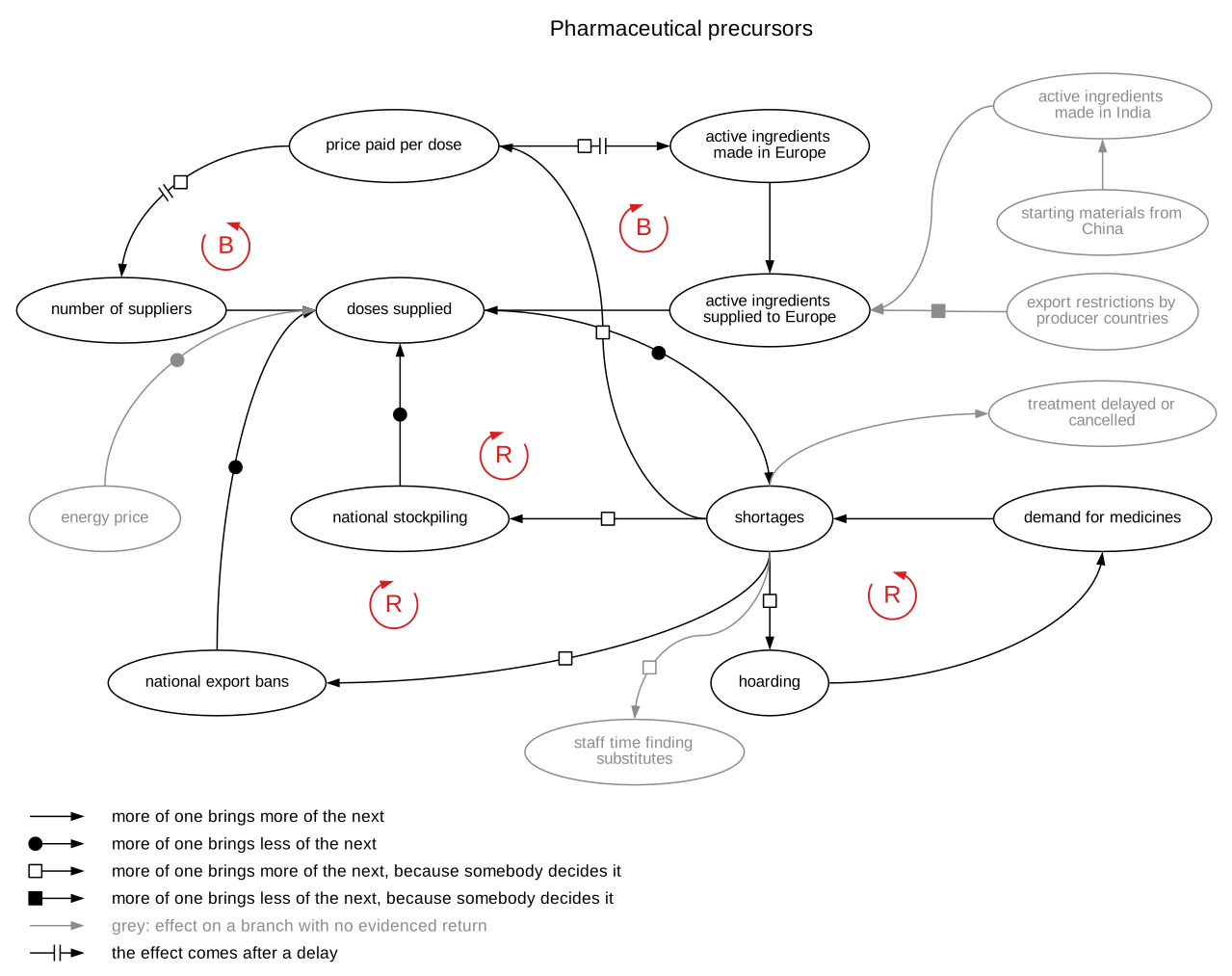
A medicine shortage can cause protective stockpiling and export bans that deepen the shortage elsewhere. Higher prices may bring more production, but building a new reliable source takes longer than emptying a pharmacy shelf.
The five loops
Reinforcing (R):
fewer doses supplied → more shortages → more national stockpiling → fewer doses supplied
fewer doses supplied → more shortages → more national export bans → fewer doses supplied
more demand for medicines → more shortages → more hoarding → more demand for medicines
Balancing (B):
fewer doses supplied → more shortages → higher price paid per dose → more suppliers, after a delay → more doses supplied
fewer doses supplied → more shortages → higher price paid per dose → more active ingredients made in Europe, after a delay → more active ingredients supplied to Europe → more doses supplied
Made somewhere else
The shortages begin long before the patient arrives at the pharmacy.
For the ingredients of paracetamol and ibuprofen the EU depends on Asia completely, and for amoxicillin and salbutamol, the asthma medicine, around 80%, according to an IQVIA study cited by the Court of Auditors.
The active ingredient is not the only thing that travels. The Commission’s proposal treats as a “key input” any “input material other than an active substance required in the manufacturing process … including primary packaging materials, excipients, solvents and reagents”. A tablet is mostly not medicine, and the rest of it has a supply chain too. Whatever comes by sea passes the narrow waters on the way.
India’s production leans on China. In 2024-25 China supplied about 73.7% of the active ingredients, bulk drugs and intermediates India imported, and antibiotics come first in the list of segments with high import dependence. For some, such as methyldopa, China supplied all of India’s imports in both years. Buying from India instead of China can mean buying Chinese chemistry with an Indian label.
None of this was an accident. The Critical Medicines Alliance traces the move of production to China and India, and its concentration there, to the structural low profitability of old off-patent medicines under intense downward price pressure. The Court of Auditors found national procurement decided mostly on price, which favoured outsourcing to low-cost countries.
What is left in Europe is thin, and Sandoz calls its plant at Kundl in Austria “the hub and center of the last remaining integrated production chain for antibiotics in the western world”. In 2020 it agreed with the Austrian government to invest more than €150 million there with public support, and committed to penicillin ingredient production in Europe for ten years “despite fierce global price competition, particularly from China”. The western world’s antibiotic chain fits in one Tyrolean valley.
Downstream of the factory
In 2007 Swedish researchers analysed the effluent from a treatment plant serving about 90 bulk drug makers in Patancheru, near Hyderabad, “a major production site of generic drugs for the world market”. It contained “by far the highest levels of pharmaceuticals reported in any effluent”, and the most abundant, the antibiotic ciprofloxacin, reached concentrations that “exceed levels toxic to some bacteria by over 1000-fold”. The authors warned that such levels “raise concerns about resistance development”.
Europe’s own rivers carry the medicine back out of its bathrooms. The recast urban wastewater directive requires extra treatment to remove micropollutants, phased in for all large plants by the end of 2045, and the makers of the medicines and cosmetics that cause it “must contribute a minimum of 80 % of the costs”. The cheap pill is being repriced at the far end of the drain.
Ways the shelf empties
India looked after its own first: on 3 March 2020 its Directorate General of Foreign Trade, in notification 50/2015-2020, restricted the export of 13 active ingredients, paracetamol among them, and of the medicines made from them, “with immediate effect and till further orders”.
Plants fail, and a Commission study traced half of reported shortages to “issues with quality and manufacturing”. When that happens at a supplier who is the only source, “production cannot be quickly taken over by another supplier”. The Commission’s assessment of eleven critical ingredients found an overreliance on single manufacturers or single countries for all eleven.
Demand runs ahead of production, as with the antibiotics in the winter of 2022.
Neighbours shut their doors as well. Export bans inside the EU are allowed “for the protection of health and life of humans”, but the Court of Auditors found they “were not always temporary and in some cases affected many medicines and were repeatedly renewed over many years”. A ban that protects one country’s patients takes the medicine from another’s.
Rising energy costs were among the causes of the 2022 antibiotic shortages, so the medicine cabinet depends on the gas too.
Suppliers also leave quietly. Under “winner-takes-all” tenders the winner becomes the only supplier for a set period, and “losing tenderers may decide to stop production” of that medicine altogether, “as their market share has become too small to be economically attractive or viable”. The market is then left “dependent on a single or only a few suppliers”.
The first months
What stands between a gap and an empty shelf is stock. Germany’s 2023 medicine-shortage law, the ALBVVG, was written to fight shortages of off-patent medicines and to improve the supply of children’s medicines. It requires six months of stock for medicines sold under discount contracts, and four weeks of children’s medicines at wholesalers.
Other member states made their own rules, and many began stockpiling as shortages rose. The Court of Auditors warned that such stocks can create or worsen shortages elsewhere, in the smaller member states especially, because manufacturers with limited capacity have to choose whom to supply first. Once stocked, a medicine stays put: the Commission’s study on shortages found that country-specific packs and labels make stock hard to move within the EU.
A packet labelled in Danish is of limited use in a Greek pharmacy.
Click to enlarge.
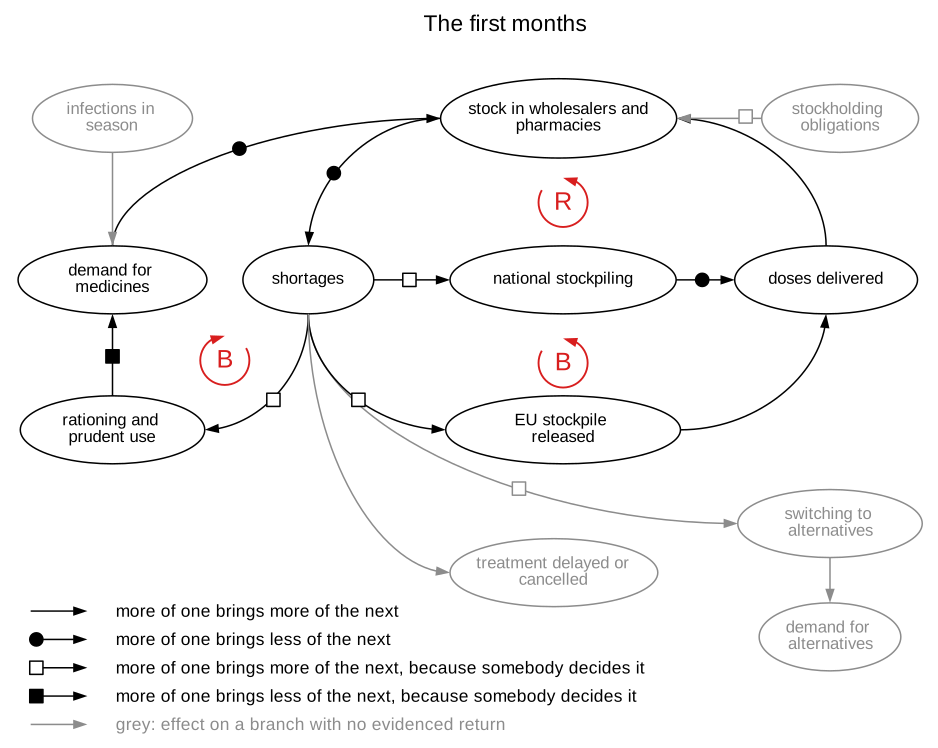
A pharmacy’s stock buys time rather than a new supply. Joint reserves may add doses and careful prescribing may lower demand, while national stockpiling can leave neighbours with fewer deliveries.
The three loops
Reinforcing (R):
fewer doses delivered → less stock in wholesalers and pharmacies → more shortages → more national stockpiling → fewer doses delivered
Balancing (B):
fewer doses delivered → less stock in wholesalers and pharmacies → more shortages → more of the EU stockpile released → more doses delivered
more demand for medicines → less stock in wholesalers and pharmacies → more shortages → more rationing and prudent use → less demand for medicines
Both balancing loops have been tried. The EU keeps a rescEU stockpile of antibiotics as a safety net “in the event that national stocks do not suffice”, and the Commission promoted “the prudent use of antibiotics” while “highlighting the need to avoid hoarding by all relevant stakeholders”.
By the winter of 2023 to 2024 the number of countries reporting critical shortages of amoxicillin and amoxicillin with clavulanic acid was about 50% lower than the year before. The Court of Auditors adds that “shortages persisted”.
Further down the ward
Between January 2023 and January 2024 nearly 40% of households met a medicine shortage, and about half of those affected reported health problems, by the Commission’s count. Hospital pharmacists named delays in care or therapy as the main consequence, and finding the substitute is work too: “time and labour costs, particularly for pharmacists, to identify alternatives and substitution protocols”. Surgery waits on the same shelf. In 2024 anaesthetic agents were among the medicines hospital pharmacists most often found short.
Patients on long treatments are switched from one product to another and asked to get used to it. Among hospital patients whose care was affected, 21% reported “adverse events/greater toxicity”, and from Slovenia came the comment that patients “have demonstrated progressively lower trust in medicines and in the supply system”.
Animals queue as well, and a survey by the Federation of Veterinarians of Europe found shortages of veterinary medicines and vaccines “an increasing problem in almost all countries”, across vaccines, antibiotics, anti-inflammatories and antiparasitics. For sheep and goats, fewer than a third of the medicines authorised at EU level were reported as actually on the market. The herds that shrink when feed grows dear need their dewormer as well.
Gone for good
A supplier that stops making a medicine may also let the marketing authorisation lapse. Coming back would then mean a new approval as well as a new production line. The Commission expects that “in the long-run, entry of new suppliers can be expected to fill the gaps”, and adds that “in certain cases, investments to enter a market may not be profitable to sustain entry”.
Germany tested the balancing loop with the ALBVVG, which abolished fixed reimbursement amounts and discount contracts for children’s medicines and let makers raise their prices once by up to 50%. A year later Pro Generika, the generics industry’s association, judged that the situation had stabilised and that making children’s medicines no longer lost money, but that no new manufacturer had taken up production since the law came into force.
A price rise keeps the remaining suppliers. Bringing back the ones that left takes longer, if it happens at all.
The bacteria keep score
�An antibiotic shortage can also breed resistance. The Commission notes that the 2022 shortages endangered patients while “risking the development of antimicrobial resistance”. When a narrow-spectrum medicine is unavailable, doctors may have to use a broader alternative, adding to the pressure that favours resistant bacteria.
Resistance already costs Europe dearly. More than 35 000 people in the EU/EEA die of resistant infections every year, by the ECDC’s estimate. The OECD puts the yearly bill for extra care and lost work at nearly EUR 11.7 billion. Its projection to 2035 is worst for the last drugs in the cabinet, with resistance to third-line drugs such as the carbapenems up to 3.2 times the 2005 level.
Resistant bacteria can also make the next pandemic deadlier. In 1918 most influenza deaths came from the bacterial pneumonia that followed the virus.
New antibiotics arrive slowly. In June 2024, the WHO reported that 13 new antibiotics had received marketing authorisation since July 2017, but only two represented a new chemical class. Phage therapy is already used in selected cases, while antisense antibiotics remain experimental. Both face substantial obstacles before becoming widely available.
Cost already keeps the poorest from care that exists. In 2024, 2.1% of people in the EU’s lowest income fifth reported going without medical care they could not afford, against 0.2% in the highest.
A medicine that runs out can come back, if a supplier returns. A medicine that stops working has to be invented again, and then paid for.
A few remedies
The first remedy on offer is to buy on more than price. The EU’s Critical Medicines Act, proposed by the Commission in 2025, would let public buyers reward resilience. The Critical Medicines Alliance recommends award criteria that reward security of supply and resilience, performance clauses that raise transparency and security of supply over time, and tenders split among several winners, so that one winner no longer takes all.
In a stakeholder survey for the proposal, 59% of respondents expected resilience-based procurement to raise prices, and 75% expected price rises from broader award criteria. Security is not free, and most of the people asked knew it.
Before protecting anything, Europe made a list: the second version of the Union list of critical medicines covers “approximately 75% of all authorised medicinal products in the EU”, and its 2025 update assessed 61 more active substance groups and added nine. A list covering three quarters of the cabinet is a start, not a choice.
Buying and stocking together are still mostly intentions. The Court of Auditors found that the Commission “has not yet issued its planned procurement guidance or organised voluntary joint procurement for critical medicines”. In June 2024 several member states raised the harm national stock requirements do to their neighbours and “called for a coordinated approach at EU level”.
Making medicines closer to home has been tried in one Austrian valley, and India is trying it for its own reasons. By December 2025 its incentive scheme had established capacity for 28 of 41 critical ingredients, starting materials and intermediates. Europe has a list, an Alliance and a proposal.
The next bad winter will arrive on its own schedule, whatever stage the list, the Alliance and the proposal have reached.
Cheap while it lasts
Imagined conversation with Lord Vetinari.
Lord Vetinari: “We have spent a century teaching the bacteria, Drumknott. They have been excellent students.”