Fertiliser and feed
What happens to Europe’s food when the inputs to its farms stop arriving?
Nitrogen normally goes on the field every year. When an application is missed, the next harvest may show it. Phosphorus and potassium wait in the soil, so a farmer can skip them for a while and the yield notices later. When feed gets dear the herds shrink, and with them the manure that partly stands in for fertiliser.
The farmland is European, but much of what makes it yield is not: imports cover 25 to 30% of the nitrogen fertiliser EU farmers spread, 35 to 45% of the potash and around 70% of the phosphate. The nitrogen made at home is made from gas. Around two thirds of the high-protein feed eaten by European animals is grown somewhere else.
In 2022 gas became scarce and dear, and most of Europe’s ammonia plants slowed or stopped with it. EU farmers spread 10.3% less mineral fertiliser than the year before, 9.4% less nitrogen and 17.9% less phosphorus. Eurostat puts the fall “in part” down to “the sharp rise in fertiliser prices following Russia’s military aggression against Ukraine”.
Farmers cut phosphorus nearly twice as hard as nitrogen. The Commission warns that dear fertiliser may lead farmers to favour nitrogen “over phosphorus and potassium inputs, with potential long-term consequences for soil fertility”.
The soil, as usual, was not consulted.
In 2026 the price rose again, this time from the Gulf. The Strait of Hormuz carries nearly a quarter of the world’s urea exports, and with it closed, urea passed $850 a tonne in April, 80% above February. That month nitrogen fertiliser in the EU cost 40% more than in December 2025, according to the Commission.
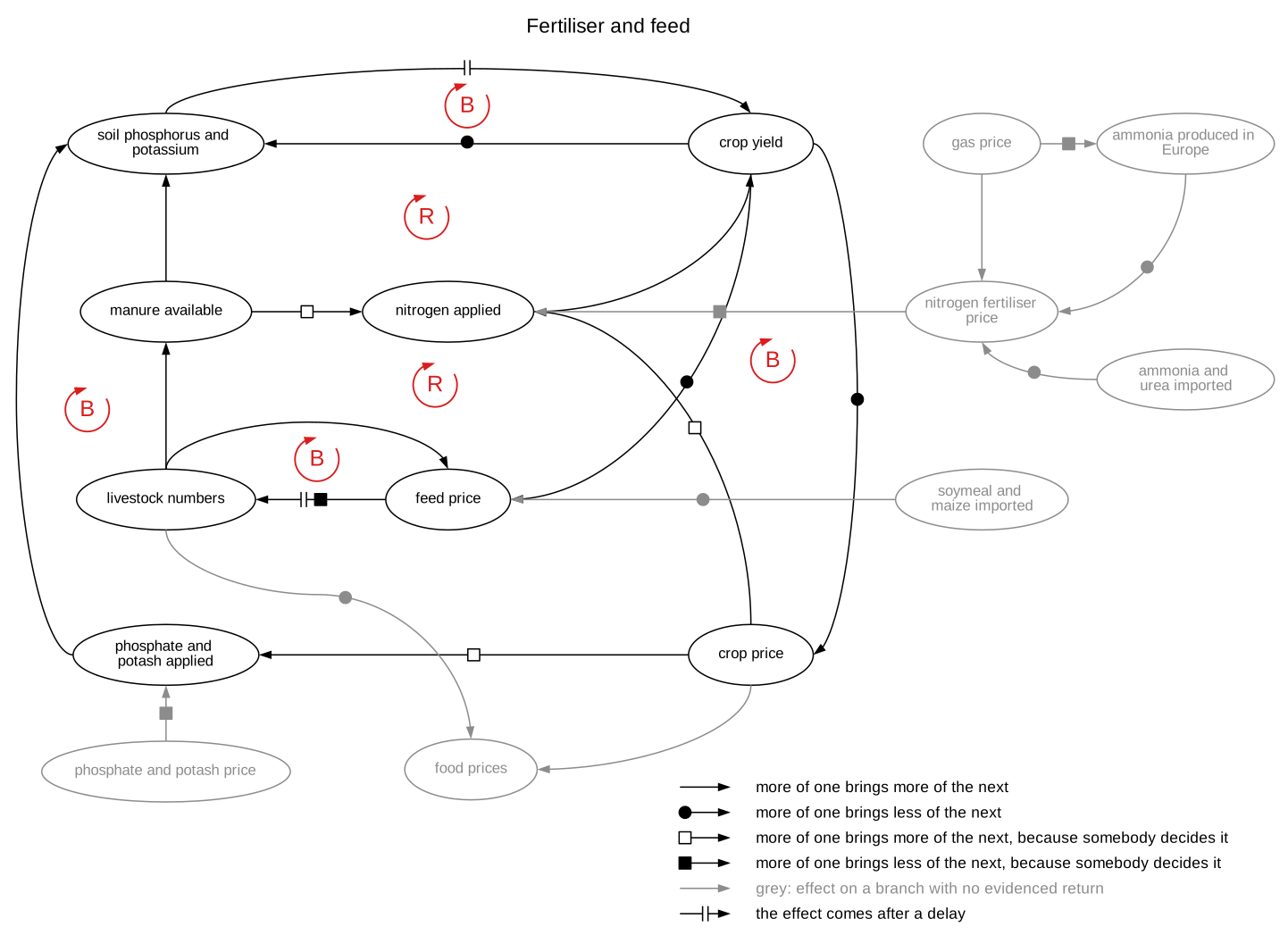
Click to enlarge.
Nitrogen reaches this year’s harvest; phosphorus and potassium can be drawn from the soil for longer. Higher feed prices shrink herds and manure supplies, so cutting costs this season can weaken the next harvest too.
The six loops
Reinforcing (R):
less nitrogen applied → lower crop yield → higher feed price → fewer livestock, after a delay → less manure available → less nitrogen applied
less soil phosphorus and potassium → lower crop yield, after a delay → higher feed price → fewer livestock, after a delay → less manure available → less soil phosphorus and potassium
Balancing (B):
less nitrogen applied → lower crop yield → higher crop price → more nitrogen applied
less soil phosphorus and potassium → lower crop yield, after a delay → higher crop price → more phosphate and potash applied → more soil phosphorus and potassium
less soil phosphorus and potassium → lower crop yield, after a delay → more soil phosphorus and potassium left behind
higher feed price → fewer livestock, after a delay → lower feed price
Bought by the boatload
Nitrogen fertiliser is made from natural gas, which accounts for 70 to 80% of the cost of making it in the EU. The share that is not imported is made at home, from gas that mostly is.
Potash is mined, some of it in the EU, though not enough. EU imports of potash peaked in 2020, and more than half came from Russia and Belarus, by the count of the Commission’s Joint Research Centre (JRC). New European mines could cut much of the dependence on Belarus and Russia by 2030.
Feed travels furthest. In 2024/25 the EU imported 13.4 million tonnes of soya bean and soya meal protein, mostly from Brazil, Argentina and the United States.
A fair slice of a European pig was grown in South America.
The sack stays empty
Nitrogen fertiliser is natural gas in a more convenient sack, so it follows the gas wherever the gas goes. Since 2023, plants holding 9% of EU ammonia capacity have closed for good. The Commission notes that ammonia made in Europe sits “at the high end of the global cost production curve”. When gas is dear, European plants struggle to compete with imports.
By 2022 the EU had shut out a supplier by banning potash from Belarus, and the JRC found the EU “dependent on external supplies of potash to fill the gap”. Canada, it judged, could fill it. Somebody usually can, at a price.
Producers look after their own farmers first, and in 2026 China, India, Mexico, Russia and the United States started, in the Commission’s words, “tapping into strategic reserves, imposing export restrictions, setting price ceilings for farmers or removing import barriers”. Fertiliser held back for a country’s own fields is not for sale at any price.
When Hormuz closed in 2026, Europe was buying its urea in the same world market as everyone the Gulf used to supply.
Europe closes some doors itself, as on 20 June 2025, when the Commission put tariffs on all nitrogen-based fertilisers from Russia and Belarus, to “reduce the EU’s strategic dependence on Russia”. In 2026 it proposed suspending, for a year, the duties on ammonia, urea and other nitrogen fertilisers from everyone else, saving an estimated €60 million. One door closes. Another is propped open.
Europe also narrows the door by rule, for reasons of its own. Since 2022 a phosphate fertiliser sold under EU rules may carry no more than 60 mg of cadmium per kilogram of phosphorus pentoxide. The Commission will report in 2026 on whether to lower the limit, “taking into account both health and environmental risks and technical feasibility, affordability and security of supply”.
Soya joins the EU deforestation rules from 30 December 2026. Clean soil and standing forests are good reasons to shorten the list of sellers. They still shorten it.
The first season
Nitrogen does not keep. In the words of the UK’s nutrient management guide, “supplementary nitrogen applications are normally made each year to meet crop demand”.
Phosphate and potash keep, and where the soil holds more than the crop needs the same guide says “savings can be made by reducing or omitting applications until the soil level falls to the target Index”. Where it holds less, “yield may be reduced”.
What a nitrogen cut costs in grain has been modelled rather than measured. A 2024 JRC study by Pacifico and colleagues simulated sudden EU-wide cuts in mineral nitrogen. A 25% cut lowered the modelled yields by about 11%, with soft wheat hit hardest. Maize in the Netherlands, Belgium and Denmark barely noticed even that cut. Those fields were already getting more nitrogen than the crop could use.
�Livestock show the shortage faster than fields. In spring 2022 the Commission reported that rising feed costs had helped push beef prices up 26% on the year. By the end of the year the EU had 134 million pigs, 5% fewer than a year earlier. The animals that remain still need their medicines, and those are often short as well.
Dear fertiliser means less of it spread, and the cut falls hardest on arable farmers, for whom, the Commission notes, “the weight of fertilisers in farm accounts is particularly high”: 24% of their intermediate inputs.
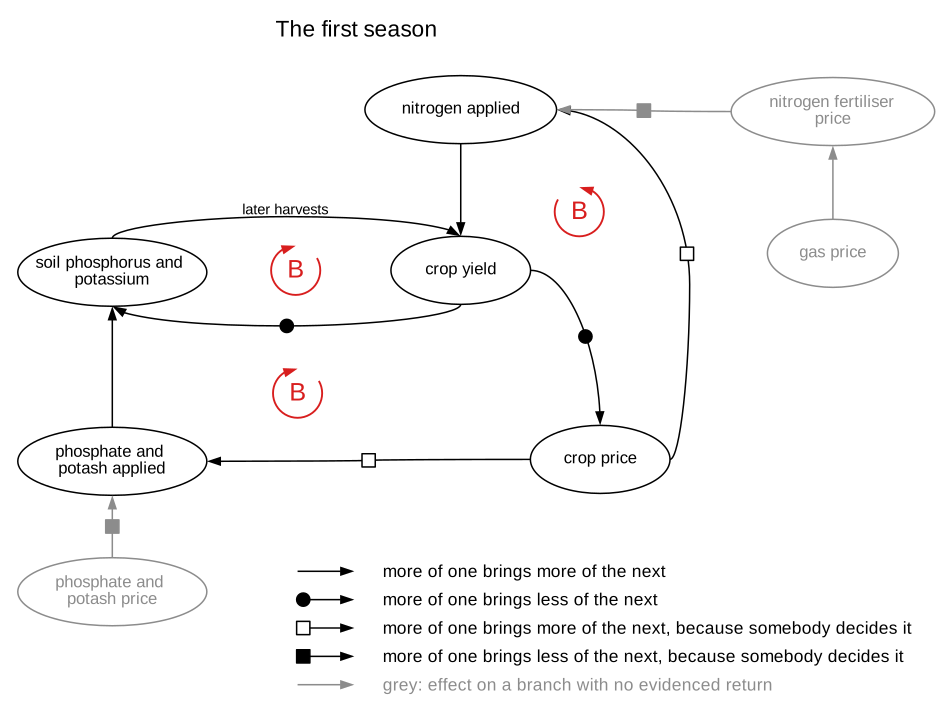
Click to enlarge.
Farmers can cut fertiliser applications immediately. The effects arrive at different speeds: nitrogen reaches this year’s crop, while phosphorus and potassium can come from reserves accumulated in the soil.
Down the food chain
Dearer feed reaches the shop as dearer meat and milk. In March 2023 food, alcohol and tobacco in the euro area cost 15.4% more than a year before, the fastest rise of any group of goods in Eurostat’s flash estimate.
Europe sells more food than it buys. In 2025 its agri-food exports came to €238.4 billion against €188.6 billion of imports. A shortfall in European fields would turn up in somebody else’s bread.
The empty plate
A dearer loaf is an inconvenience for most households and a missed meal for some. In 2025, 8.5% of people in the EU could not afford a meal with meat, chicken, fish or a vegetarian equivalent every second day, and 18.1% in Romania. Among people at risk of poverty in 2024 the share was 19.4%, against 6.4% for everyone else. A fertiliser price is a farming statistic in Brussels and a dinner in Bucharest.
Slow to come back
An ammonia plant that closes is replaced by imported ammonia. The dependence on imported gas becomes a dependence on imported product.
The sow herd shrank two years running, by 370,000 in 2021 and half a million in 2022. Sows are bred, not ordered, and a herd comes back at the speed of pigs.
Soil drawn below its target needs “additional phosphate and potash” to climb back, at whatever fertiliser costs by then. The Commission warns that dear fertiliser could lead farmers to “reduce the area they cultivate”. A field left fallow keeps its soil. Whether it keeps its farmer is another matter.
Fields in 2050
A sudden shortage is only one clock. The soil and climate also change slowly, whether or not the next cargo arrives.
Without adaptation, the JRC expects climate change “to substantially lower grain maize and wheat yields in southern Europe”, with irrigated maize there losing “more than 10%” of its potential yield at 2°C of warming. EU production as a whole “could still slightly increase”, because other regions are expected to fare worse. Europe may keep its place as a food exporter because the rest of the world loses more, a comparative advantage of the bleakest kind.
The soil that next year’s harvest depends on is already run down. In the Commission’s words, “soil degradation is an issue in every EU country, with 60 to 70% of soils in an unhealthy state”.
Phosphate is a separate and longer dependency, and it sits mostly in one country: by the USGS count, Morocco holds 50 of the world’s 74 billion tonnes of phosphate rock reserves, about two thirds.
The Commission’s outlook to 2035 has pigmeat and beef production falling and the dairy herd in “continuous decline”, while the EU remains “a net importer for maize and oilseeds”. A smaller herd needs less imported feed, and leaves less manure for the fields.
Making do
Manure is the fertiliser Europe already has. RENURE materials, nitrogen recovered from manure, “allow farmers in Nitrate Vulnerable Zones to replace more mineral fertilisers without undermining water protection”, since an amendment to the EU Nitrates Directive, the Commission says.
The Commission will also work towards “a combined minimum reuse and recycling rate for phosphorus from sewage sludge and from urban wastewater” by early 2028. Europe imports its phosphate by the boatload and flushes it away, and has started thinking about fishing it back out.
Ammonia without gas exists, at a price: green ammonia “faces higher production costs than fossil-fuel based alternatives”. Using less is cheaper, and the Commission’s Fertiliser Action Plan recommends that member states spend more of their farm budgets on “precision farming” and other ways of putting fertiliser only where the crop will use it.
Protein grown at home would shrink the feed import. The Commission plans to promote nitrogen-fixing crops in a forthcoming protein plan. They would also need land.
Eating differently would shrink the import further. Swedish and Dutch researchers found that 75–82% of current EU animal fat and protein production could be kept without soybean imports and without more cropland for feed. That would free 11–14 million hectares outside the EU, at the cost of less pork and poultry and more plant-based food. It is an option in a journal, not an instruction to anybody’s kitchen.
Stocks are still only being thought about, and the Commission “will assess stockpiling and other preparedness options for key fertilisers and inputs”. Several of the countries looking after their own farmers in 2026 had reserves to tap.
None of it would fill a sack within a single season: the protein plan is still forthcoming and the stockpiling still being assessed.
Somebody else’s ground
The phosphate has a contested address. OCP, Morocco’s state phosphate company, lists Boucraâ among its mining sites, with about 2% of the reserves it counts “in Morocco”. Boucraâ lies in Western Sahara.
In October 2024 the EU Court of Justice ruled that the 2019 EU-Morocco agreements on fisheries and agricultural products, “to which the people of Western Sahara did not consent”, breached the principles of self-determination. The consultation had reached “the inhabitants who are currently present in that territory” rather than the people of Western Sahara, “a significant proportion” of whom “now lives outside that territory”. The ruling concerned fish and tomatoes, not phosphate. The question it asked, whose land, applies to rock just as well.
The soya has an address too. In 2018, by the count of Trase, a project of the Stockholm Environment Institute and Global Canopy, 23% of the EU’s soy imports from South America came from the Cerrado. The Cerrado is “a uniquely biodiverse savannah ecosystem in Brazil where imports of both soy and beef have driven large-scale land conversion”. The European pig eats a Brazilian savannah, a field at a time.
And when Europe outbids, somebody is outbid. With Hormuz shut, the Commission noted, “low- and middle-income countries reliant on the global market to source their fertilisers are most affected, in particular countries in Asia, Africa and Latin America that traditionally buy nitrogen fertilisers from the Middle East”.
Other people’s hands
Some of the cost falls on the people who bring the harvest in, many of whom are not from there.
What the water keeps
And some of the cost is paid long after the harvest. The fertiliser that misses the crop finds the water. Nutrients “stimulate the growth of algae”, and in excess lead “to the depletion of oxygen in water, a phenomenon known as eutrophication”; nitrate in groundwater threatens “particularly infants, in whom high exposure can cause methemoglobinemia (‘blue baby syndrome’)”. The soil keeps one set of accounts. The rivers and the wells keep another, and their bills are paid by people who never bought a sack.
The second harvest
Imagined conversation with Lord Vetinari.
Lord Vetinari: “A city can live a whole season on its soil’s savings. The soil, unlike the banks, does not offer an overdraft.”