Energy imports
What happens in Europe when the energy it buys from elsewhere stops arriving?
When imports falter, prices go up first, and shortages wait politely until the stocks run out.
A higher gas price becomes a colder room for some households, an electricity bill for others and an operating cost that can close a factory. Gas is also a raw material for fertiliser and chemicals. Much of the damage outlives the cut, because some of what closes while the gas is away does not reopen when it comes back.
The EU imports 57% of its energy, and in 2024 two thirds of the imports were oil and petroleum products and a quarter were gas. Stored gas covers about a quarter of what the EU burns in a winter.
In 2021 Russian pipelines delivered 141 billion cubic metres (bcm) of gas to the EU. In 2022 they delivered 64. Each cut came with a reason. Flows to Poland and Bulgaria stopped on 27 April 2022 over contracts denominated in roubles. Nord Stream 1 stopped on 11 July, “allegedly due to maintenance reasons”, and had still not come back from maintenance on 26 September, when an explosion settled the matter. In between, on 26 August, the wholesale price at the Dutch trading hub, Europe’s benchmark, peaked above €300/MWh.
The EU’s energy regulators found that the price rises “were unable to attract large additional supplies in a tightening global market”. Instead, the higher prices reduced demand and gave priority to buyers “with stronger financial capabilities”.
Europe had the stronger financial capabilities and used them. The EU took in 52 bcm more LNG than the year before, some of it in cargoes diverted from China, Brazil and India. Pakistan, outbid, ran short.
Click to enlarge.
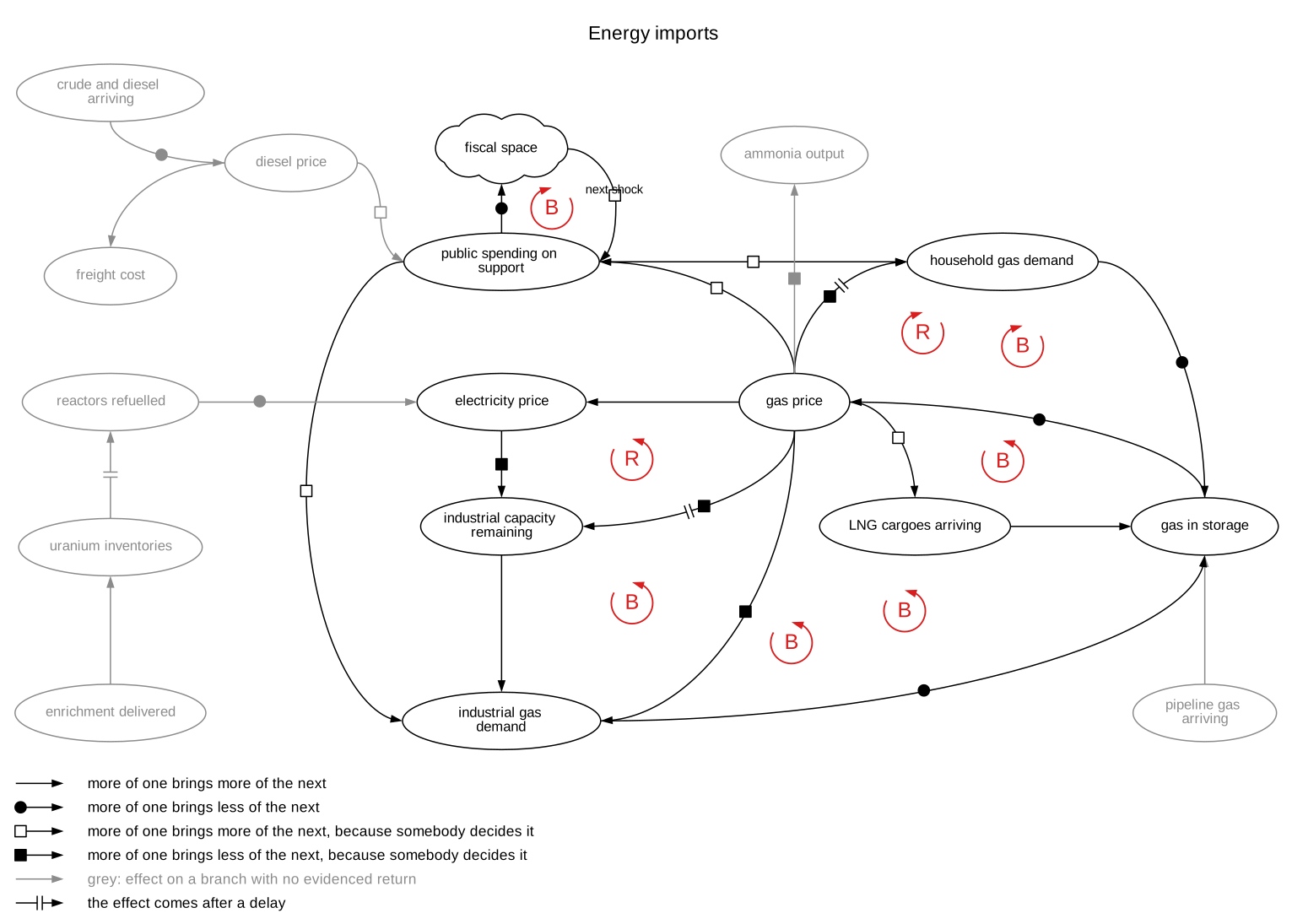
A higher gas price can attract cargoes, but it also forces demand down. One balancing loop saves storage by closing factories, sometimes for good. Higher public spending may cushion households while leaving less money for the next shock.
The eight loops
Reinforcing (R):
less gas in storage → higher gas price → more public spending on support → more industrial gas demand → less gas in storage
less gas in storage → higher gas price → more public spending on support → more household gas demand → less gas in storage
Balancing (B):
less gas in storage → higher gas price → more LNG cargoes arriving → more gas in storage
less gas in storage → higher gas price → less industrial gas demand → more gas in storage
less gas in storage → higher gas price → less household gas demand, after a delay → more gas in storage
less gas in storage → higher gas price → less industrial capacity remaining, after a delay → less industrial gas demand → more gas in storage
less gas in storage → higher gas price → higher electricity price → less industrial capacity remaining → less industrial gas demand → more gas in storage
more public spending on support → less fiscal space → less public spending on support at the next shock
Other people’s taps
�Half of the EU’s gas came by pipeline in 2025 and 40% as LNG, according to the EU Agency for the Cooperation of Energy Regulators (ACER).
Russia’s share of gas imports fell from 45% when the war began to 12% in 2025. An EU regulation in force since 18 March 2026 bans the rest by November 2027. Russia is leaving on a published timetable. That is more notice than it gave.
�The EU imports around 97% of the crude oil it uses, from many suppliers. Its refined products come from fewer. Jet fuel is around 38% imported, mostly from Kuwait, India and the UAE, and EU refinery capacity has fallen by 5% since 2015.
�Nuclear fuel goes through more stages before it reaches a reactor: mining, conversion, enrichment and fabrication. In 2025 Russian providers did 22.6% of the enrichment for EU utilities, and by the end of the year every EU operator of a Russian-designed VVER reactor had contracted fuel from someone else.
A supplier and its route are separate dependencies. Qatar is a friendly supplier, and its LNG leaves through the Strait of Hormuz. Norway is a neighbour, and its gas crosses the North Sea in pipes on the seabed. The European Network of Transmission System Operators for Gas (ENTSOG) keeps the loss of “the largest offshore infrastructure supplying continental Europe” among its standing scenarios.
Ways the tap closes
In 2022 Russia stopped supplying contract by contract, and each cut came with its own paperwork: payment terms in April, repairs in June, maintenance in July. The next stop is the EU’s own. Since March 2026 it has been refusing the Russian gas still on offer, in steps that end in a full ban in November 2027.
A route can close while the supplier stays willing. The war that began on 28 February 2026 “essentially halted” traffic through Hormuz, which in 2025 carried around a quarter of the world’s seaborne oil trade and over 110 bcm of LNG. Qatar’s Ras Laffan, the world’s largest liquefaction facility, has been offline since an attack on 2 March.
Qatar supplied around 8% of the EU’s LNG, so the gas kept arriving and the price rose instead. The Dutch hub price doubled from €30 to €60/MWh in the first weeks of the war, and jet fuel rose by more than 170% against the start of the year.
Nearer home, the Balticconnector pipeline between Finland and Estonia was damaged in the early hours of 8 October 2023. Investigators recovered a large anchor next to the damage and found drag marks along the seabed. Finland ran on its LNG terminal at Inkoo until the pipe returned to commercial use on 22 April 2024.
Being outbid needs no cut at all: the cargoes exist and go to whoever pays more. In 2026 ENTSOG reports “intensified competition for available cargoes between Europe and Asia”, and its tight scenario assumes “limited LNG supply attraction to Europe”. Being the richest buyer in the room is an excellent strategy. It depends on the room.
The rouble demand of 2022 turned supply into a lever by making delivery conditional on paying in roubles. In August 2025 a joint statement on trade with the United States said that the EU “intends to procure US liquified natural gas, oil, and nuclear energy products with an expected offtake valued at $750 billion through 2028”. ACER notes that the reliance on US gas “exposes the EU to price volatility and tariff risks”. Energy bought inside a trade deal carries its conditions with it, and a dependency can become a permission.
Winter is coming
Prices move first. Storage decides how long Europe can keep burning gas while buyers cut back and importers look for cargoes.
Storage is the buffer, and it is smaller than its fill level suggests. Over winter 2025/26 EU storage covered about 26% of total gas consumption. On 1 October 2026 it was 72% full, against 83% a year earlier. ENTSOG expects it to fall to 29% by the end of March if LNG arrives normally and to 13% if LNG stays tight. A summer that starts at 13% refills only to 80% by September, even with normal LNG.
A hard winter is paid for in the next one.
�Oil stocks have to cover at least 90 days of net imports. On 11 March 2026 IEA members agreed to release 400 million barrels, the largest release in the agency’s history. In the tanks around Amsterdam, Rotterdam and Antwerp, crude and diesel stocks stayed close to their averages. Jet fuel fell below 70% of its five-year average by May.
The shortage was not in crude but in the part already refined into something an aeroplane can burn.
A cut in nuclear fuel arrives slowly, because inventories owned by EU utilities would fuel their reactors for more than three reloads on average, and every utility holds enough for at least one. A cut in enrichment would show in the reloads of later years, not in next week’s output.
When gas is short, the price does the rationing. Between August 2022 and March 2023 EU gas consumption ran 17.7% below the average for the same months of the previous five years, against a target of 15%. Industry cut first. In a German study cited by ACER, industrial demand was 27% lower year-on-year across autumn and winter 2022, while households’ savings “were more modest and took more time to materialise”.
ACER counts household gas consumption “the least price elastic due to structural needs”. The structural needs are mostly radiators.
ACER notes that “in Europe, gas-fired generation frequently sets the marginal price, particularly during peak demand periods”, so a gas price reaches the electricity bill too.
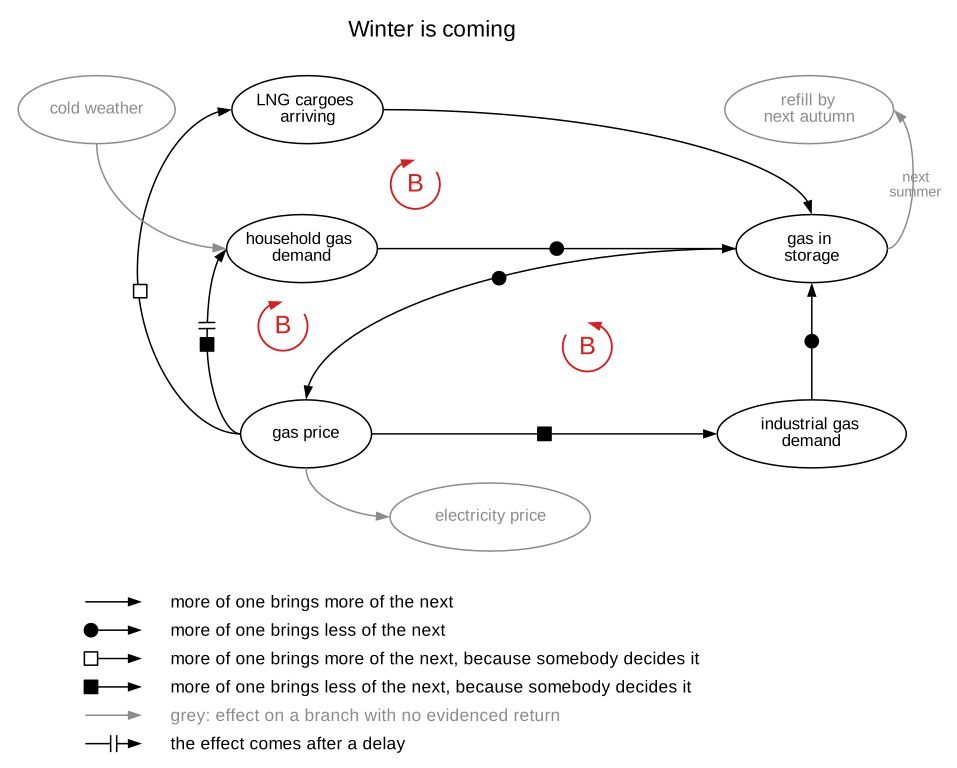
The balancing loop works: price up, demand down. It works first on plants whose customers can buy the same ammonia elsewhere. Households cut later and less. They pay instead.
Click to enlarge.
Storage delays the shortage; it cannot create new gas. A high price lowers industrial demand quickly and household demand more slowly, while the stock left in spring sets the terms for the following winter.
Cold rooms
A gas price ends, for some households, as a temperature. In 2024, 9.2% of the EU population “was not able to keep their home adequately warm”, 19.0% in Bulgaria against 2.7% in Finland. The same market price lands in a well-insulated flat in Helsinki and a draughty one in Sofia. The rest of the adjustment happens out of sight: one room heated instead of three, a jumper instead of a radiator, and someone deciding who sits nearest the heater.
Factories that close
Gas is a feedstock as well as a fuel. Industry takes 25% to 30% of the EU’s final gas demand, and where gas is the feedstock there are, in ACER’s words, “little to no fuel alternatives”. Ammonia is nitrogen from the air and hydrogen from gas, so expensive gas makes expensive ammonia. By October 2022 about 70% of European ammonia production capacity had been reduced or shut down, leaving imported ammonia or less fertiliser.
EU gas consumption fell by more than 50 bcm in 2022. ACER expected “a substantial part” of the fall to become permanent through efficiency investments, fuel substitution and “solidified behavioural changes”, and named outsourced or relocated production among the causes.
Glass, steel and aluminium went the same way as ammonia, quietly. In 2022 industrial production in gas-intensive sectors such as “fertilisers, steel and aluminium” fell on average by around 8% in the EU, less than their gas use. “Several plants reduced production,” the IEA found, “and in some cases imported finished products from outside the EU instead of manufacturing them domestically at higher cost”. The gas was saved by buying the product from someone who still had gas.
BASF shut its plant for TDI, a raw material for foam, along with one ammonia plant, the melamine plant and the fertiliser facility at Ludwigshafen by the end of 2023, with further shutdowns in its ammonia and adipic acid chains due by the end of 2026. The ammonia, methanol and melamine plants are to be “verkauft, abgebaut und umgesiedelt”, sold, dismantled and moved.
The long bill
An energy shock ends, but its closed plants, spent budgets, emptier storage and new suppliers remain.
The long-run risk is a slow loss of industry. Europe keeps paying more for energy than its competitors, and the industry that uses most of it keeps shrinking. In 2024, the Draghi report found, EU companies paid electricity prices “2-3 times those in the US” and gas prices “4-5 times higher”, and production in energy-intensive industries had “fallen 10-15% since 2021”, replaced by “increasing imports from countries with lower energy costs”. Plants that close for this reason can stay closed, as at Ludwigshafen.
EU countries allocated €646 billion in support during the 2022 crisis, equivalent to 4% of their GDP, according to Bruegel figures cited by ACER, and that money stays spent. In 2026 they committed close to €12 billion. The Bruegel authors read the smaller sum as “limited fiscal space following the COVID-19 pandemic and the 2022 energy crisis”, together with expectations that this disruption will prove less persistent.
The scramble also bought new dependencies. The United States now provides over half the EU’s LNG and 27% of its gas, and ACER’s verdict is that the shift away from Russian gas “changed the profile of this dependency” but “did not eliminate the underlying reliance”. Terminals and long-term contracts outlast the emergency that ordered them.
Much of the gas Europe still needs arrives as LNG, and ACER expects about a third of that LNG to be bought without a long-term contract until at least 2030, which leaves Europe exposed to price swings on the world market.
The way to end the gas dependency is to need less gas. The Commission found that cutting emissions by 90% by 2040 gives Europe the most energy independence and the best protection against fossil fuel price shocks.
A few levers
Storage is the lever pulled hardest, and it has a price. The 2022 storage measures drew in “substantial gas volumes ahead of winter 2022/2023, but in some instances incurred high injection costs”, ACER found. The target is now 90% at any point between 1 October and 1 December, with additional flexibility “in the case of difficult conditions”. Difficult conditions are the ones storage is for.
Since 2023 European companies have also bought gas together, and the EU’s AggregateEU platform matched more than 42 bcm of their demand with suppliers’ offers.
Electrification and domestic generation would shrink the import itself. ACER finds that higher shares of renewables and nuclear lower wholesale prices. In Spain, wind and solar cut the share of hours in which gas sets the electricity price from 75% in 2019 to 15% in 2026, according to figures the Bruegel authors cite, and they call electrification “an energy security imperative”. The next import shock will show how far that protection goes.
Spare routes have held so far. Finland’s LNG terminal covered a broken pipe, and Italy’s Edison has replaced 23 of its 35 missing Qatari cargoes, mainly with US gas. Nobody has yet had to cover a cut on two routes at once.
Smoke somewhere else
When the gas left, coal came back for a while. Some closed or reserve coal plants re-entered the market in 2022, and EU coal power generation rose. “Only in Germany, with 10 gigawatts (GW), is the reversal at a significant scale,” the IEA found. Coal helped keep electricity available, at the cost of higher emissions than planned.
The gas Europe buys instead leaks methane on the way, in the countries it comes from. Under the EU methane rules, importers of oil, gas and coal must show from 2027 that their suppliers measure and report methane “equivalent to those set out in the regulation”. From 2028 they must report the methane intensity of production, and from 2030 show that it is “below certain maximum intensity values”. Until then, the methane from a cargo’s wellhead is counted in another country’s air.
And the cargo Europe wins is a cargo someone else loses. In 2022 that someone was Pakistan.
A lower gas price can reopen a valve. It cannot put a dismantled plant back on its foundations.
Out by teatime
Imagined conversation with Lord Vetinari.
Lord Vetinari: “A furnace goes out in an afternoon, Drumknott. Relighting it takes years, a subsidy and, as a rule, a different country.”