Critical raw materials
What happens in Europe when the metals inside its machines stop arriving?
Export licensing has already disrupted European production. In April 2025 China put seven heavy rare earths under export licensing. By early June, CLEPA, the association of Europe’s car parts suppliers, reported “the shutdown of several production lines and plants across Europe, with further impacts expected in the coming weeks as inventories deplete”. Hundreds of licence applications had gone in since early April, and by CLEPA’s count only about a quarter “appear to have been approved”.
The quantities are small and the reach is long. Rare earth magnets drive the motors of electric cars and the actuators, speakers and sensors of ordinary ones, gallium and germanium go into chips, and graphite goes into battery anodes. Very little of any of it is refined in Europe. China refines 99% of the world’s gallium, 94% of its germanium and 94% of its refined graphite.
The dependence sits less in the ground than in the refinery. Ore can be dug in Australia and still pass through China before it becomes anything a factory can use.
Nothing was banned. The door stayed open and the paperwork slowed down, which turned out to be enough.
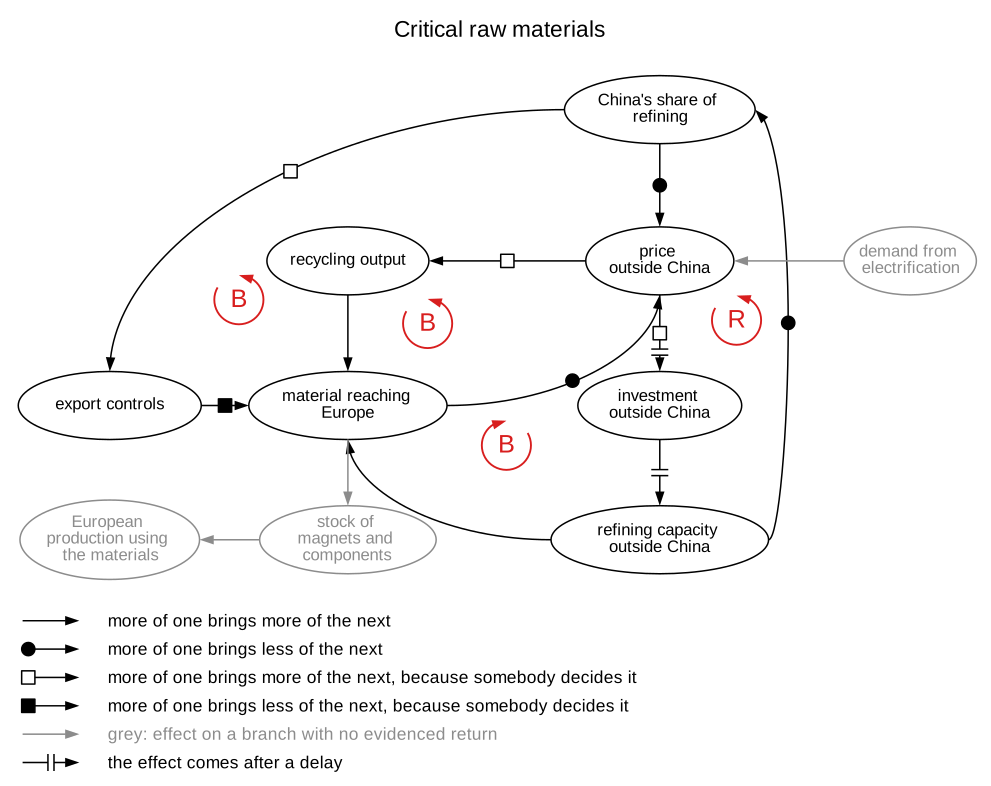
Click to enlarge.
Export controls reduce the flow of usable material; less material then raises prices outside China. Those higher prices can eventually support new refineries, but persistent low prices have already discouraged the investment needed to build them.
The four loops
Reinforcing (R):
larger Chinese share of refining → lower price outside China → less investment outside China, after a delay → less refining capacity outside China, after a delay → larger Chinese share of refining
Balancing (B):
larger Chinese share of refining → more export controls → less material reaching Europe → higher price outside China → more investment outside China, after a delay → more refining capacity outside China, after a delay → smaller Chinese share of refining
less material reaching Europe → higher price outside China → more investment outside China, after a delay → more refining capacity outside China, after a delay → more material reaching Europe
less material reaching Europe → higher price outside China → more recycling output → more material reaching Europe
Refined in one place
Gallium is a by-product, mostly of aluminium, and germanium a by-product, mostly of zinc, according to the Commission’s 2023 study on critical raw materials. Neither is mined for its own sake. They are recovered by whoever runs the refinery for something else, and the refineries that run are mostly Chinese.
China’s share grows at each step. In 2024 it mined around 60% of the world’s magnet rare earths, ahead of Myanmar, Australia and the United States, did about 91% of the separation and refining, and made 94% of the sintered permanent magnets, up from around half two decades ago.
The price outside China counts for little to the carmaker. A tripling of rare earth prices would raise the price of a car by about 0.1%, by the IEA’s reckoning. It counts for a great deal to anyone trying to build a refinery that has to sell into that price.
Further down the line
Electrification runs on these materials, since electric cars need magnets in their motors and graphite in their batteries, so the way out of the gas runs through Chinese refineries. If the trade in battery-grade graphite stopped entirely, the IEA puts more than $300 billion a year of production outside China at risk.
The same materials go into weapons and telecoms. Germanium goes into “lenses or windows in infrared night-vision devices” and is “a component of glass in telecommunications fiber-optic cable”. The magnets China now refuses for military use sit, on the IEA’s list, in “cars, wind turbines, industrial motors, data centres and defence systems”.
The licence queue
China’s lever comes in several grips, and the first is paperwork. The April 2025 controls on seven heavy rare earths did not stop exports. They made each one wait for a permit. CLEPA found the procedures opaque and inconsistent from province to province: some licences were refused on procedural grounds, and others required firms to disclose sensitive intellectual property.
By late summer the EU Chamber of Commerce in China, counting rare-earth licence applications by EU firms only, reported that fewer than 15% had been approved, “leading to 7 production stoppages in August and a further 46 expected stoppages in September”. The price of a licence could include “commercially and militarily sensitive information about their products and clients”.
For defence there was no price at all: “Export permits for rare earth metals used for defence purposes are being categorically denied”. Europe is rearming with magnets it may not be allowed to buy.
The lever can be aimed, and it can reach. In December 2024 China banned the export of gallium and germanium to the United States, a ban it suspended in November 2025 until 27 November 2026. Europe was not the target. That is not the same thing as being out of range.
In October 2025 the controls were extended to “internationally made” products containing Chinese-sourced materials or manufactured using Chinese technologies, so a magnet made outside China could need Chinese permission. Proposed controls on rare earth “related products, equipment and technologies” put the know-how to build a refinery on the list as well.
Substitution was tried and noticed. Magnet makers had turned to holmium as a substitute, and the October 2025 package added holmium to the list. The way round became the next item on the list, though that package is also suspended until November 2026.
The number of mineral tariff codes under Chinese export controls has tripled since 2023, and the suspensions run until November 2026, which makes the lever a date on a calendar.
Before the lines stop
Manufacturers’ stocks were the only cushion, and in 2025 CLEPA expected them to run down within weeks. According to the IEA, the April controls ended up “forcing some automakers to reduce utilisation rates or temporarily halt operations”.
Export controls split the market. By July 2026, European prices for gallium and the heavy rare earths dysprosium and terbium were around five times Chinese domestic prices; germanium was nearly three times as expensive.
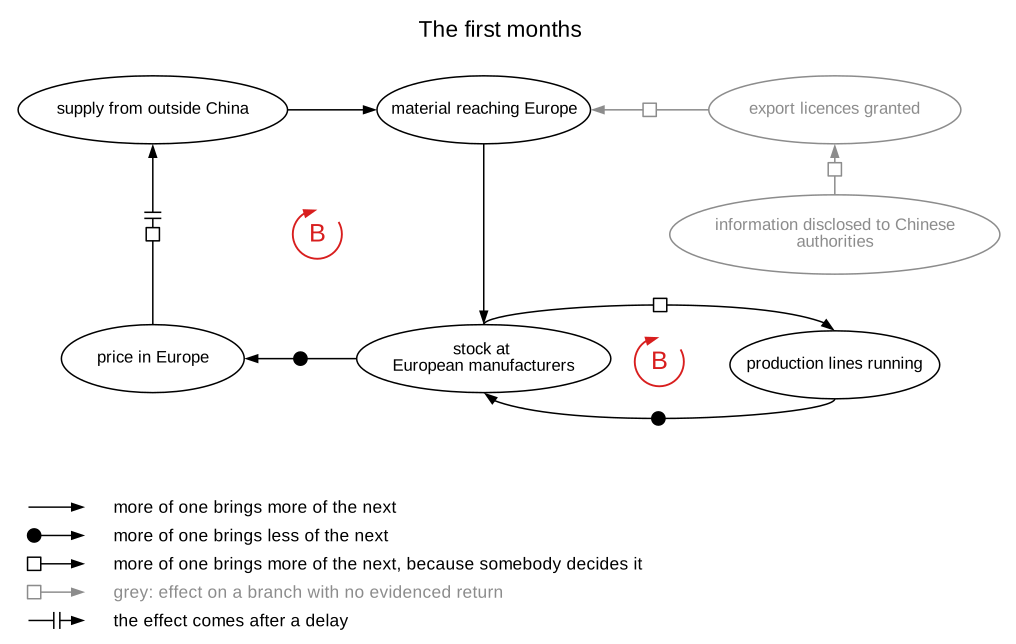
Click to enlarge.
Both loops balance, and neither is comfortable. One balances by stopping the production lines, which saves the stock by not using it. The other balances by drawing supply from outside China, which takes longer than the stock lasts.
The two loops
Balancing (B):
less material reaching Europe → less stock at European manufacturers → higher price in Europe → more supply from outside China, after a delay → more material reaching Europe
less stock at European manufacturers → fewer production lines running → more stock at European manufacturers
The quiet lever
The quietest grip needs no announcement, because a low price keeps competing projects unbuilt and nobody has to be told anything.
Concentration in refining has a habit of keeping itself. The IEA describes a pattern “seen for some other critical minerals: oversupply drives low prices, rendering production outside China uneconomic, in turn resulting in curtailment or rationalisation, and eventually increasing China’s market concentration”. For rare earths in particular, “for decades, investment levels in rare earth companies in geographically diverse regions remained low”, low prices among the reasons.
A low price is just as capable of delaying a new refinery as an export licence is of delaying a shipment.
Slow to build
Refineries take time, and mines take longer. In the IEA’s words, “mining projects generally require longer lead times for permitting and construction than refining or processing facilities”. Even if every announced project is built, refining capacity outside China in 2035 would match only about two thirds of the rare earths expected to be mined, and planned magnet production only a third.
Building one costs more outside China. Capital costs for refining projects are 20% to over 150% higher outside the dominant supplier, and, the IEA notes, “outside China, only a handful of suppliers provide key battery-grade-graphite processing equipment”. Some of the equipment needed to escape the dependency comes from the dependency.
Rare earths are the one case where China’s hold has slackened a little. New projects in the United States and Malaysia brought, in the IEA’s words, “a modest decline in concentration” between 2023 and 2025, “highlighting the role of targeted policy and investment support”. The loop can be balanced. It takes money, and it takes years.
The smelters go quiet
Europe’s own processing is shrinking while its demand climbs. The European Court of Auditors finds that “at present, the EU’s processing capacity is shutting down”. The EU-27 lost around half of its primary aluminium processing capacity between 2019 and 2023, and “100 % of rare-earth processing is done outside the EU”.
The auditors count high energy costs among the main reasons, since smelting uses a great deal of energy and electricity costs more in the EU than in other regions. The energy prices that drive out the furnaces drive out the smelters too. Meanwhile the EU’s annual demand for the rare earths in wind turbines may rise sixfold by 2030.
On present plans, Europe looks unlikely to meet several of its 2030 benchmarks. The auditors call them “non-binding”, and they found most strategic projects in their sample still at an early stage, and highly unlikely to contribute much to the 2030 targets. Only three mature projects had a high chance of contributing.
A mine in the EU typically takes 10 to 15 years to open, and can take 20. Recycling is meant to supply 25% of strategic materials by 2030, yet the EU recycles 4% of its heavy rare earths and 3% of its light ones, and recycles no gallium or lithium at all.
Europe’s way out of Russian gas therefore runs through Chinese refineries well into the 2030s. Any new licence list can stop European production lines again, as the April 2025 list did.
A few counterweights
�Europe’s counterweight begins with targets for 2030 in the European Critical Raw Materials Act, among them that no more than 65% of any strategic material should come from a single third country. In October 2026 the Commission selected 46 more Strategic Projects, four of them on rare earths for permanent magnets.
Stock and scrap come next. The Commission’s RESourceEU plan of December 2025 announced a European Critical Raw Materials Centre to act “as portfolio manager for diversified and resilient supply chains, including through joint purchasing and stockpiling”, and a stockpiling pilot intended to become operational in early 2026. By September it was still looking for an organisation to run the pilot, with applications closing on 9 October. So far the reserve exists on paper.
The IEA puts the yearly cost of stockpiling the eleven riskiest materials, for all countries outside China together, at less than $900 million. RESourceEU also restricts the export of magnet scrap and sets recycled-content shares for new magnets.
Partners are the next counterweight, and partners have conditions. RESourceEU builds on 15 Strategic Partnerships with resource-rich countries. In June 2026 Mozambique restricted the export of unprocessed materials and, the IEA reports, “mandated local value addition and required 10% of mining revenues to be directed to local communities”. The countries Europe hopes to buy from would also like a refinery, and some of the money.
The last counterweight is a price that stays up. The IEA lists a Japanese agreement to buy neodymium-praseodymium until 2038 at a market-linked floor price, and a US investment of $400 million in MP Materials. A floor answers the patient lever with a patient bill, paid every year the price stays low.
The ore’s far end
Wherever Europe ends up buying, the minerals are still dug and refined somewhere, and much of the cost stays there. A growing share of the heavy rare earths China refines is mined in Myanmar. Global Witness, the campaigning NGO, found imports of heavy rare earth oxides from Myanmar to China rising from 19,500 tonnes in 2021 to 41,700 tonnes in 2023, “more than double China’s own quota for domestic HREE mining”. Myanmar has become “the single largest source of vital HREE”.
In Kachin Special Region 1, held by militias aligned with the junta, the number of mining sites grew by more than 40%. A community member in the town of Chipwe told the investigators: “There are no longer fish in the waters. Stepping into the water can cause itching and infections. When the animals drink the water, they die.”
The refinery leaves its own mark: at Baotou, where much of China’s rare earth processing sits, the tailings “are contaminated with radioactive thorium with a mean concentration of 5%”. The pond “has no liner system or vegetation cover”, and the dam stands “about 35 m above the Yellow River”. Cheap rare earths were cheap partly because somebody else kept the waste.
The mine meets pasture
Bringing the mine home brings it to somebody’s home. LKAB’s Per Geijer deposit near Kiruna, with 2.2 million tonnes of rare earth oxides, is one of the EU’s designated strategic projects, which means faster permits. In April 2026 the Stockholm Environment Institute concluded that the mine could violate the rights of the Sámi reindeer herders: it would stop them moving their herds between winter and summer pastures. LKAB said it had not reviewed the report, and that it wanted “dialogue with the Sami village to develop appropriate and far-reaching measures for compensation”.
The patient embargo
Imagined conversation with Lord Vetinari.
Lord Vetinari: “The cheapest way to stop a man building a refinery, Drumknott, is to sell him everything it would make, slightly cheaper, for twenty years.”