Semiconductors
What happens when Europe makes the machines that make chips, but cannot get the chips?
Nexperia’s wafers are made in Europe and finished in Asia. In autumn 2025 the finished chips stopped coming back, and European carmakers faced a supply crisis.
On 30 September 2025 the Dutch Minister of Economic Affairs invoked the Goods Availability Act (Wet beschikbaarheid goederen) against Nexperia, a chipmaker headquartered in Nijmegen, over “serious governance shortcomings”. On 4 October China put an export control on Nexperia’s Chinese operations.
Nexperia makes most of its wafers in Germany and the United Kingdom and has them cut, packaged and tested mostly in China, Malaysia and the Philippines, and the government’s letter notes that the Asian plants that finish the chips cannot run without wafers from Europe. China’s export control stopped finished chips leaving Nexperia’s Chinese plants.
Within a month ACEA, the association of Europe’s carmakers, warned that “assembly line stoppages might only be days away”.
The chips that threatened Europe’s car factories in 2025 were not the clever ones. In mid-October ACEA had called Nexperia “an important, high-volume supplier”, and by the end of the month it was calling its chips “simple chips”. Nobody thought about them until they were gone.
Europe makes the machines that make chips and buys most of the chips it uses from abroad. ASML, in the Netherlands, holds more than 80% of the world market for lithography equipment and all of it for extreme ultraviolet (EUV) machines. Most chips are cut, packaged and tested in Asia, in Malaysia, Viet Nam and China, and the most advanced are made in Taiwan. Europe has some capacity for older, simpler chips and, when the European Chips Act was proposed, none at all for the most advanced chips, at 7 nanometres and below.
Click to enlarge.
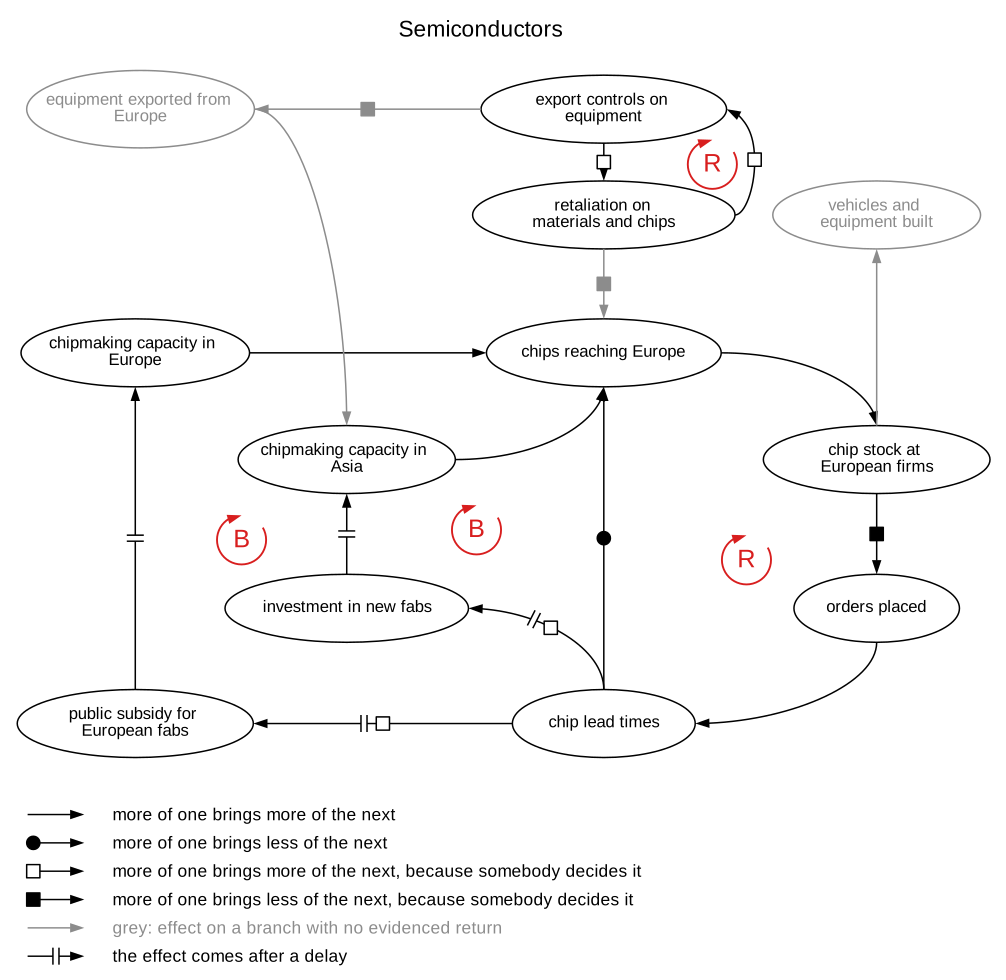
Europe’s chip equipment helps build capacity elsewhere, while restrictions can provoke restrictions in return. When orders surge against dwindling chip stocks, lead times lengthen. New chip factories, or fabs, offer relief after years rather than weeks.
The four loops
Reinforcing (R):
less chip stock at European firms → more orders placed → longer chip lead times → fewer chips reaching Europe → less chip stock at European firms
more export controls on equipment → more retaliation on materials and chips → more export controls on equipment
Balancing (B):
fewer chips reaching Europe → less chip stock at European firms → more orders placed → longer chip lead times → more investment in new fabs, after a delay → more chipmaking capacity in Asia, after a delay → more chips reaching Europe
fewer chips reaching Europe → less chip stock at European firms → more orders placed → longer chip lead times → more public subsidy for European fabs, after a delay → more chipmaking capacity in Europe, after a delay → more chips reaching Europe
Round trip to Asia
A chip starts with a design, takes shape on a wafer, then has to be cut, packaged and tested. Those jobs can happen in different countries. The Court of Auditors maps design to the United States and Taiwan, wafer fabrication to Taiwan, South Korea and China, assembly, test and packaging to Southeast Asia, and equipment to the EU, the United States and Japan.
Europe’s own fabs are many and modest. There are over 50 of them, and most make older types of chip on small 150 mm and 200 mm wafers. Nexperia, in the Dutch government’s words, “is the last producer with manufacturing capacity in Europe for so-called ‘legacy’ chips”.
The newest fab is going up in Dresden. ESMC, a joint venture of TSMC, Bosch, Infineon and NXP, received €5 billion of German state aid, approved by the Commission in August 2024, for chips at 28 to 12 nanometres for car and industrial uses. Europe’s answer to depending on TSMC is to invite it in.
Europe buys between 8.5% and 10% of the world’s chips, and about 20% of the equipment and devices they end up in. Cars take 37% of Europe’s chip demand and industrial manufacturing 25%. The gallium that goes into chips is refined almost entirely in China. Europe makes the machine, assembles the car, and in between buys the chip from someone else.
Ways the line stops
A factory can also stop for its owner’s reasons. The Dutch government said Nexperia’s chief executive was “transferring production assets, funds and knowledge to a foreign entity controlled by the CEO” and planned to “close or substantially downscale European production and research sites”. The government took control to keep that production in Europe. Four days later China blocked exports from Nexperia’s Chinese plants, and the chips European carmakers needed stopped arriving.
Wafers made in Germany are packaged in Asia, so the last step can be cut off. When China required export licences for Nexperia’s Chinese plants, the licences came slowly and unpredictably, and some of Nexperia’s customers ran short and stopped production.
Controls run both ways, and since 1 September 2023 the Netherlands has required a licence to export advanced deep ultraviolet lithography equipment, and widened the list in 2024. One of the government’s stated goals is “preserving the Netherlands’ technological leadership position”.
China’s export control on Nexperia came four days after the Dutch order and eight days before the Dutch government made that order public. Bruegel, the Brussels think tank, reads the sequence plainly: “Beijing retaliated”, blocking exports to the EU of Nexperia chips made as wafers in Hamburg and finished in Dongguan.
The Netherlands is pressed from across the Atlantic as well. Washington has repeatedly lobbied the Dutch government to revoke ASML’s export licences for China, a market worth 33 percent of ASML’s sales in 2025.
Demand can jump too. In 2021 delivery times doubled from about 10 weeks to 20 for microprocessors, memory, power management and analogue chips, and companies made it worse by over-ordering and stockpiling.
The Court of Auditors counts the tension between China and Taiwan as a lasting source of insecurity for the industry. A halt in Taiwan would hit the most advanced chips first, since that is where they are made.
Smaller accidents have cut supply already. In 2020 and 2021 there were earthquakes, a fire at the Renesas fab in Japan, ice storms in Texas, power outages at Infineon, NXP and Samsung fabs, and a drought in Taiwan, where fabs need water.
When there is not enough, the chipmaker chooses who waits. In 2020 cars brought TSMC just 3% of its revenue, and chips for IT equipment stayed first in line. Space and defence, at about 1% of the market, waited longer still, and the delays reached the EU’s Galileo navigation and Copernicus Earth-observation satellites. The makers of grid equipment, buying in small volumes too, got low delivery priority from chip vendors, which slowed the connection of wind turbines and solar plants. A buyer that orders few chips is served last, however much depends on them.
Weeks of stock
There is not much stock to start with. The Commission found that some industries’ drive towards zero inventory had left very little stock to absorb a sudden rise in demand. Its own Chips Act communication reckoned the car industry could run out of chips within weeks.
In October 2025 ACEA found that stocks of Nexperia chips were expected to last only a few weeks, and qualifying new suppliers would take several months. Many other suppliers make the same kind of chip. Getting them approved for a particular car part, and building up their output, is the slow bit.
Car chips must be certified together with the process that makes them, which limits the fabs and packaging firms a car chip supplier can use. The Court of Auditors doubts that even the Chips Act’s crisis tools can move production quickly, given the many kinds of chip that industry uses and how long it takes to requalify a line, “even between ostensibly similar products”.
Click to enlarge.
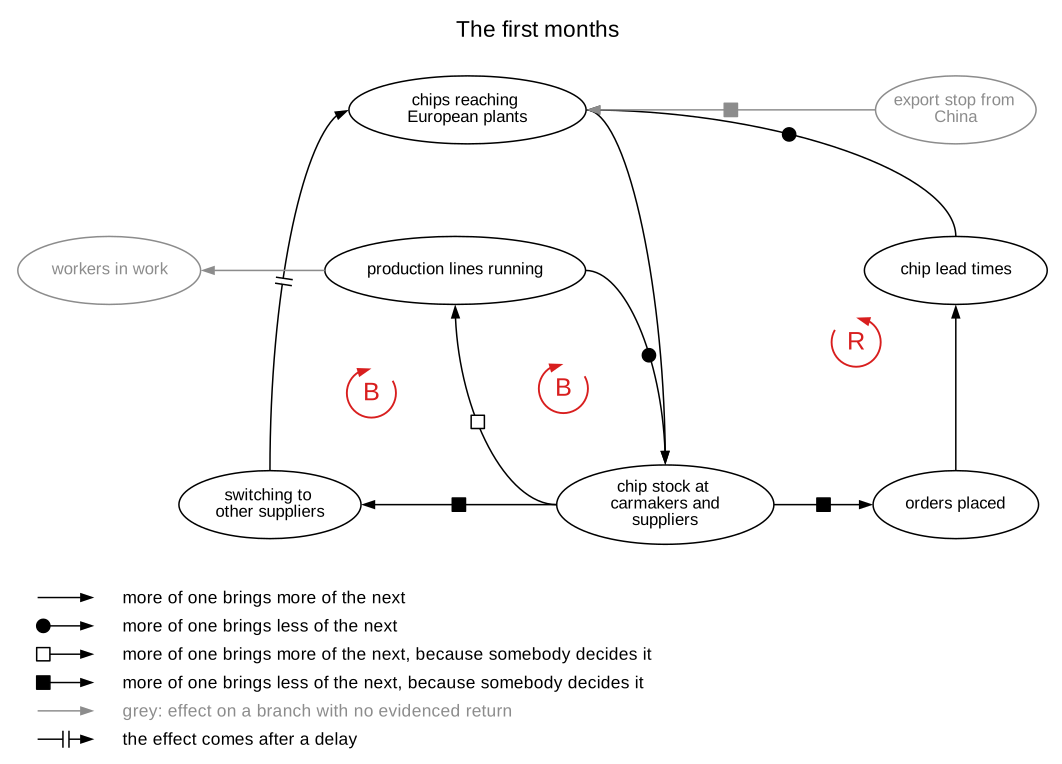
Car plants run on stocks that can disappear within weeks, and switching chip suppliers takes months. The quickest balancing loop is the one nobody wants: the lines stop, and the stock lasts longer.
The three loops
Reinforcing (R):
fewer chips reaching European plants → less chip stock at carmakers and suppliers → more orders placed → longer chip lead times → fewer chips reaching European plants
Balancing (B):
fewer chips reaching European plants → less chip stock at carmakers and suppliers → more switching to other suppliers → more chips reaching European plants, after a delay
less chip stock at carmakers and suppliers → fewer production lines running → more chip stock at carmakers and suppliers
The parts suppliers stop first, and ACEA’s members reported in late October that “part supplies are already being stopped”. In 2021 the wait for chips ran to a year or more, and car factories cut production or shut down, laying off workers.
When the chips stop, the line stops, and the line is people. Some 13.5 million Europeans work in the automotive sector, 8% of all manufacturing jobs in the EU. In August 2021 the ifo institute found the German car industry still held up by bottlenecks in intermediate products, chips above all, and its employment expectations had turned negative.
The rest of the bill arrived at the dealership. By August 2022 euro area car prices were rising 8.7% a year, and the ECB reckoned the rise would have been less than half that without the supply disruptions and the energy shock. The missing part fitted on a fingernail. The price rise did not.
Further down the board
Car lines are only the first to stop. The same chips run machines, hospital equipment and trains.
In 2021 German car production fell by 34% from 2019, “back to 1975 levels”. Nexperia’s chips are “often used in the electronic control units of vehicle electrical systems”, according to ACEA, and the Dutch government lists the automotive, consumer electronics and telecommunications sectors among Nexperia’s customers.
�The 2021 shortage, the Commission noted, reached well beyond cars. Machinery took the next blow after cars, nearly as hard, and its makers are often small firms with little bargaining power. In a September 2021 survey by the VDMA, Germany’s machine builders’ association, 46% of its members reported serious shortages of electrical and electronic components.
Equipment makers, ASML among them, were hit as well, with tool deliveries up to three years late, so the shortage slowed the building of the fabs that were meant to end it.
Hospitals depend on the same chips. For some medical systems production volumes fell by more than 70%, and, the Commission found, one missing microcontroller in patient monitoring systems “prevents the installation of tens of thousands of beds in intensive care”.
In factories the problem arrives slowly. The controllers, drives and relays that run a plant are built to last decades, while the chips inside them are made only as long as somebody orders them. ZVEI, the German electrical and electronics industry association, defines obsolescence as the state in which something is “nicht mehr verfügbar”, no longer available, and its answers are a last-time buy, long-term storage or a redesign. A plant whose controller is discontinued keeps running until the day a spare is needed.
Railways have it worse. The German rail industry association notes that a contractual service life of more than 30 years, with spare parts guaranteed throughout, is “keine Seltenheit”, no rarity, while electronic components have “eine deutlich kürzere Lebensdauer”, a markedly shorter life, than the trains they sit in.
Communications equipment takes 15% of Europe’s chips, in the routers and base stations that the internet depends on. Behind all of it sits one company on one island and a handful of equipment suppliers.
The simple chips move
The next shortage may come from the growing market for the simplest chips, even without a repeat of the Nexperia dispute.
The simple chips are the ones Europe will depend on most. Older-generation chips made up around 76% of global foundry production in 2024 and are projected to make up 70% in 2027, and China accounts for 40% of the world’s planned new capacity for them, according to Rühlig of the Swedish Institute of International Affairs.
By 2030 EU companies will need to import at least 8.2 million wafers a year, by Rühlig’s estimate. The EU Institute for Security Studies concludes that “it is only logical that China-based fabs will meet most of the expanding European demand”, and as European firms buy more of those chips, “this will result in yet another strategic dependency”.
Low prices speed the shift to China. China’s party-state subsidises its chipmakers, and the institute sees the first signs of a price war for some chip types. The concern, as Rühlig sets it out, is that subsidised firms that cannot sell at home export their overcapacity and squeeze out competing suppliers. Rühlig himself finds that China’s new capacity meets real demand instead. On either reading, Europe buys the chips from China.
In 2025 Europe learned that its own wafers were finished in China. By 2030 the chips may be made in China from the start.
Years to build
New capacity takes years, so a shortage outlasts its cause. Once demand outruns supply, recovery takes at least two to three years, because capacity needs heavy investment.
Building in Europe is slower still. The Chips Act aims at 20% of world production by value by 2030, a target the Court of Auditors calls overly ambitious. It found the Act “very unlikely to be sufficient”, since EU production capacity would have to roughly quadruple, and the share is currently predicted to reach only 11.7% by 2030. Because the industry runs on a few very large projects, one project cancelled, delayed or failed can shift the whole result.
One did in July 2025, when Intel dropped its planned projects in Germany and Poland. The fab in Magdeburg had been promised close to ten billion euros of German state aid, and ZEW’s Irene Bertschek concluded that the plans were “cancelled just in time”: “It would have been worse if the ten billion euros had already been paid out”.
People are slower to build than fabs. The Court of Auditors heard of a severe shortage of skilled labour, with a global gap projected to reach a million skilled workers by 2030. Chip packaging is slower still to come back. One project has moved some packaging steps from Asia to Europe. Bruegel points out that Nexperia, with its wafers made in Europe and its chips finished in China, shows that Beijing has “substantial leverage despite the European location of the fabs”.
Holding one end
Europe’s answer so far has been money and pilot lines. The European Chips Act counts on at least €86 billion of public and private investment up to 2030, and the Court of Auditors credits it with reasonable progress, though not with the 20% it was aimed at. For a shortage already under way, the Act lets the Commission request information and buy jointly now, and issue priority-rated orders from 2028 at the earliest. The one tool that could oblige a factory to serve critical sectors first does not exist until then.
Stock would buy the weeks that money cannot, and the 2021 shortage traced back partly to zero-inventory habits. A chip held in reserve costs money in every year it sits unused and pays for itself only in the year it is needed. Carmakers had spread their orders too. ACEA said in October 2025 that they had diversified their supply chains in recent years but could not bring the risk to zero.
The Dutch government reached for a different emergency lever. It invoked the Goods Availability Act, which it calls “highly exceptional”, to keep Nexperia’s production in Europe, and suspended it seven weeks later, in November 2025, once China was licensing exports again. The minister did so trusting that China “will actually continue to grant export licences for all (European) companies and all countries”. The price was paid in parts that did not arrive. The court inquiry into the company went on; the letter expected it “to take some time”.
Europe does hold one end of the chain: nobody else makes the most advanced lithography machines. The Dutch government controls their export partly to keep the Netherlands’ technological lead, and Bruegel argues that this kind of indispensability is worth more than self-sufficiency, since it gives Europe “a credible retaliation threat, should others weaponise their own chokepoints”. The same controls give every buyer who is refused a reason to build a machine of its own. The next round of export controls will test which effect is stronger.
Water under the fab
A fab drinks like a small town and keeps a cupboard of chemicals that would worry a larger one. The Court of Auditors notes that chipmaking needs a great deal of water and hazardous chemicals, and that five member states had proposed restricting several synthetic chemicals the industry depends on, for their links to health risk and long-lasting environmental harm.
In the north of Dresden the chip industry already uses about 30% of the city’s water, while the groundwater sits half a metre below its long-term average after years of drought. The utility now sends filtered Elbe water straight into Infineon’s works, from an intake designed for up to 900 cubic metres an hour, more than is needed so far. Europe invited TSMC to Dresden. Dresden will have to give it a drink.
In Taiwan’s 2021 drought TSMC bought water by the lorry-load, about 20 tonnes a truck, to keep its fabs supplied.
On the assembly line
The back end, where Europe’s wafers go to be cut and packaged, belongs to an electronics industry that runs largely on women. They are more than 60% of its workers worldwide, often employed on assembly lines and in supply chain logistics, while relatively few work in engineering or design. When a European minister mentions the back end, this is who is standing at it.
The excellent position
Imagined conversation with Lord Vetinari.
Lord Vetinari: “A city that makes the machine and buys the product is in an excellent position. It is the position of a man who owns the only key to a shop that is closed.”