The long way round
Crossings happen. What makes the next one more likely?
A holiday for fish
The IPBES workshop report examined what covid did to the pressures behind spillover. The economic slowdown “decreased the demand for many industrially produced commodities and thus reduced direct extractive pressures on the environment”: commercial fishing in Peru dropped 80%, and high seas landings fell by 6.5%.
Travel restrictions took away the tourism fees that are “the principal source of funding for national parks worldwide”, so rangers and guides were laid off and enforcement against illegal extraction fell. IPBES reports more hunting and poaching following, in one place with a citation and in another as anecdote. HIV/AIDS did the same earlier, and the Ebola epidemic cut tourism to East Africa for over two years after it ended.
The same pandemic cut the fishing and the rangers’ pay. IPBES expects the first to be “likely temporary and insignificant in the long term” and says nothing of the kind about the second.
Earnings into pasture
In January 2021 Soares, Fearnside and Sparovek put a questionnaire to 46 landholders in the Rio Juma settlement in Apui, southern Amazonas, where most of the municipality’s clearing happens. From their costs and sales they worked out the annual return in 2020: 38 to 59% for cattle ranching, 95 to 214% for land speculation.
A plot is cleared and sown with grass, cattle graze it and are sold, and the money pays for the next plot. Small and medium landholders are “reinvesting the earnings obtained from cattle ranching in more deforestation”.
Mass-produced darkness
Lord Vetinari, in Guards! Guards!: “Down there are people who will follow any dragon, worship any god, ignore any iniquity. All out of a kind of humdrum, everyday badness. Not the really high, creative loathsomeness of the great sinners, but a sort of mass-produced darkness of the soul.”
Central bank figures cited by Soares and colleagues show that in 2023 alone “US$ 4 billion of subsidized rural loans financed cattle ranching operations and the expansion of pasturelands in the Amazon”.
In 2008 the central bank made subsidised rural credit in the Amazon conditional on proof of land title and compliance with environmental law. Assuncao and colleagues compared municipalities before and after.
Between 2009 and 2011 the deforested area ran about 60% below what it would have been without the restrictions, and the fall in cattle loans accounts for 75% of that. No other study in this series measures a decision against the clearing it prevented. Nobody has traced it on to crossings.
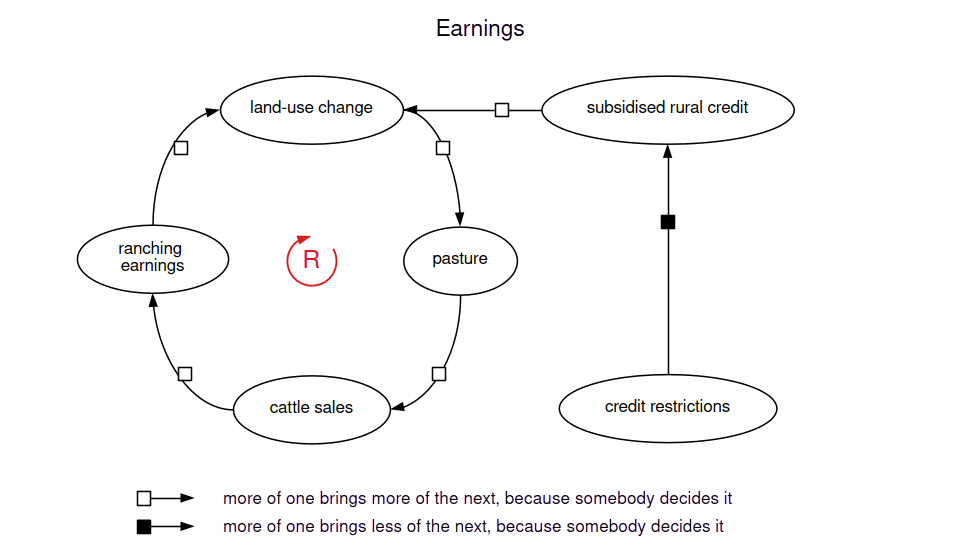
Land in Apui is priced by its distance from the town, the quality of its pasture and its road access, not by any title to it, so grass and a road are worth more than forest. Rising prices “attract new and more capitalized actors, who continue to migrate to the region, channeling more capital towards accelerating deforestation and land accumulation”. A settler who sells takes the gain to a cheaper frontier and clears there.
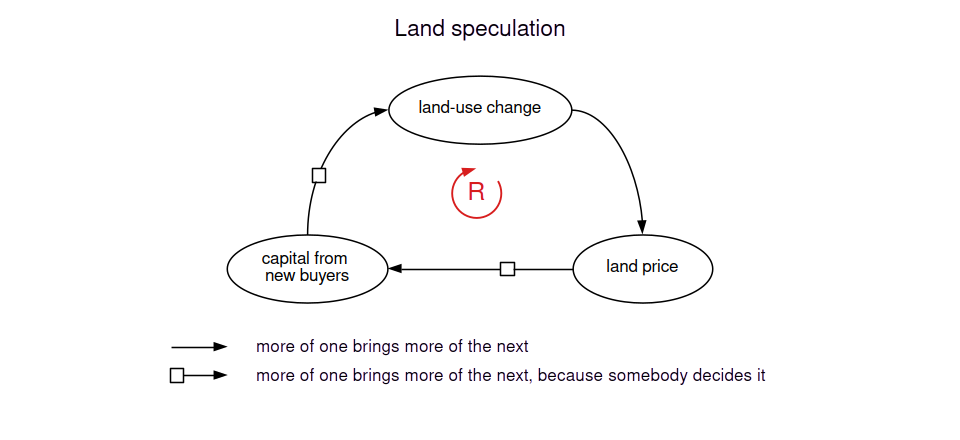
The authors call the capital “exogenous and endogenous”: some arrives from outside the frontier, and some is the frontier’s own earnings coming round again.
Money from outside has paid for this clearing before. When the Real Plan of 1994 ended the overnight deposits, “voluminous funds” were “invested in deforestation” and clearing peaked in 1995. When inflation fell, land prices dropped, speculation paid less, and clearing fell in 1996 and 1997.
The returns come from one settlement, from a snowball sample, and from a year when enforcement was weak under Bolsonaro. Nine of the 34 landholders with enough data for a return were losing money. The two logics are not peculiar to Apui. A review of 36 studies finds “capital accumulation through cattle laundering, land speculation, and the purchase of improvements from displaced smallholders” on one side, and smallholders pushed on by “structural exclusion” on the other. Large landowners “deforest disproportionately”.
More pasture, roads and cattle add places where workers, livestock and wildlife meet. A 2026 evidence synthesis finds that deforestation and urbanisation often increase zoonotic transmission risks, particularly in studies of mosquito-borne and rodent-borne diseases, but that effects differ by pathogen and region. The ranch keeps its earnings. Four IPBES authors wrote in April 2020 that “profits accrue largely to the private sector”, while “public health systems and local communities” often “pay the price of resulting disease outbreaks”.
Money arrives first
Who signs the permit, extends the loan, buys the crop, places the order or starts the fire? And can they pass the cost to somebody else while keeping the return?
An outbreak followed by a wildlife-trade ban might push clearing and trade back. A review of seventy studies found logging and poaching rising after health shocks more often than falling.
Health shocks prompted new formal forest-management rules in several places, particularly in Asia and Africa, while some informal arrangements weakened. Just over a tenth of the studies link the change to less logging and poaching. Just over a quarter link it to more logging and poaching, with forest cover and wildlife lost, including increased deforestation in Colombia and Brazil.
Those are shares of the studies, not of the forests. Most are qualitative or single cases, so they report what happened in one forest rather than which way health shocks push clearing in general.
IPBES traces the clearing and the trading to economic incentives. The direct drivers of biodiversity loss and disease emergence, it says, “are caused by economic incentives, new patterns of production and consumption, population pressures, culture, ethics and values”.
Land-use change covers “deforestation, human settlement in primarily wildlife habitat, the growth of crop and livestock production and urbanization”. Somebody owns that land, pays for its conversion and expects a return on what grows there.
Global demand for palm oil “drives substantial deforestation and other land use changes in many tropical developing countries that have been linked to increased mosquito abundance in disturbed land and rising cases of malaria”. Malaria is not a crossing out of an animal reservoir, and nothing in it returns to the demand.
The money enters before the clearing. Forests & Finance documents lending and investment connected to companies in beef, palm oil, soy, timber, rubber, and pulp and paper supply chains in tropical forest regions. A loan can pay for machinery, roads, livestock or a processing plant before the resulting commodity is sold. An investor can own a claim on the income from that production without owning the forest that disappears. The dataset names the lenders and the sectors. It does not say which loan cleared which hectare.
Rarer and dearer
Wildlife trade depletes an animal population, yet buyers and hunters keep at it as the animals get scarcer.
Courchamp and colleagues found that as a species becomes rare, some buyers pay more for it. Higher prices can keep hunting profitable, so hunting removes more animals and raises the value of those left. The authors call this the anthropogenic Allee effect. It runs against the expectation that exploitation becomes uneconomic before a species disappears.
Collectible butterflies in Papua New Guinea sell for more when they are rarer, after correcting for wingspan. Caviar prices rise as sturgeon become scarcer. A peppermint angelfish goes to aquarium collectors for more than ten thousand dollars. Among the amphibians and reptiles sold by a French retailer in 2006, species listed by CITES cost more per unit of adult weight than unlisted species.
A move from Appendix II to Appendix I is proposed nine to fifteen months before it takes effect, so poachers get a year’s warning. Of the 89 species that made that move and had ever been traded illegally, 23 show a peak of illegal trade within a year of the change. Courchamp and colleagues read the timing as the listing setting the trade off.
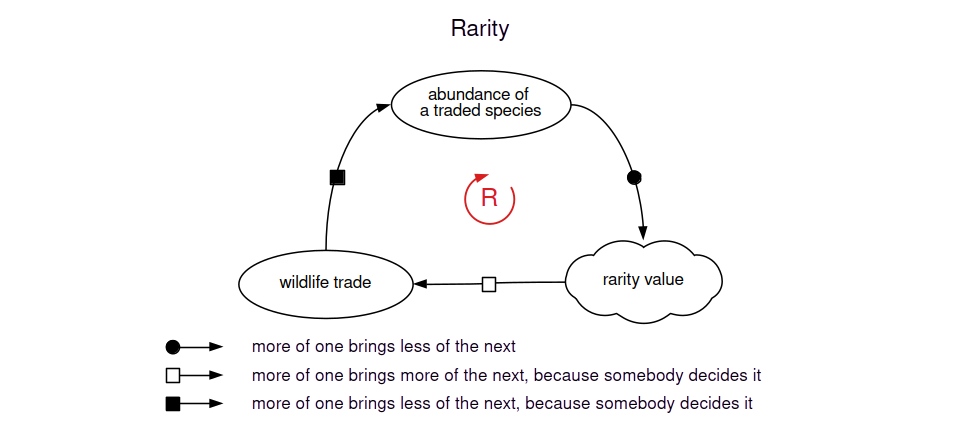
Courchamp’s evidence remains correlational. The authors say a true test would track how demand for one species changes as that species becomes rare, which they could not do.
Second-hand rain
In Lovejoy and Nobre’s account, the Amazon “generates approximately half of its own rainfall by recycling moisture 5 to 6 times” as the air crosses the basin from the Atlantic towards the Andes.
Rain falls on the forest. Roots take the water out of the soil, leaves give it off as vapour, the wind carries it west, and it falls again. Half the rain over the basin has fallen on it before. Eneas Salati measured oxygen isotope ratios in rainwater collected from the Atlantic to the Peruvian border, and found how much of it was second-hand.
Pasture releases much less water during the dry season than forest. Clearing reduces moisture in the air when rainfall is already scarce, extending the dry season.
The first model to examine the question found that at about 40% deforestation central, southern and eastern Amazonia would get less rain and a longer dry season, with a shift to savanna in the east. With fire and a warming climate added, Lovejoy and Nobre put the tipping point at 20 to 25%. They decline to locate it exactly, “for the commonsense reason that there is no point in discovering the precise tipping point by tipping it”. Both numbers mark where the forest would give way to savanna, not how fast it gets there.
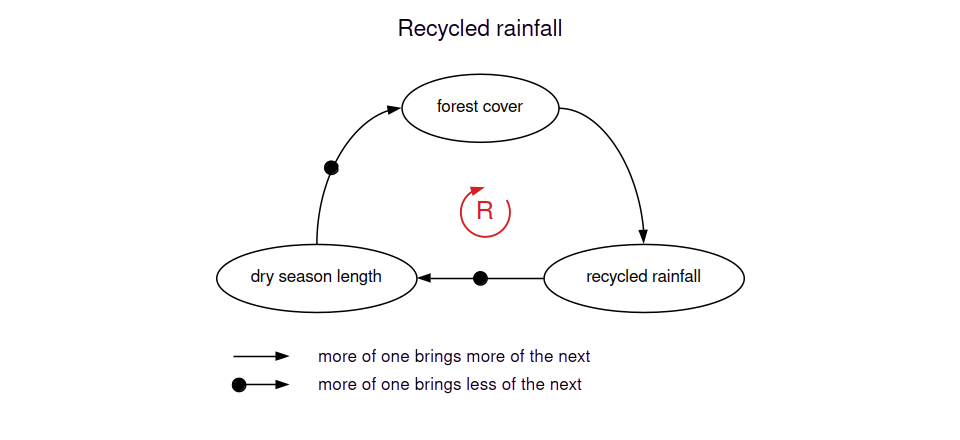
Nobody clears the forest that dies this way. The next field still needs a rancher’s earnings or a buyer’s capital.
Eby and colleagues trace a chain in eastern Australia. Loss of winter feeding habitat, periods of food shortage and changes in where flying foxes roost brought some bats into agricultural areas. Bats feeding near horse paddocks can expose horses to Hendra virus; infected horses can then expose people.
The study associates food shortages and changed bat behaviour with clusters of crossings. No step runs back from the infection to the habitat loss that started it. The horse stands between the bat and the person, as the pig did for Nipah.
Fire feeds itself with a one-year delay, in Lovejoy and Nobre’s words: “Widespread use of fire leads to drying of surrounding forest and greater vulnerability to fire in the subsequent year.”
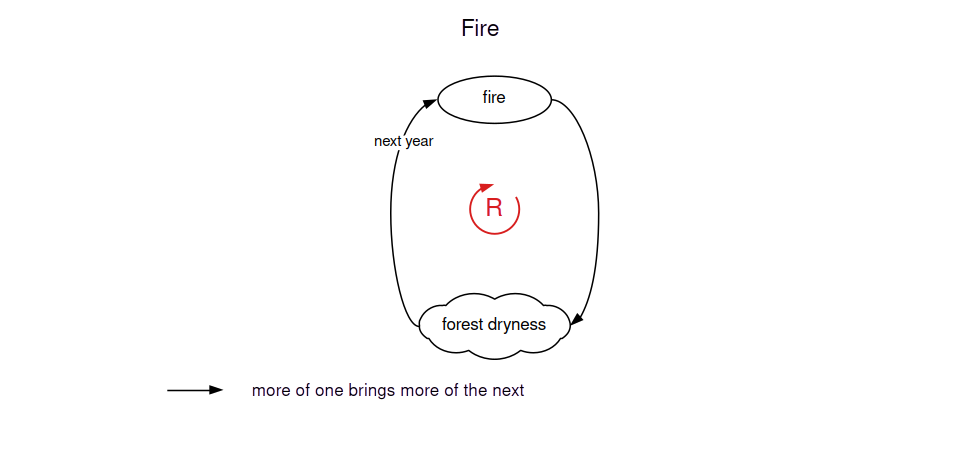
Fire dries the surrounding forest, and dry forest catches when the next ignition comes, from a match or from lightning. Burned area is counted from orbit as reliably as forest cover.
Prepaid pandemics
Recent pandemics, four IPBES authors wrote, are “a direct consequence of human activity”, “particularly our global financial and economic systems, based on a limited paradigm that prizes economic growth at any cost”. Propping up intensive agriculture without fundamental change, they wrote, “essentially subsidizes the emergence of future pandemics”.
Opposite sides
Lord Vetinari, in Guards! Guards!: “There are, always and only, the bad people, but some of them are on opposite sides.”
The workshop report that followed proposes removing subsidies “for activities that involve deforestation, forest degradation and land use change”, levies on meat consumption and livestock production, and integrating “the economic cost of pandemics into consumption, production, and government policies and budgets”. A charge like that would push back only if outbreaks raised it and the charge cut the clearing. The report was not endorsed by the IPBES Plenary; its proposals are the workshop authors’ recommendations.
Milk without moo
Lord Vetinari, on taxation: “The task is to extract the maximum amount of milk with the minimum amount of moo.”
The one intervention that was measured cut the credit paying for clearing; nobody measured what it did to the reinvested earnings.