Crossings to humans
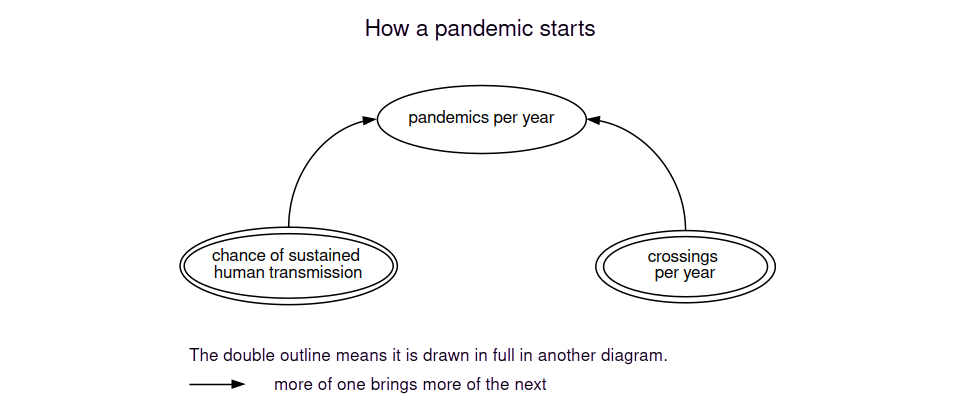
The crossings factor of the chain is a rate: how often a pathogen gets out of an animal and into a person.
Two signs
Allen and colleagues rebuilt the global database of emergence events and corrected for how hard anyone was looking. A new disease in Maryland gets written up, while the same disease in Kinshasa may not. After correcting for that bias, they found that zoonotic risk “is elevated in forested tropical regions experiencing land-use changes and where wildlife biodiversity (mammal species richness) is high”.
Keesing and colleagues report the opposite effect. Losing biodiversity “frequently increases disease transmission”, because the species that disappear first are often poor hosts for a pathogen. Their loss leaves competent hosts with a larger share of the encounters. For hantaviruses, lower diversity among small mammals increases the prevalence of the virus in those hosts.
The next sentence of their abstract says the other thing: “areas of naturally high biodiversity may serve as a source pool for new pathogens”.
The two findings act on different things. Allen’s concerns how many kinds of pathogen the animals carry. A rich mammal community contains more host species and therefore more opportunities for something circulating in one of them to be new to a human immune system. Keesing’s concerns how many of the animals are infected. Thin the community out and the surviving competent hosts carry more of what remains.
A single effect of biodiversity on crossings would have to carry one sign, and whichever it carried would hide one of the two mechanisms.
None comes with numbers
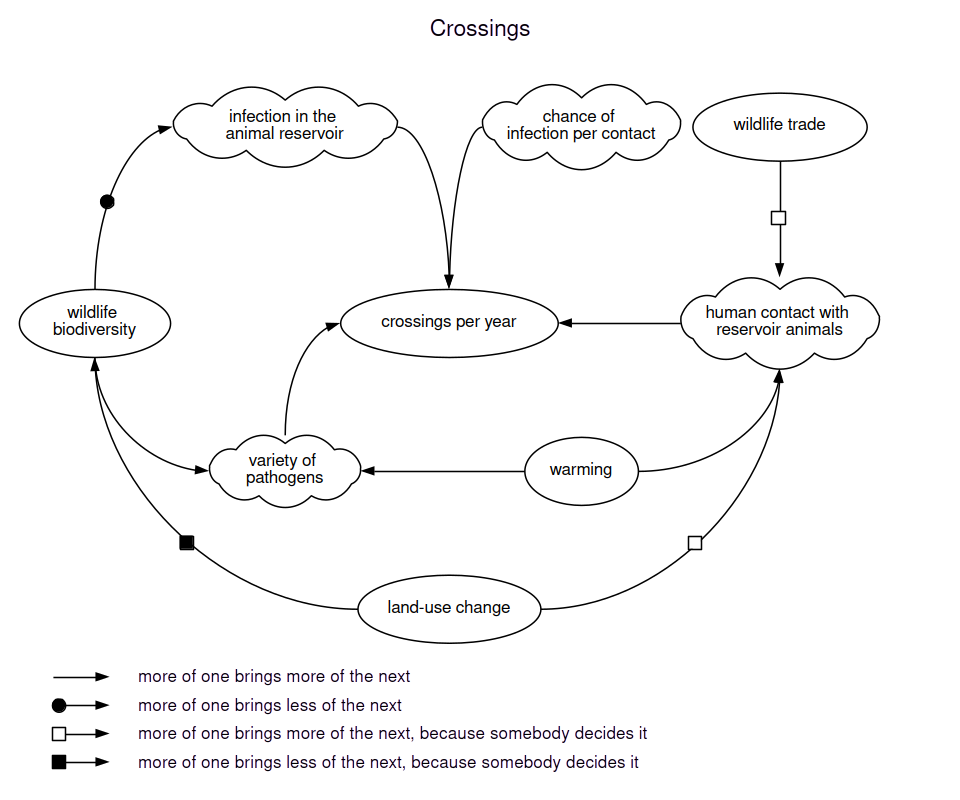
Lloyd-Smith and colleagues break that rate into three components: “the prevalence of infection in the animal reservoir, the rate at which humans come into contact with these animals, and the probability that humans become infected when contact occurs”. Their figure multiplies the three, so one factor of the chain contains a product of its own.
Two of those three components are hard to estimate. A basic model is straightforward to build, but it is “very challenging to delve into underlying mechanisms and estimate key parameters, particularly the cross-species contact rate and the resulting probability of infection, which typically arise from multiple and largely unobserved ecological, behavioural and physiological factors”. Searching for models that include the crossing at all, they found six.
A fourth term, the variety of pathogens the animals hold, is not in Lloyd-Smith’s model and is argued rather than evidenced. Adding it gives:
crossings per year =
infection in the animal reservoir x human contact with reservoir animals x chance of infection per contact x variety of pathogens
Contact here counts every meeting in a year across everyone exposed, so the number of people is inside it. None of the four comes with a number.
The IPBES workshop report on biodiversity and pandemics names what pushes on human contact: land-use change, agricultural expansion and intensification, and wildlife trade and consumption. These, in its words, “bring wildlife, livestock, and people into closer contact, allowing animal microbes to move into people”. The report attributes over 30% of emerging infectious diseases to land-use change alone and says that about 24% of all wild terrestrial vertebrate species are traded globally. It also states of itself that it has not been reviewed, endorsed or approved by the IPBES Plenary.
Somebody signs a clearing permit and somebody licenses a market. Warming pushes on contact too, without anyone signing for it.
Weather moving hosts
Clearing and trade move people towards the animals. Warming moves the animals. IPBES gives this as a projection, saying climate change “is projected to cause shifts in host and vector ranges”, and also points to something already observed, naming tick borne encephalitis in Scandinavia.
The European Climate and Health Observatory cites a WHO Europe assessment that ticks “have already expanded to higher latitudes and altitudes in Europe”. It also records that the Asian tiger mosquito is “now established across the continent, pushing northward and into higher altitudes where they could not previously survive”.
Not every disease a warmer climate brings north arrives by a crossing out of an animal reservoir. The tiger mosquito has made local dengue transmission possible, but dengue in Europe is seeded by people: most infections are imported by travellers, after which the mosquito carries the virus from person to person. West Nile fever runs the other way, “in an enzootic cycle between mosquitoes and birds”, with mammals “considered dead-end hosts”. A human case of West Nile comes out of the bird reservoir and stops, which is what crossings per year counts.
A host or a vector that reaches ground where it did not live before can raise how often people meet something infected. Moving hosts can also meet new microbes. IPBES says that movements of people and animals under a changing climate are likely to let microbes “make contact with new hosts, to potentially invade new niches and to infect even relatively unrelated hosts”. Neither source puts a number on either effect.
Clearing, trade and warming raise contact, prevalence and the variety of pathogens over decades. None of these sources shows a spillover changing the next decision to clear or trade.
Some crossings pass through livestock first, as Nipah did in Malaysia, where pigs amplified the virus before it reached people.