Catching on
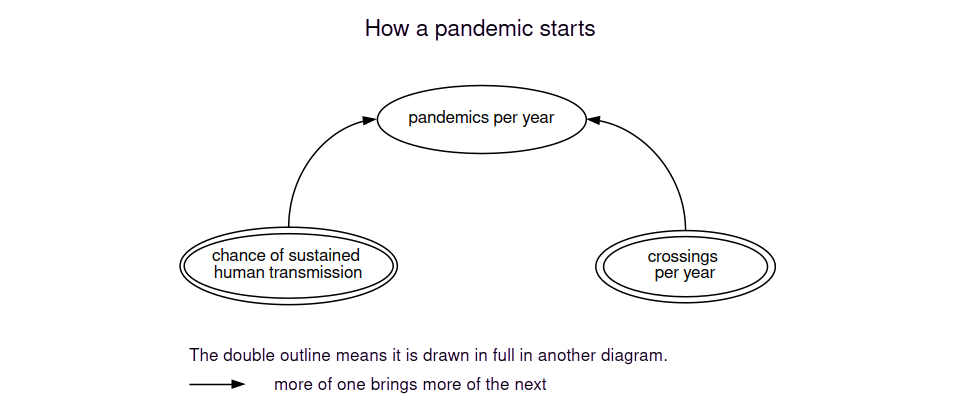
The second factor of the chain, the chance of sustained human transmission, turns on one quantity. Antia and colleagues define it as “the average number of secondary infections arising from one infected individual in a completely susceptible population”, and write it as R0. Below one, a pathogen that reaches a person dies out in people. Above one, it can keep going.
Wolfe, Dunavan and Diamond sorted animal diseases into five stages, from those that only ever infect animals to those that only ever infect people, and assigned twenty five major human diseases to them. Lloyd-Smith and colleagues use R0 to separate the middle three.
At R0 of zero, as with West Nile virus, a human case infects nobody else. Below one, as with monkeypox, a case starts a short run of human to human transmission that, in Lloyd-Smith’s words, stutters to extinction. Above one, as with plague and pandemic influenza, the chain can sustain itself. Sustained transmission has to pass two thresholds on that scale: getting above zero, and then getting above one.
A loop appears in the middle of that scale. Antia’s group supplies the mechanism. Raising R0, even while it remains below one, “nonetheless increases the number of subsequently infected individuals”. Each of those infections creates another opportunity for the pathogen to mutate. In their words, “these long transmission chains provide an opportunity for the pathogen to adapt to human hosts, and thus for the disease to emerge”. Their paper gives a path from R0 to chain length to adaptation. Closing that path into a loop, by letting adaptation raise R0 again, is an intuitive jump; Antia and colleagues do not state it.
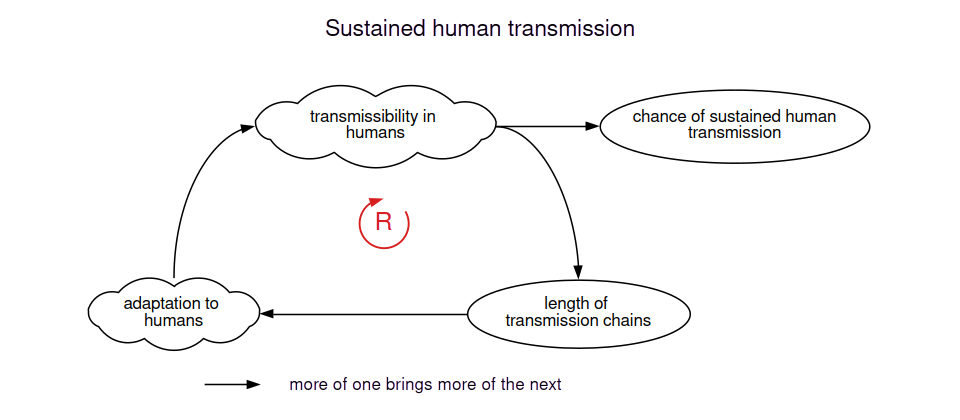
A pathogen stuck below one could raise its own R0 this way, over weeks and months within one outbreak, while the drivers behind crossings work over decades.
Nobody counts transmissibility or adaptation. Chains can be counted, once primary cases can be told from secondary ones.
Transmissibility also depends on the population in which transmission occurs. Lloyd-Smith and colleagues note that monkeypox transmissibility “appears to be rising as population immunity drops because fewer people have been vaccinated against smallpox”.