Piggy in the middle
In Malaysia, the Nipah virus went from fruit bats into pigs, and the pigs amplified it on its way into people. Pulliam and colleagues write that “pigs act as amplifier hosts, enabling infection of humans via droplet transmission during respiratory infections”, while the risk of direct transmission from bats to people there “is believed to be low”. Between September 1998 and April 1999 the virus caused 246 reported cases of encephalitis in peninsular Malaysia and Singapore, most of them in pig farmers and abattoir workers. There was no evidence of transmission between people, so “the pattern of human infection necessarily followed the spread of the virus in pigs”.
Direct infection from bats to people there is believed to be rare. The herd turned what the bats passed to pigs into 246 human cases.
Mangoes beside the sties
Pig and mango production both tripled in peninsular Malaysia between the early 1970s and the late 1990s. Pigs were first brought to the index farm, in the Tambun area of Perak, in 1970, and by 1980 the farm held 30,000 pigs. About 400 mango trees were planted in 1983, several directly beside the pig enclosures, and began fruiting in 1987. Other farms in the area grew mostly pomelos, which flying foxes do not eat.
Flying foxes do eat mangoes. The virus is thought to pass from them to pigs through saliva on discarded fruit pulp, or through droppings and urine falling into the sties.
Burning out
Between December 1996 and February 1997 the virus appears to have spread into each of the farm’s three breeding sections. In January 1997 unusually many piglets died in at least two sections. Human cases later diagnosed as Nipah began in early 1997. Piglet deaths then went back to their usual level.
Pulliam’s group modelled the farm. The first introduction “produced an explosive epizootic that drove itself to extinction”, and in their simulations most first epidemics end by “depleting the susceptible population”.
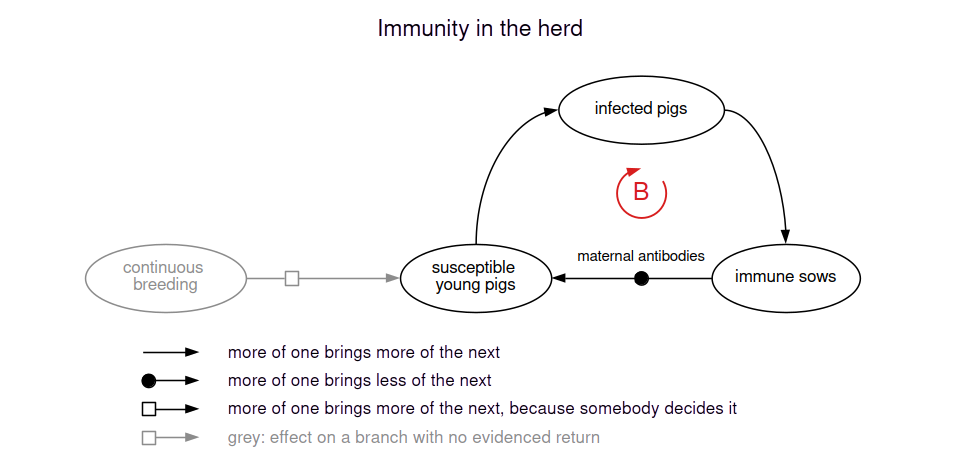
Infected pigs that survive become immune, sows among them. Immune sows pass antibodies to their piglets. In Pulliam’s model, a piglet carrying its mother’s antibodies is immune, so the more infection the herd has had, the fewer young pigs the virus can reach, and the fewer pigs it infects next.
Antibodies in the piglets
After the first outbreak the virus was gone from the farm, but the flying foxes still came to the mango trees. Around July 1997 piglet deaths rose again, together with the next human cases. The authors think the virus was “likely to have been reintroduced from the flying fox reservoir”, or possibly brought in from other pig farms nearby. Nothing in the paper points to a changed virus. What had changed was the herd.
The farm went on breeding. Many sows were now immune, so many piglets were born carrying their mothers’ antibodies. They lost them after moving from the breeding sections to the growing section. In the authors’ words, “loss of maternal antibodies after entry into the growing section provides a source of susceptibles independent of the presence of infection”. The first time, the virus met a herd with no immunity, spread explosively and used up the susceptible pigs. The second time, susceptible pigs arrived a few at a time, and the virus kept finding new ones to infect. “The qualitative difference in infection dynamics results primarily from the prevalence of maternal antibodies in the young pig population.”
This time it stayed, circulating until the farm was culled in 1999. In the simulations, “a single reintroduction of the virus is most often sufficient to produce a subsequent epizootic that leads to persistent circulation”. The authors name two parts of the most probable cause: fruit trees planted on land used for pigs, and “repeated introduction of the virus into a high-turnover commercial pig population”.
Fire sales
The index farm supplied gilts and piglets to smaller farms nearby, and infection reached other farms in the Tambun area, “probably via movement of infected pigs from the index farm”. Between September and November 1998 a cluster of human cases appeared, and farmers sold pigs off in a hurry. Pig movements, the fire sales among them, carried the virus throughout Perak and south to Negeri Sembilan and Selangor. In the south, where pig farms stood close together, the density “may have allowed respiratory transmission of the virus between adjacent farms without physical movement of infected pigs”.
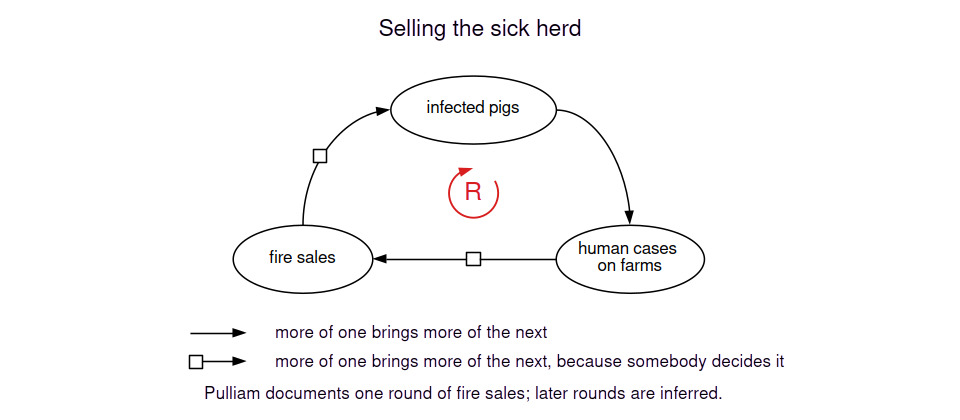
Infected pigs caused human cases, the cases set farmers selling, and the pigs sold carried the virus to other farms. Pulliam documents one round of it, the sales after the cluster in Perak. Whether the cases in the south set off another round is not in the paper.
Restrictions on planting fruit trees near pigsties, the authors wrote in 2012, “appear to have prevented introduction of the virus into pig populations in Malaysia since 1999”.
Emptied and disinfected
A 2024 report on avian influenza by EFSA and ECDC splits what farming does to a virus into four steps: “(1) the probability of virus introduction from wild birds into farmed animals …, (2) the propagation of the virus once it has been introduced into a farm …, (3) inter-species transmission in a farm and (4) onward spread to other farms.” Steps 2 and 4 “result in virus amplification allowing for continued virus circulation and exposure to other farms and species, and, consequently, continued virus evolution”. More circulation giving the virus more chances to change is the first half of what sustained human transmission proposes for people. The second half, adaptation raising transmission again, is not in the report.
Introduction depends on what is around the farm. Farms near water and water birds are at higher risk, and outdoor housing creates “the highest risk of introduction”. The sixfold increase the report gives for it was measured for low-pathogenic avian influenza. Farm size would raise the chance of introduction if every bird were equally exposed, but “this (theoretical) association may not take place in practice due to on average better biosecurity practices in large farms”.
Spread inside a farm depends on how soon anyone notices. Chickens and turkeys die fast, so outbreaks in them are usually spotted quickly, while in ducks “detection and reporting could be delayed”. “In the absence of early detection, farm size/number of flocks is a risk factor since more animals can become infected resulting in more virus produced.” Between farms, “the probability of continued virus evolution following ongoing spread between farms increases with regional farm density.”
Turnover has two signs. “By applying all-in-all-out, the farm is emptied and disinfected, so the virus transmission stops, whereas farms where animals are always present on the same premise (animals of multiple ages) could create a reservoir of virus.” The report thinks this unlikely in chickens and turkeys with no earlier immunity, and a possible risk in ducks and vaccinated poultry. The index farm in Perak, with sows, piglets and growing pigs on one site, was of the second kind.
Cows that looked healthy
The EFSA and ECDC report was approved on 14 March 2024, before H5N1 was found in dairy cattle in the United States. Caserta and colleagues traced that outbreak.
In cows, “the mammary gland is the main site of virus replication, resulting in substantial virus shedding in milk”. The shedding was measured. How the virus gets into the udder was not. One “possible transmission route” is through the teat, from contaminated floors and bedding or “mechanically via the milking equipment during milking”. Cows that looked healthy were transported from an affected farm to one in a different state, and the virus then passed from cow to cow there. Between farms, it spread “by the movement of cattle between farms, and probably by movement of wild birds and fomites including personnel, shared farm equipment and trucks”. Genome sequences show that the virus in a farm cat came from the cattle, and the authors add that “feeding raw milk to farm cats was a common practice”. The paper does not show which way it reached the cats. The authors call “efficient and sustained mammal-to-mammal transmission” in this outbreak “unprecedented”.
The first sheep reported with this virus was a ewe in Yorkshire. In March 2025 the UK’s Chief Veterinary Officer confirmed H5N1 in a single sheep “following repeat positive milk testing”, on a farm where the virus had already been found in captive birds. Testing of livestock on such farms had begun “following the outbreak of avian influenza in dairy cows in the US”. The rest of the flock tested negative.
In December 2025 H5N1 of genotype DI.2.1, not the B3.13 of the American herds, was found in a cat on a dairy farm in the Netherlands. Ballmann and colleagues then tested the cattle. They found no viral RNA, but antibodies in 34 of 72 lactating cows and 24 of 38 young animals. Wageningen Bioveterinary Research found no antibodies in more than 3,000 blood samples from other Dutch dairy farms. The antibodies show that the cattle had been exposed, but not when or how.
In December 2025 EFSA assessed the American genotype reaching EU dairy cattle “via trade or migratory birds from the US” as “highly unlikely”, and the impact if it did as “high for most Member States”. The measures it rated most effective against spread inside the EU are “milking hygiene, banning movement of cattle in infected areas, avoiding the exchange of workers, vehicles and equipment”.