From slogan to chain
Xavier Lescure, professor of infectious diseases at Paris Cite and head of COREB, the French network for emerging infections, published Epidemia on 24 September 2026. Three days later, Nathalie Raulin reviewed it in Liberation and described its argument as a simple equation: pandemic risk is emergence plus propagation plus fragility.
In her summary, the book ties emergence to deforestation and intensive livestock farming, naming Lassa, Marburg and Ebola in the first case and H5N1 in the second. It ties propagation to globalisation, which can carry an infectious agent across the planet within a few hours of flight, and to the misuse of medicines that drives antibiotic resistance. It ties vulnerability (fragility) to stressed bodies and suffocated public hospitals.
Lescure himself multiplies the terms. On the day the book appeared, his own post joined the same three words with multiplication signs.
Adding up to nothing
A sum makes a promise about the world. Each term contributes its share whatever the others are doing, so a world with no emergence at all can still carry the risk from propagation and fragility. Try that on a virus that never leaves its bat. It emerges nowhere, so it propagates nowhere, and no hospital ward, however overstretched, ever meets it.
Multiplication gets the bat right. When conditions have to hold one after another, their chances multiply, each counted only among the cases that got through the one before. One zero therefore takes the whole product to zero.
The weakest link
Gerald Weinberg’s Law of Limiting Factors: “When a number of conditions are necessary to a process, its rate is controlled by the least favorable of these conditions.” A product lets every condition count; Weinberg’s law hands the rate to the worst one. Both send a bat that never sheds its virus to zero.
For a disease coming out of an animal, the three terms are not three separate sources of pandemic risk. They are successive conditions on one route, from an infection in an animal to transmission that sustains itself in people. A pathogen that escapes a laboratory, or that somebody releases on purpose, follows a route of its own. This chain does not cover those routes.
Plowright and colleagues describe the first part of the route as a hierarchy of barriers. A pathogen has to “pass every barrier”, and spillover happens “only when gaps align in each successive barrier within an appropriate window in space and time”.
They do not express those barriers as a product. The interactions between them are “nonlinear and dynamic in space and time”, and the processes that spillover needs “have not been connected, compared and quantified for any single zoonotic pathogen”. The multiplication here is a translation of a chain of necessary transitions, not an equation taken from their paper.
Depends on the counter
The World Bank’s chapter on pandemic risk takes its definition from a dictionary of epidemiology: an epidemic “occurring over a very wide area, crossing international boundaries, and usually affecting a large number of people”. Pandemics, the chapter adds, “are, therefore, identified by their geographic scale rather than the severity of illness”.
Marani and colleagues counted something different. Their record contains 395 epidemics between 1600 and 1945. Of these, 182 have a known occurrence, duration and death toll, 108 are known to have killed fewer than ten thousand people, and 105 have only an occurrence and a duration. From the first group they calculate an intensity by dividing deaths by the duration of the epidemic and by the world population alive when it began.
They excluded epidemics that were still in progress, which removes AIDS, malaria and covid, and epidemics ended by a vaccine or an effective treatment, which is why the series stops in 1945.
In 2023 the authors corrected the paper. The code had counted events in two successive years as though they fell in one year. The correction lowered the estimated probabilities throughout, and the mean recurrence interval for an event the size of the 1918 influenza pandemic rose from about 400 years to 879.
The World Bank chapter sorts events by geographic reach, while Marani’s group sorts them by intensity, which is a death rate. Their estimates give the recurrence of an epidemic of a stated size, so the record calibrates the output rather than supplying it.
Fragility waits outside
If the output is pandemics per year, the slogan turns into a chain:
pandemics per year =
crossings per year x chance of sustained human transmission
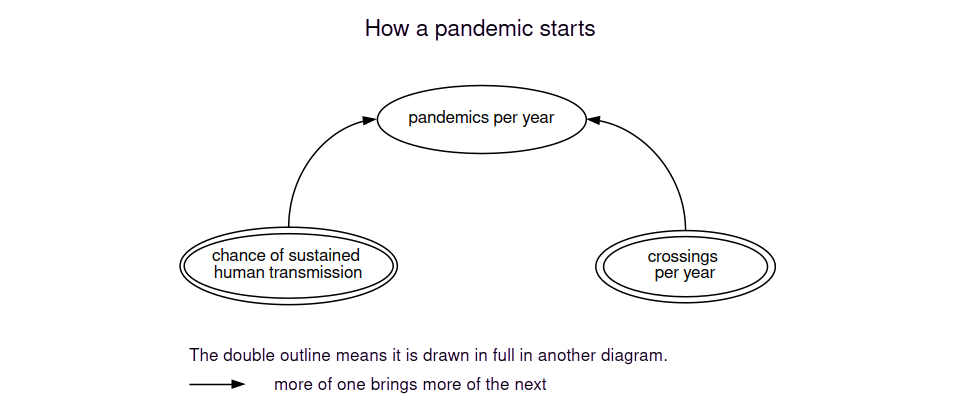
Fragility has dropped out, since it sets how bad a pandemic gets once one has started, while this output counts pandemics starting; the reframed chain brings it back as vulnerability.