Forecast load
Data centres planned for the AI build-out ask for a grid connection before they buy a single chip. Connections have often been handed out in the order they were asked for, years before anything is switched on. The same grid serves houses, heat pumps and factories.
In 2022 builders of affordable housing in Ealing, Hounslow and Hillingdon, in west London, asked the Greater London Authority for help. Their local grid operator, SSEN, could not connect their schemes until the late 2020s, or in some cases 2030. SSEN’s explanation, as the GLA set it out, was that data centres and batteries had been “requesting and securing connections”, “rapidly reserving capacity that otherwise might have gone to developers”. The reserved demand was equivalent to that of tens of thousands of homes. The transmission upgrades that would free the area would not be complete until 2029.
None of that demand had to be drawing power to keep the houses waiting. A reservation is enough. In December 2025 the London Assembly’s planning committee reported that parts of the west London grid had been full since 2022, temporarily halting new housing, and that short-term fixes had connected more than 12,000 homes. The report cites forecasts that data-centre demand in London will grow by between 200 and 600 per cent.
The towel principle
A shortage of grid capacity in 2030 cannot be fixed in 2030, because power takes years and projects take quarters. So capacity is promised on forecasts, and whoever asks first holds it. Around Frankfurt, the grid operator Syna received requests for about 800 MW of extra data-centre capacity this year, roughly the peak load of Frankfurt itself. Twenty-five data centres already hold contracts with it, and if all of them drew their full capacity the peak would rise by twice that. A data centre asking now should plan, its technical director said, for the early or mid 2030s.
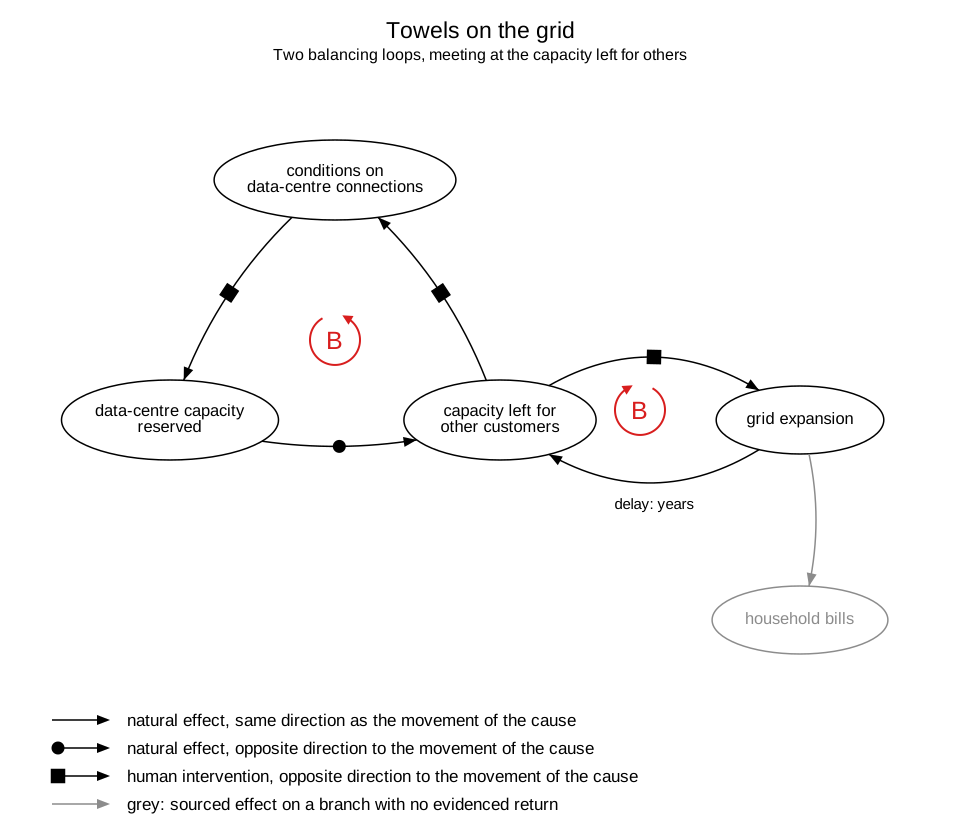
Syna now hands out capacity in steps. When a customer reaches 75 per cent of the capacity it agreed, Syna considers the next extension. The point, in its words, is to avoid reservations on the “Handtuch-Prinzip”, the towel principle, where operators secure capacity they do not yet need. Small businesses and heat pumps can still connect. Thousands of heat pumps went onto its network last year.
The IEA expects grid constraints to delay around a fifth of the data-centre capacity planned worldwide for 2030.
Bring your own power
Ireland met the problem earlier and on a smaller grid. Data centres used 5 per cent of the country’s metered electricity in 2015 and 23 per cent in 2025. In 2025 their consumption rose by 10 per cent, and that of every other user, households included, by 2 per cent.
The Commission for Regulation of Utilities considered a moratorium in 2021 and judged it disproportionate. In December 2025 it rejected one again and set conditions instead. A new data centre of 10 MVA or more must bring dispatchable generation or storage, on site or nearby, to match the capacity it asks to import. It cannot run at full load until that generation exists. A smaller one, from 1 MVA, must have generation of its own behind its meter, trading in the wholesale market and matching the capacity it imports. Any data centre of 1 MVA or more must, within six years of switching on, meet 80 per cent of its annual demand from new renewable generation in Ireland.
The regulator’s reason is that data centres can raise their demand faster than networks and power stations can be built, which “can have implications for the capacity available for other customers”. Nearly all of Ireland’s data centres are in Dublin. The conditions apply to applications made after the decision. The sites already connected keep their connections.
The queue
In the Netherlands the cost arrives as waiting. In October 2026 the grid operators’ association, Netbeheer Nederland, told Nieuwsuur that data centres account for almost a third of the capacity requested on the waiting list for grid connections. That is about 15 GW, roughly the connection capacity of 15 million households, in a country with 8.5 million.
More than 15,000 applicants are in the queue. Grid operators may now, in some cases, give new housing estates priority over data centres. The grid operators put the cost of the expansion at more than €200 billion by 2040, and household bills will rise considerably to pay for it. Netbeheer has asked the cabinet for “harde keuzes”, hard choices, about where data centres may go and how many there may be.
A requested gigawatt is a request, and some of it will never be built. Until it is withdrawn, it holds a place in the queue that a factory switching from gas or a new housing estate is also standing in.
After the boom
In 2002 the fibre stayed in the ground and changed hands. A grid built for data centres would stay too. Transmission lines and substations are paid off over decades. The chips they were built to feed age in a few years. If the load arrives, the bills buy capacity that gets used. If it does not, the question is who is still paying.
That depends on what was agreed in time. In Ireland the regulator’s consultation heard the risk from the other side: respondents worried about terminated connection applications, sunk costs left with developers, and “the negative message sent to potential foreign investors”.
Other respondents worried that the new generation would raise costs for all consumers. The regulator’s answer was that all market charges and a large share of network charges are paid per megawatt-hour, so a data centre pays its share through the energy it uses.
The substation does not know who ordered it.