Dark fibre
Nettime is a mailing list for net criticism that has run since 1995. In September 2026 two of its writers, the cultural critic Brian Holmes and Felix Stalder, who teaches digital culture in Zurich, argued in a thread about what the AI boom will leave behind.
Holmes asked what anyone expects to get out of AI. Years ago he and the media theorist Armin Medosch read the economist Carlota Perez on technology surges, and the next surge they expected never came. Stalder answered with an essay on imperial state capitalism by Ilias Alami, who teaches political economy at Cambridge, and with a set of data-centre numbers. His guess was that when the AI bubble bursts, the machinery may be turned towards geo-engineering. Holmes agreed, and added a permanent emergency and AI-driven micro-surveillance, justified by what the technology lets a single person do. The challenge of the future, he wrote, was what the economic historian Karl Polanyi called “freedom in a complex society”.
Stalder cites Alami on states as shareholders, and Holmes’s first message describes a contest for global hegemony. Stalder asks what happens once the bubble bursts. Holmes answers that the crisis under way now is where the climate era takes shape. Neither asks who will own the machinery after the crash, or who will be allowed to use it. Much of what comes next is being narrowed now, by whoever holds the stakes and keeps the lists. The future is already here, and it is unevenly owned.
In on the ground floor
States and their sovereign funds have been buying into the same machinery, from Paris and Seoul to the Gulf, Beijing and Washington. In May 2025 the French public investment bank Bpifrance, Abu Dhabi’s sovereign vehicle MGX, Mistral and NVIDIA announced a joint venture for an AI campus in the Paris region planned to reach 1.4 GW, a claim on buildings and power rather than on a model. Alami counts sovereign funds behind roughly two out of three of the mega-unicorns valued above $5 billion, and argues that the capital is aimed at one stack: AI labs, the data centres and chips under them, the minerals in the chips, the energy that runs them, and the weapons increasingly built on top.
A minority stake is a modest instrument. Modesty is most of its charm. It is faster than founding a state laboratory, draws private money in rather than pushing it out, sells more easily as “a stake for taxpayers” than as nationalisation, and works inside the investment treaties and arbitration tribunals that, as Alami puts it, were built to make outright expropriation costly after the wave of Third World nationalisations. Nothing has to be seized. It is bought, quietly, while the public debate is still about what the technology can do.
Closing-down sale
After a technology boom, the crash is often when ownership of the surviving assets becomes visible. In Carlota Perez’s account, the aftermath of a major technology bubble is a season of mergers and acquisitions in which the surviving giants mop up the weaker firms and whatever useful assets they held, ending in oligopolies across the economy. What follows depends, she argues, on the capacity of the state to restrain finance and hand investment back to production.
The bust began in America. By 2002 no more than two per cent of North America’s long-distance capacity was in use. Europe followed. Its operators had committed close to €100 billion to licences for third-generation mobile, most of it in the United Kingdom and Germany in 2000, at the top of the market. Firms with strong balance sheets bought assets at very low prices against what had been paid for them.
KPNQwest, in Amsterdam, had built Europe’s largest data network, across 18 countries. Its market value fell from over €42 billion to €13 million, and in May 2002 it went bankrupt. Its Ebone backbone was switched off in July, and a fortnight later the receivers sold its main assets, city networks from Paris to Vienna among them, to Interoute, majority-owned by the Sandoz Family Foundation, for about €15 million. KPNQwest had paid €645 million for Ebone less than a year before.
In America the network operator Level 3 bought its bankrupt rival Genuity; by 2007 half or more of the traffic on its backbone was video. Level 3 was already in Europe. On the day KPNQwest went bankrupt, it agreed to carry internet traffic for KPN’s own subsidiaries in the Netherlands and Belgium. The companies died. The fibre changed hands. The physical capacity for the following decade’s traffic was already in the ground in 2002, unlit. When demand arrived, it found the glass under new management.
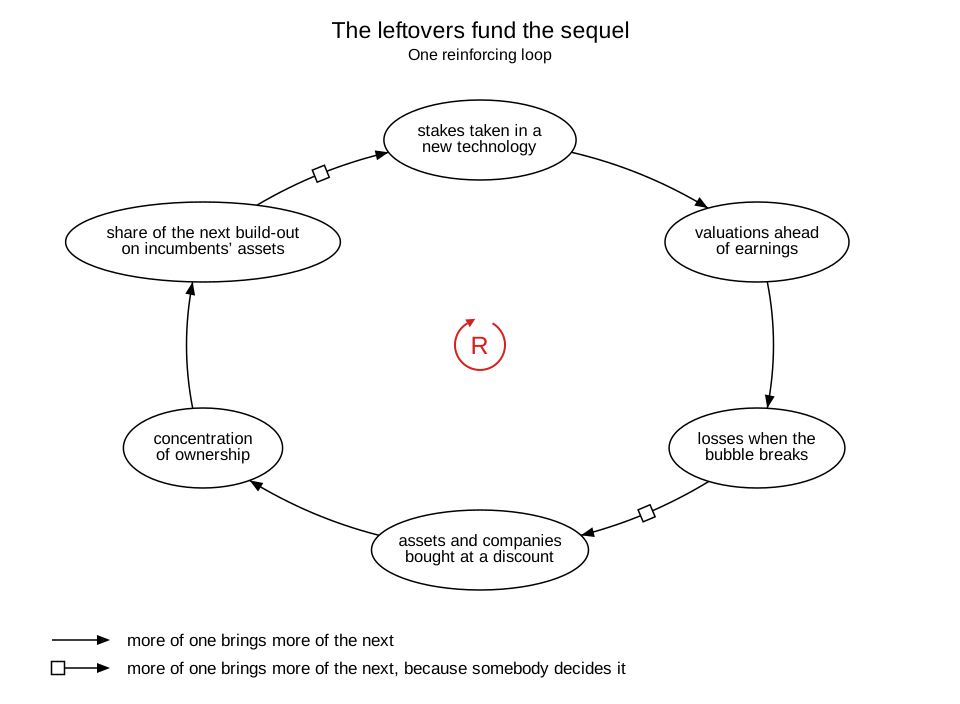
AI infrastructure may be next in line for the same sale. A failed model company leaves behind buildings, chips, power contracts, network connections and code. Some of it will keep its value and some will not: chips age fast, and a power contract can turn into a liability. A crash may test which parts of the installed base still have a use, and transfer the claims on those that do.
Perez’s sequence assumes a state standing outside the casino. A state holding equity is sitting at the table. It has chips.
In 2002 the French state held a majority of France Télécom, which carried a net debt of almost €70 billion. The finance minister told Les Echos that the state shareholder “would take appropriate steps if France Télécom were to face any difficulties”. Standard & Poor’s kept the company at investment grade on the strength of the state’s indications. In December the state offered a €9 billion credit line, which France Télécom never signed. Whether the credit line, read with the minister’s words, was state aid took the Commission and the European courts until 2018 to settle.
A public stake does not by itself decide what happens: the state can sell it, keep it, distribute its returns, attach conditions to it, or use it to preserve a capability rather than to fetch the best price. It can give the state a voice in what happens to the company after the crash.
If the bust comes, part of the loss lands on public balance sheets, and the assets become available to whoever can carry the loss, refinance the debt or buy the distressed claim: the largest firms, the deepest-pocketed investors, and states or sovereign funds with the reserves to do so.
In Alami’s survey the firms and the states are increasingly hard to tell apart. Gulf monarchies build AI champions with dual civilian and military mandates, run by the same security elites who control the sovereign funds. Russia’s war economy fuses oil revenue, defence conglomerates and a facial-recognition champion. European states sponsor sovereign military technology and domestic champions.
Under those conditions a crash sets a closing price.
Terms and conditions apply
Ownership decides who can provide. Lists decide who can receive. In August the United States designated Autistici/Inventati, an Italian collective running mail, blogs and mailing lists, without charge or hearing. The list was American, and so was the .org registry that suspended the collective’s domain. The bank that closed its account was Italian, and no Italian rule required it. The state does not need to own the bank. It needs the bank to believe that keeping the relationship costs more than ending it.
Each intermediary decided for itself, and none of them needed an order. Within a fortnight the collective had shut down.
Europe keeps lists of its own, and has been tightening their enforcement: since 2024 a directive obliges member states to make deliberately violating Union restrictive measures a criminal offence, and companies in the Union are obliged to use their best efforts to stop entities they own or control abroad from undermining the Union’s Russia sanctions. The list decides who may be served. The ledger decides who owns the servers. Alami notes governments using the same tools for domestic surveillance, predictive policing and social media tracking under the guise of security. Surveillance does not wait for the emergency. The paperwork will do.
Off the grid
Some ownership is too dispersed to collect. In the year to mid-2025, solar panel imports into Africa rose 60 per cent, and outside South Africa they nearly tripled in two years. The energy think tank Ember thinks part of the surge is going onto rooftops: shops, offices, churches and small factories, driven by power cuts and the price of diesel. Against diesel at Nigerian prices, a panel can pay for itself in about six months, before counting inverters and installation. In Sierra Leone the panels imported in a single year could, if all instslled, generate the equivalent of well over half of reported national generation, a figure Ember itself warns may be inflated.
A continent’s worth of rooftops cannot be designated as a group, bought at a discount in a crash, or entered as a line on a sovereign balance sheet. It is hard to put a church roof on a sanctions list. Ownership at the point of use does not dissolve the concentration upstream, though. China made about 80 per cent of the world’s solar panels in 2024, and the inverter, the finance and the grid connection can sit in still other hands. There are two ledgers: who owns the means of making the equipment, and who owns the productive asset once it is on the roof. Whether the second changes the bargaining power created by the first is still open.
Polanyi ended The Great Transformation on a test rather than a hope: regulation extends some freedoms and restricts others, and only the balance counts. In the same chapter he asked for the right to nonconformity to be protected by institutions, so that the objector keeps a niche and a life to live. Dispersed ownership can create room for action; whether that room stays open depends on institutions. A mail server that declined to remember opened such room too, until a list closed it.