Data exhaust
Online services keep records of the people who use them: what they searched, posted or asked, when, and from where. Some of it is kept because the service needs it, some because it sells, and some because a law requires it.
The crash of 2000 left fibre in the ground under new owners. It also left, in the words of Brian Holmes, writing on the nettime mailing list, “surveillance capitalism, when Google realized that the data exhaust from search could be recycled into an advertising bonanza”. The services that survived the crash kept their users, and what the users left behind became a stock of its own.
Holmes’s word makes it a by-product. Much of it is collected on purpose, kept for one use and put to another. An app with an advertising slot to sell sends the phone’s position and advertising identifier to hundreds of bidding firms at once, and the losers keep what they saw. The newest use is training.
Public posts, adults only
In April 2025 Meta announced that it would train its AI models on public posts and comments shared by adults on its products in the EU, and on people’s questions to Meta AI. Private messages were excluded, unless someone in the chat shared them with Meta’s AI. The models would “better understand and reflect” European “cultures, languages and history”. Google and OpenAI, Meta added, had “already used data from European users to train their AI models”. The reason given is Meta’s own.
The Irish Data Protection Commission had first heard of the plan a year earlier. Meta paused after the DPC raised concerns, and went ahead after an opinion from the European Data Protection Board and a list of changes the DPC asked for.
Users could object on a form, or make their posts private. The DPC reminded everyone “to regularly review their privacy settings and controls”. The way out of the training set ran through each user’s settings, one account at a time.
More capable, more watched
In July 2025 the European Commission published the General-Purpose AI Code of Practice, the voluntary route to complying with the AI Act. Its safety and security chapter concerns only “the most advanced models”. Among the ways their providers can watch how a model is used after release, it lists “privacy-preserving logging and metadata analysis techniques of the model’s inputs and outputs” and access limited “to vetted users”.
In June 2025 the European Commission noted that 85 per cent of criminal investigations rely on electronic evidence. It planned AI tools to help authorities “process large volumes of seized data”. A tool that reads large volumes may make them more useful to keep.
Police can also buy it. netzpolitik.org has found German police forces in the data-broker market, buying what a warrant would otherwise cost.
Little to hand over
In May 2025 the Commission began an impact assessment for EU rules on data retention. None exist at EU level: most member states have national laws, which differ, and some have none. The roadmap planned a second roadmap, on encryption, to find ways of giving police lawful access to encrypted data, and a new decryption capability for Europol.
A provider that keeps little has little to retain and little to hand over. That is why it is built that way. In August 2026 the United States designated Autistici/Inventati, an Italian collective that ran mail, blogs and mailing lists, and Treasury’s notice listed “encrypted email accounts” among the services it held against the collective. The State Department’s fact sheet presented the design as infrastructure for keeping users anonymous and untraceable.
Two days later an attacker broke into Noblogs, the collective’s blog platform, and took the user database. It held email addresses and hashed passwords. “Since we do not log IP addresses, the attackers could not possibly access this data.” The design that limited the breach was the design the designation counted against the collective. The .org registry, PayPal and the collective’s bank closed their doors within days, and the collective decided to shut down.
Where its users went is less certain. Nobody has to agree set out a herding hypothesis: displaced users move to providers inside US jurisdiction, where warrants reach. The migration threads show some heading for Riseup in Seattle and finding it invitation-only. That is consistent with the hypothesis and does not prove it.
Downloads in a week
Collection also pushes the other way. In January 2021 WhatsApp told its users to accept new terms or stop using the service. Outside Europe the terms covered sharing data with Facebook; in Europe, WhatsApp said, nothing changed. According to Sensor Tower figures reported by the BBC, Signal downloads in the UK went from a few thousand a week to almost 200,000 in the week after the announcement. WhatsApp put the change back to May, after protests and what a Verfassungsblog commentary called “eine massive Abwanderung zu anderen Anbietern”, a mass move to other providers.
In May the Hamburg data protection authority ordered Facebook Ireland to stop processing WhatsApp users’ data for its own purposes. It was the first use of the GDPR’s urgency procedure. In July the European Data Protection Board declined to make the order final, and told the Irish authority to investigate instead.
Providers move too, in both directions. In 2021 the Swiss authorities ordered the Swiss mail provider Proton to collect information on an account that turned out to belong to a French climate activist. “There was no possibility to appeal this particular request,” Proton wrote, quoting its own threat model: a law-abiding provider “can be legally compelled to log your IP address”. The encrypted mail stayed unreadable. Later that year Proton won a Swiss court ruling that email services are not telecommunications providers, and so fall outside the retention rules written for them.
Luxembourg
The retention rules have a court at the end of them. In 2014 the Court of Justice of the European Union, in Luxembourg, declared the Data Retention Directive invalid. Traffic and location data, it said, “may provide very precise information on the private lives of the persons whose data are retained”. One of the cases came from Austria, brought by the government of Carinthia and by more than 11,000 individual applicants.
In 2016 the court held that member states could not impose a general obligation to retain data on providers. Some states then worried, in the court’s later words, that “they may have been deprived of an instrument which they consider necessary”. In 2020 the court confirmed the rule and set out its exceptions: general retention against a genuine and present threat to national security, limited in time, and general retention of IP addresses and of users’ civil identity.
Each round of rules has drawn a round of cases, and each judgment has narrowed retention without ending it. The impact assessment may be the next round. The judgments concern what states may oblige providers to keep. A purchase obliges nobody, and in Germany the safeguard attaches to compulsion.
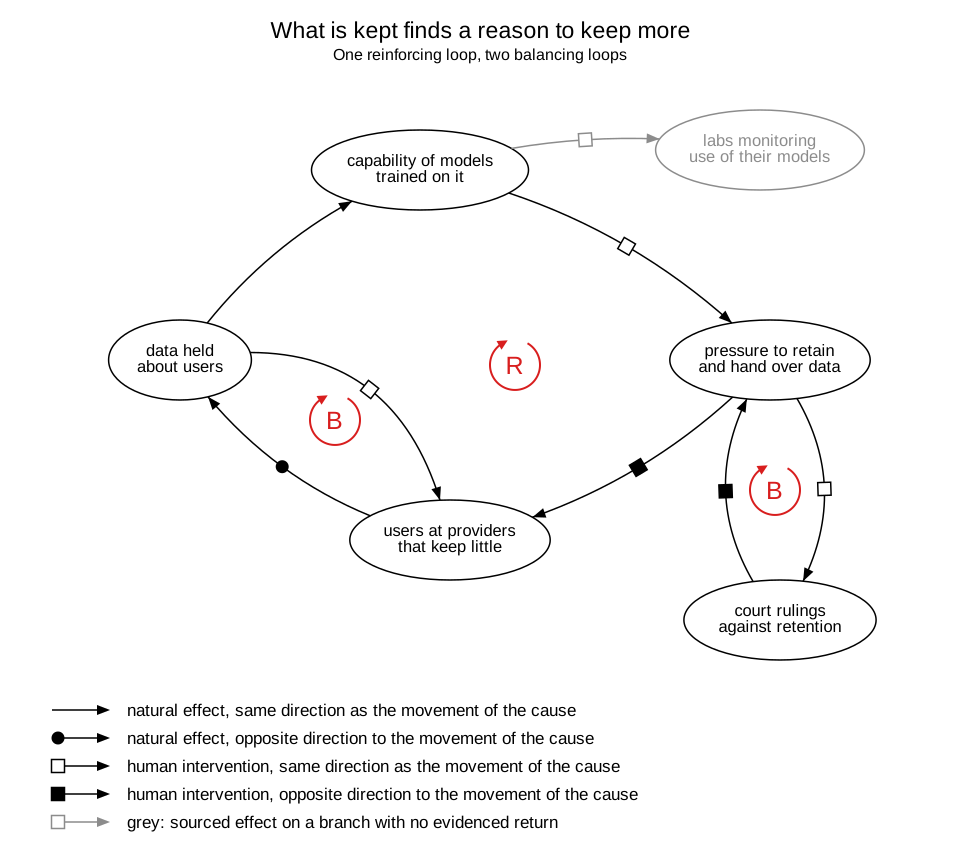
A wiped disk
In October Amsterdam police seized one of the collective’s servers in a data centre at Science Park. They acted on a request for mutual legal assistance from the United States, and began making an image of it for the American authorities. According to Domani, the server had been taken out of service and wiped when the collective closed. The police copied a wiped disk.