AI systems bolted on without governance
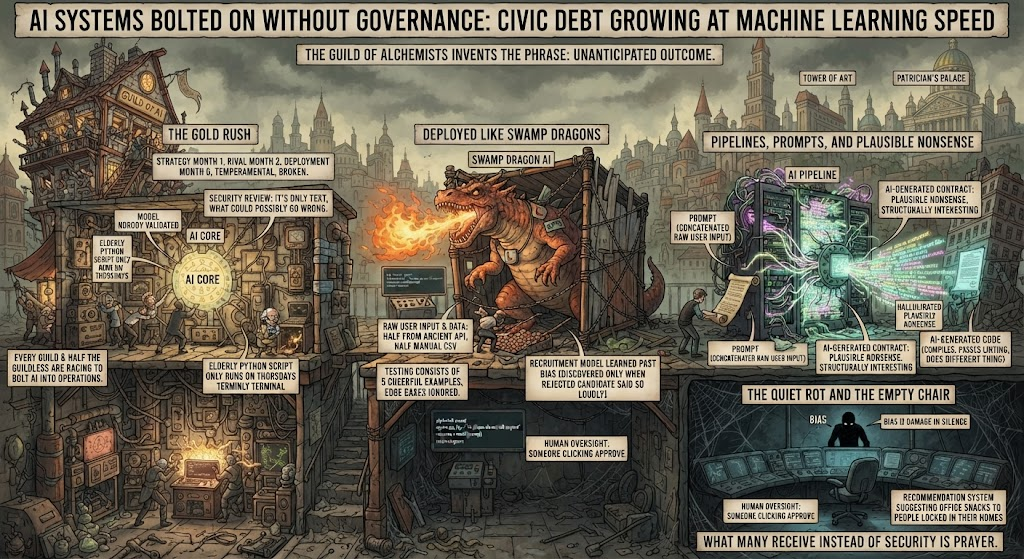
In Ankh-Morpork the phrase artificial intelligence has become popular with the sort of people whose enthusiasm greatly exceeds their understanding. This is rarely a good combination. It is the sort of enthusiasm that led the Guild of Alchemists to invent the phrase unanticipated outcome.
Every guild and half the guildless are racing to bolt AI into their operations, less because they understand it than because a neighbour announced an AI strategy and nobody wants to be the only one in the city without a transformative automation journey to brag about over a pint of something that probably counts as a health hazard. The result is technical debt with an unusually fast interest rate: models nobody validated, pipelines held together with rope and one elderly Python script that only runs on Thursdays, prompts fed raw user input, and documentation consisting of a single comment reading fix later.
The clerk’s brief
From the clerks, for the Patrician’s eyes
Compiled September 2026. Newest first; the settled patterns sink into the assay at the end. The clerks confess they had this file compiled by hand, twice, and checked against sources. His Lordship will appreciate the irony.
July 2026: Only the high-risk deadline moved
On 27 July 2026 the AI Omnibus entered into force as Regulation (EU) 2026/1744. The high-risk obligations for the standalone uses listed in Annex III, due on 2 August, now apply from 2 December 2027; those for systems embedded in products already regulated for safety move from 2 August 2027 to 2 August 2028. Most of the rest of the Act, transparency included, applied on 2 August as scheduled. The bolted-on systems have gained between sixteen months and two years in which to be bolted on further.
July 2026: The August wall approaches
Most of the AI Act’s remaining rules, including those for high-risk systems and transparency, apply from 2 August 2026, when enforcement begins, according to the Commission’s implementation timeline. The same timeline records that the schedule has already shifted once: under the AI omnibus simplification package, high-risk systems embedded in regulated products now have until August 2028. The clerks note the familiar shape, a deadline announced with fanfare and amended before arrival, and observe that these bolted-on systems will meet the law in whatever state the gold rush left them.
March 2026: The assistants leak
GitGuardian’s secrets sprawl report, published March 2026, finds commits made with Claude Code leaking secrets at 3.2 per cent against a 1.5 per cent baseline across public GitHub, against a backdrop of 28.65 million new hardcoded secrets reaching public repositories in 2025, with leaks of credentials for AI services up 81 per cent and eight of the ten fastest-growing kinds of leak tied to AI services. GitGuardian itself warns that the gap should not be read as a simple tool failure. The clerks note that the fastest-growing leaks are of the keys to the new tools themselves.
February 2026: Checked for flaws, not for everything
Black Duck’s research, published February 2026, cites its earlier finding that 76 per cent of organisations check AI-generated code for security risks and only 24 per cent evaluate it for security, licensing and quality together, and reports that open-source vulnerabilities have doubled as AI accelerates code creation. The clerks note that most generated code is checked for the flaw an attacker would use, and far less of it for whose code it is.
August 2025: The first obligations landed on the model makers
The AI Act’s obligations for providers of general-purpose AI models entered into application on 2 August 2025, along with the requirement for member states to designate national authorities. Accountability began, notably, at the top of the supply chain rather than at the point of deployment, which the clerks consider sensible and also convenient for everyone doing the deploying.
The assay so far
Capability seems to be adopted at announcement speed, governance at budget speed, and the gap between them is discovered in production, by customers, auditors, or attackers, whoever arrives first. Since August 2025 the law has begun assigning names to the empty chair, with the heavier obligations now arriving December 2027 and, for embedded systems, August 2028. The clerks’ standing assessment is that regulation is moving at the speed of committees while deployment moves at the speed of enthusiasm, and that enthusiasm has never once waited.